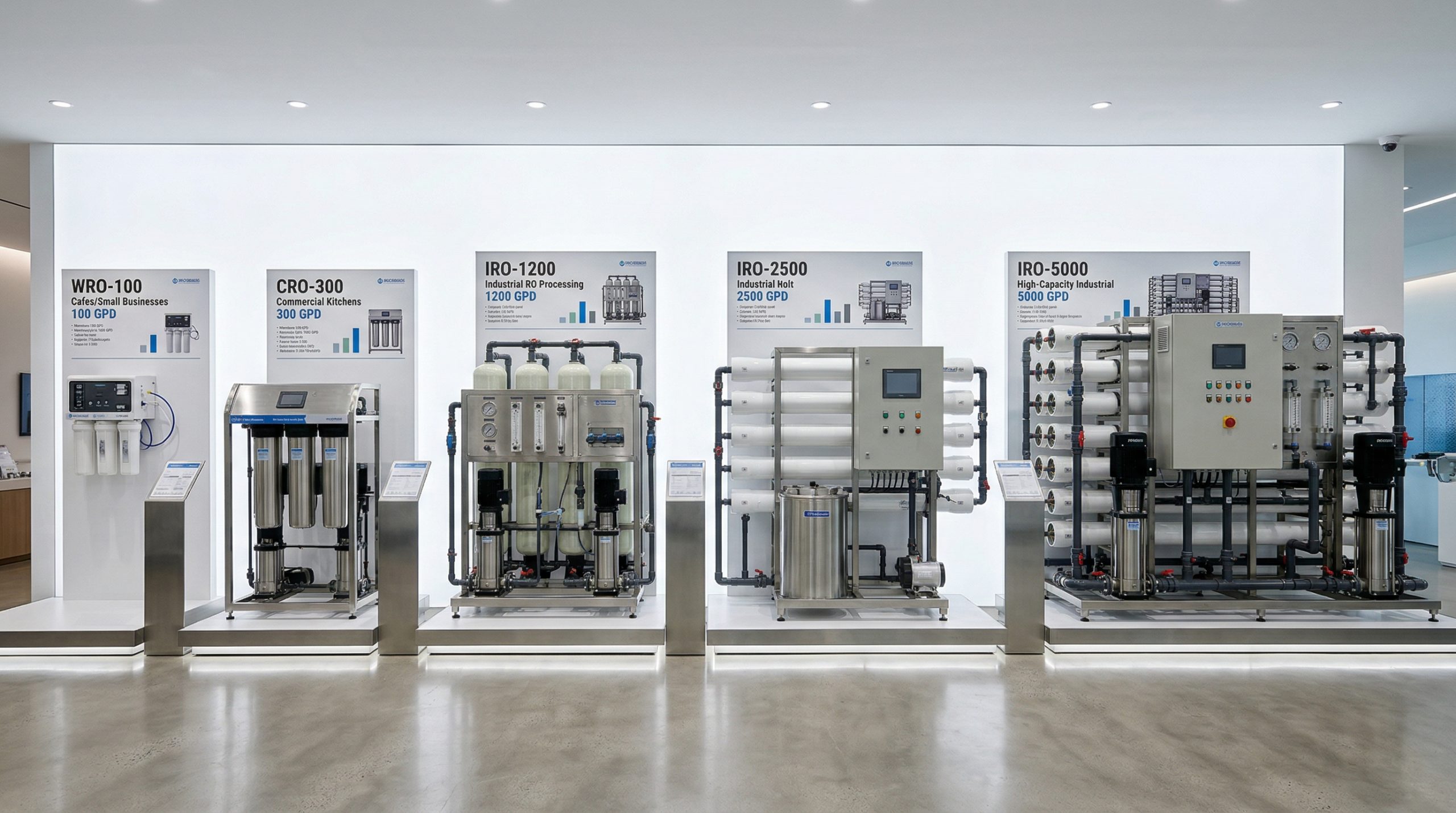

A commercial reverse osmosis system is a pressure-driven water purification unit designed for continuous, high-volume operation in business and industrial environments. The right system size — measured in gallons per day (GPD) — depends on your daily water demand, feed water quality, required rejection rate, and peak flow requirements. This guide provides the framework to specify the right commercial RO system for your operation.
What Is a Commercial RO System?
Reverse osmosis is a membrane separation process that removes dissolved solids, contaminants, and microorganisms from water by forcing it under pressure through a semi-permeable membrane. The membrane passes clean water (permeate) while rejecting a concentrated waste stream (brine or concentrate) that is discharged or further treated.
Commercial RO systems differ from residential units in scale, construction, and operational demands. Where a home RO unit may produce 50–100 GPD, commercial systems range from 500 GPD to several million GPD for large industrial applications. They are engineered for continuous operation, automated controls, remote monitoring capability, and compliance with industry-specific standards such as NSF/ANSI 61 for drinking water contact materials or FDA cGMP requirements for food and pharmaceutical applications.
Key components of a commercial RO system include a sediment pre-filter, carbon pre-filter (for chlorinated water), antiscalant dosing system, high-pressure pump, RO membrane array, permeate storage tank or direct-flow configuration, post-treatment (UV, remineralization, pH adjustment), and an automated control panel with data logging.
How to Size Your Commercial RO System
Accurate sizing is the single most important factor in commercial RO system specification. An undersized system creates production bottlenecks and forces membranes to operate above design flux rates, accelerating fouling. An oversized system wastes capital, energy, and increases maintenance costs.
The fundamental sizing calculation is: Required GPD = (Daily water demand / System recovery rate) x Safety factor. For example, a restaurant consuming 800 gallons of purified water per day, with a system recovery of 75% and a 1.25 safety factor, needs a system rated at approximately 1,333 GPD.
The following table provides general sizing benchmarks by application type:
| Application | Typical GPD Range | Notes |
|---|---|---|
| Restaurant / Cafe | 500 – 2,000 GPD | Ice machines, coffee, food prep, steam equipment |
| Hotel / Resort | 2,000 – 10,000 GPD | Laundry, kitchen, pool/spa makeup water |
| Car Wash | 1,000 – 5,000 GPD | Spot-free rinse; TDS below 50 ppm typical target |
| Light Industrial | 5,000 – 50,000 GPD | Process water, cooling tower makeup, boiler feedwater |
| Food and Beverage Manufacturing | 10,000 – 500,000 GPD | Product water, CIP, bottling lines |
| Pharmaceutical / Lab | 5,000 – 200,000 GPD | Often followed by DI polishing to USP Purified Water spec |
Note that these are starting ranges. A detailed water audit — measuring actual daily consumption, peak demand periods, and seasonal variation — should inform the final system specification.
Key Specifications to Evaluate
When comparing commercial RO systems, the following specifications are most critical to evaluate:
TDS Rejection Rate
Standard commercial RO membranes achieve 95–99% TDS rejection. Verify that rejection rate specifications are based on standardized test conditions (typically 250 ppm NaCl, 77 degrees F, 150 psi). Real-world rejection may be lower depending on feed water temperature, TDS, and membrane age. For applications requiring very low permeate TDS (pharmaceutical, semiconductor), specify membranes rated at 99%+ rejection and design for two-pass RO or a downstream polishing step.
System Recovery Rate
Recovery rate is the percentage of feed water converted to usable permeate. Standard commercial RO systems operate at 65–80% recovery. Higher recovery reduces water waste and operating costs but increases scaling potential on the membranes. Systems treating high-hardness or high-sulfate water should use antiscalant dosing and may be limited to lower recovery rates without risking membrane damage.
Membrane Count and Array Configuration
Commercial systems use standard 4-inch or 8-inch diameter membrane elements in pressure vessels. Array configuration (e.g., 2:1 arrangement) determines flow balance and pressure profile across the system. Larger systems use multiple pressure vessels in parallel and series arrangements to optimize recovery and minimize energy consumption.
Operating Pressure
Feedwater TDS directly drives pressure requirements. Brackish water systems (TDS 1,000–10,000 ppm) typically operate at 150–400 psi. Seawater desalination requires 800–1,200 psi. Higher pressure means higher energy costs, so accurate feed water analysis is essential for energy modeling and pump specification.
Automated Controls
Commercial systems should include automated flush cycles, low-pressure shutdown, high-pressure alarms, permeate quality monitoring (conductivity), and data logging for regulatory compliance. Modern systems offer remote monitoring via SCADA or cloud-connected HMI interfaces.
Industries Using Commercial RO Systems
Commercial RO technology serves a remarkably broad range of industries, each with distinct water quality requirements and operational profiles:
Food and Beverage: RO is used for process water, beverage production (beer, soft drinks, bottled water), dairy processing, and clean-in-place (CIP) systems. FDA and NSF compliance is mandatory, and product consistency depends on stable, low-TDS water quality.
Hospitality: Hotels and resorts use RO for drinking water, ice production, kitchen operations, and laundry — reducing scale buildup in equipment and extending appliance life. Improved water quality also enhances guest experience through better-tasting beverages and cleaner laundry.
Pharmaceutical and Life Sciences: USP Purified Water and Water for Injection (WFI) standards require extremely low TDS, endotoxin control, and microbial purity. RO serves as the primary purification step in pharmaceutical water systems, typically followed by electrodeionization (EDI) and UV disinfection.
Manufacturing: Boiler feedwater, cooling tower makeup, and process rinsing in electronics, metal finishing, and automotive manufacturing all benefit from RO-treated water. Removing hardness and silica from boiler feedwater dramatically reduces scale, maintenance costs, and energy consumption.
Healthcare: Hospitals and dialysis centers require high-purity water for dialysate preparation, sterilizer feedwater, and laboratory use. AAMI standards govern dialysis water quality, and RO is the recognized treatment technology.
Total Cost of Ownership
The purchase price of a commercial RO system represents only a portion of its true cost. A realistic total cost of ownership (TCO) analysis should include:
- Capital cost: Equipment, installation, and commissioning — typically $5,000 to $150,000+ depending on system size and complexity.
- Energy: RO high-pressure pumps are the primary energy consumer. Budget $0.25–$0.75 per 1,000 gallons of permeate produced, depending on feed water TDS and system pressure.
- Membrane replacement: Membranes typically last 3–5 years. Budget $150–$400 per 8-inch membrane element, with replacement frequency depending on feed water quality and operating conditions.
- Pre-filter consumables: Sediment and carbon pre-filters require regular replacement — typically every 3–6 months depending on feed water turbidity and chlorine levels.
- Chemical costs: Antiscalant, cleaning chemicals, and pH adjustment reagents add $0.05–$0.20 per 1,000 gallons.
- Waste water: The reject stream represents 20–35% of feed water consumption in a well-designed system. Factor in the cost of this water and its disposal.
Over a 10-year period, operating costs typically exceed the original capital cost by a factor of 2–4x, making membrane life, energy efficiency, and pre-treatment design critical variables in total cost optimization.
Why Choose AMPAC Water Systems
AMPAC Water Systems has designed and manufactured commercial and industrial RO systems for over 30 years, serving clients in food and beverage, hospitality, manufacturing, healthcare, and municipal water treatment. Our engineering team provides free system sizing consultations, feed water analysis interpretation, and TCO modeling to help you make a fully informed purchasing decision.
All AMPAC commercial RO systems are assembled and tested in our facility before shipment, include comprehensive documentation for regulatory compliance, and are backed by responsive technical support. We stock replacement membranes, pumps, and controls for the systems we sell, ensuring minimal downtime when service is needed.
Request a commercial RO sizing consultation and quote from AMPAC today.
Frequently Asked Questions: Commercial RO Systems
What is the difference between commercial and industrial RO systems?
The distinction is primarily one of scale and application complexity. Commercial RO systems typically range from 500 to 50,000 GPD and serve applications like restaurants, hotels, and light manufacturing. Industrial RO systems operate at higher flow rates (50,000 GPD and above), often treat more challenging feed water, and may incorporate advanced features like energy recovery devices, multi-stage membrane arrays, and integration with broader water treatment trains including softeners, degassers, and EDI polishers.
How long does a commercial RO membrane last?
With proper pre-treatment and maintenance, commercial RO membranes typically last 3–5 years. Key factors affecting membrane life include feed water hardness and scaling potential, chlorine exposure (polyamide membranes are chlorine-sensitive), biological fouling pressure, operating flux rate, and regularity of cleaning-in-place (CIP) procedures. Conducting periodic membrane autopsies helps diagnose fouling mechanisms early and extend membrane service life.
Can a commercial RO system handle well water?
Yes, but well water requires careful pre-treatment design. Common well water challenges include high hardness (calcium and magnesium scaling), iron and manganese (which foul membranes rapidly if not removed upstream), hydrogen sulfide, and biological contamination. A water analysis performed before system design is essential. AMPAC engineers well water RO systems with appropriate pre-treatment — including aeration, filtration, softening, and antiscalant dosing — to protect membranes and ensure consistent performance.
What TDS level should I target in my RO permeate?
Target TDS depends entirely on your application. For drinking water and beverages, 50–150 ppm is typical and produces pleasant-tasting water. For boiler feedwater, targets are often below 1 ppm, requiring RO plus EDI or mixed-bed DI polishing. For laboratory and pharmaceutical applications, below 1 ppm (USP Purified Water: conductivity at or below 1.3 uS/cm) is required. Your equipment manufacturer’s specifications should drive the permeate quality target.
How much reject water does a commercial RO system produce?
A well-designed commercial RO system operating at 75–80% recovery produces approximately 20–25 gallons of reject (brine) for every 100 gallons of feed water. The reject stream contains all the contaminants removed from the permeate and must be properly disposed of — typically to drain or back to an equalization tank for systems using municipal water. In water-scarce regions or facilities with high water costs, reject water can sometimes be repurposed for irrigation, cooling tower makeup, or equipment washdown where lower water quality is acceptable.
Do I need a permit to install a commercial RO system?
Permit requirements vary by jurisdiction, application, and discharge destination. Facilities discharging brine to a municipal sewer system may need an industrial pretreatment permit if the brine contains regulated constituents (e.g., PFAS concentrate, heavy metals). Facilities in regulated industries (food processing, pharmaceutical, dialysis) must document water system design and commissioning for regulatory compliance. AMPAC can provide system documentation packages to support permit applications and compliance audits. Always consult your local water authority and environmental regulator before installation.
Conclusion
Selecting the right commercial RO system is a decision with long-term operational and financial consequences. Accurate sizing, rigorous specification comparison, and a realistic total cost of ownership analysis are the foundations of a sound investment. With the right system, properly pre-treated feed water, and a disciplined maintenance program, a commercial RO system will deliver consistent, high-quality purified water for a decade or more.
AMPAC Water Systems is ready to help you navigate the specification process. Contact our engineering team for a no-obligation sizing consultation.