How Much Water Do AI Data Centers Actually Consume?
The artificial intelligence boom has created a water consumption problem that most people do not know exists. Every time a large language model generates a response, processes an image, or trains on a new dataset, it consumes electricity—and that electricity generates heat. Removing that heat requires cooling, and the most common industrial cooling method is evaporative cooling, which consumes water.
The numbers are staggering. A 2024 study by researchers at the University of California, Riverside estimated that training a single large AI model like GPT-4 consumed approximately 700,000 liters (185,000 gallons) of water for cooling. For inference (running the trained model to answer queries), the same researchers estimated that generating 10-50 responses consumes roughly 500 milliliters (about one bottle) of water. Scale that to billions of daily queries across all major AI platforms, and the aggregate consumption is measured in hundreds of millions of gallons per day.
The International Energy Agency (IEA) projects that global data center electricity consumption will more than double between 2022 and 2026, reaching 1,000 TWh annually—roughly equivalent to Japan’s total electricity consumption. Because the majority of this electricity ultimately becomes waste heat that must be rejected, cooling water demand scales proportionally. Industry analysts project global data center water consumption will reach 280 billion liters (74 billion gallons) annually by 2028.
Why Do Data Centers Need So Much Water for Cooling?
Data center cooling systems must reject enormous amounts of waste heat to keep server hardware operating within safe temperature ranges. The thermal density of modern AI hardware drives this requirement to levels unprecedented in commercial computing.
Traditional vs. AI Server Heat Generation
A traditional data center rack hosting conventional servers dissipates 5-15 kW of heat. An AI training rack equipped with the latest GPU accelerators (NVIDIA H100/H200, AMD MI300X) can dissipate 40-120 kW per rack—and next-generation liquid-cooled AI racks are pushing toward 200 kW. This 3-10x increase in heat density means that cooling systems designed for traditional computing are fundamentally inadequate for AI workloads.
How Evaporative Cooling Works
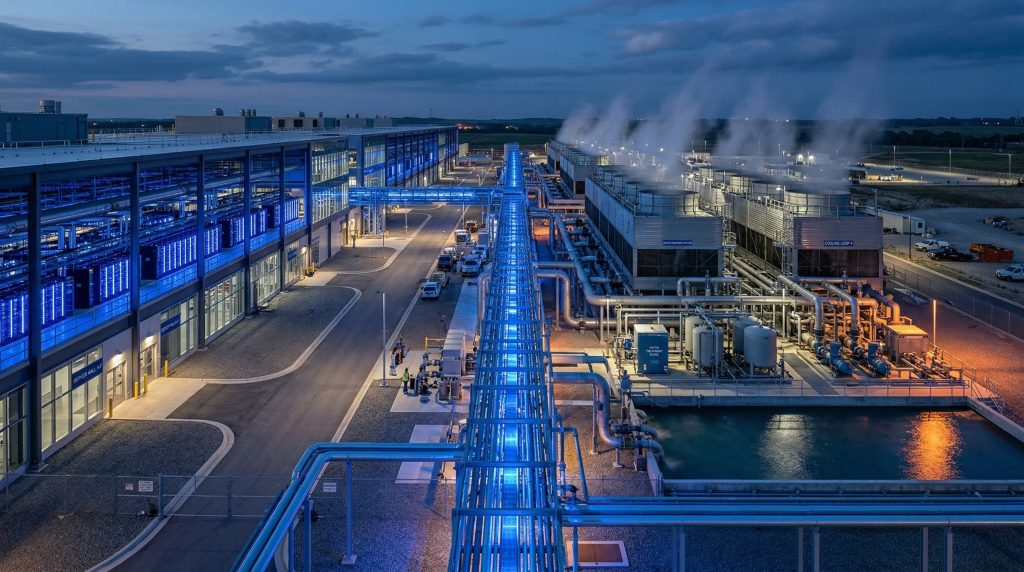
The dominant cooling architecture for large data centers uses evaporative cooling towers. Warm water from the data center’s cooling loop is circulated through the cooling tower, where a portion of it evaporates into the atmosphere. The evaporation process absorbs heat (latent heat of vaporization), cooling the remaining water, which is then recirculated back through the data center. This is extremely energy-efficient—evaporative cooling can achieve Power Usage Effectiveness (PUE) ratios of 1.1-1.3, meaning only 10-30% of total energy goes to cooling infrastructure.
The trade-off is water. For every 1 MW of heat rejected through evaporative cooling, approximately 1,500-2,500 gallons per hour of water is consumed through evaporation, drift, and blowdown. A 100 MW hyperscale data center—a common size for AI-focused facilities—can consume 3-6 million gallons of water per day during peak summer operation.
Blowdown: The Overlooked Water Stream
Evaporation concentrates dissolved minerals in the remaining cooling water. Left unchecked, these minerals would scale heat exchange surfaces and corrode piping. To prevent this, cooling towers continuously discharge a portion of the concentrated water (blowdown) and replace it with fresh makeup water. Blowdown typically represents 20-40% of total cooling tower water consumption, depending on the cycles of concentration at which the system operates.
Blowdown is the water stream where treatment technology can have the greatest impact. Rather than discharging concentrated blowdown to the sewer and replacing it with fresh municipal water, data centers can recover 70-80% of blowdown water using reverse osmosis, recycling it as makeup water and dramatically reducing total water consumption.
Why Is Utah Becoming a Data Center Hub—and What Are the Water Risks?
Utah has become one of the fastest-growing data center markets in the Western United States. Several factors make the state attractive for hyperscale and enterprise data center development:
- Low electricity costs: Utah’s blended commercial electricity rate averages $0.08-$0.10/kWh, well below the national average and significantly below rates in California, Oregon, and Washington where data center markets are saturated.
- Cool climate: Utah’s semi-arid climate with low humidity enables extensive use of free cooling (using ambient air for heat rejection) during cooler months, reducing the hours per year that evaporative cooling is required.
- Fiber connectivity: Salt Lake City is a major fiber optic junction point for transcontinental routes, providing low-latency connectivity to both coasts.
- Business environment: Utah’s tax structure, permitting processes, and workforce availability are favorable for large-scale data center construction.
- Seismic stability: Compared to some other Western states, Utah’s geological risk profile (while not zero) is manageable with proper engineering.
The water risk, however, is significant. Utah is the second-driest state in the nation by average annual precipitation. The Wasatch Front, where the majority of data center development is occurring, is already under persistent drought conditions. Municipal water supplies are strained, and large-scale industrial water users face increasing scrutiny from regulators, water conservancy districts, and the public.
A single 50 MW data center consuming 2-3 million gallons per day represents a meaningful draw on local water resources—equivalent to adding a small city’s water demand to an already stressed system. Multiple large facilities in the same water district compound the impact. For data center operators, this creates both a reputational risk and an operational risk: communities may resist new projects, and water districts may impose allocation limits or surcharges that affect operating economics.
How Can Data Centers Reduce Water Consumption?
Data center operators have multiple strategies available to reduce water consumption, ranging from cooling system optimization to on-site water treatment and recycling. The most effective approach combines several strategies.
Strategy 1: Optimize Cooling Tower Cycles of Concentration
Cycles of concentration (COC) is the ratio of dissolved solids in blowdown water to dissolved solids in makeup water. Higher COC means less blowdown and less makeup water. Most cooling towers operate at 3-5 COC. By improving makeup water quality with RO pre-treatment, data centers can increase COC to 8-15 cycles, reducing total water consumption by 20-40% compared to untreated municipal water.
| Cycles of Concentration | Blowdown as % of Evaporation | Total Water Use (relative) |
|---|---|---|
| 3 COC (typical, no pre-treatment) | 50% | 100% (baseline) |
| 5 COC (standard treatment) | 25% | 83% |
| 10 COC (RO pre-treated makeup) | 11% | 74% |
| 15 COC (RO + softening) | 7% | 71% |
Strategy 2: Blowdown Recovery with Reverse Osmosis
Instead of discharging cooling tower blowdown to sewer, a blowdown recovery RO system can treat this concentrated water stream and return 70-80% as usable makeup water. The remaining 20-30% (RO concentrate) is a much smaller volume that can be discharged or further concentrated. For a data center blowing down 500,000 gallons per day, an RO recovery system can save 350,000-400,000 gallons per day of fresh water.
Blowdown recovery systems are particularly effective when combined with RO pre-treatment of makeup water. The combination of pre-treated makeup (enabling high COC) and blowdown recovery can reduce total water consumption by 50-65% compared to an untreated baseline.
Strategy 3: Alternative Water Sources
Data centers located in areas with available alternative water sources can further reduce their impact on potable water supplies:
- Reclaimed municipal wastewater: Tertiary-treated municipal effluent, when available, can serve as cooling tower makeup with appropriate additional treatment (typically RO polishing). Several data centers in Arizona and Texas already use reclaimed water.
- Brackish groundwater: In Utah, brackish aquifer water is available in many areas along the Wasatch Front. Brackish water RO systems can treat this water to cooling tower makeup quality at a fraction of the cost of desalination.
- Rainwater and stormwater harvesting: While Utah’s low rainfall limits this strategy, large-footprint data center campuses can collect meaningful volumes during spring snowmelt and storm events for seasonal use.
Strategy 4: Direct Liquid Cooling (Reducing Evaporative Load)
The newest generation of AI-focused data centers is increasingly adopting direct liquid cooling (DLC), where coolant circulates directly through server cold plates rather than relying on air-based cooling with external cooling towers. DLC systems can reject heat through dry coolers (air-to-liquid heat exchangers) that consume zero water, or through closed-loop cooling towers that consume significantly less water than open evaporative systems.
However, DLC does not eliminate water consumption entirely for most facilities. Supplemental evaporative cooling is still needed during peak ambient temperatures, and many data centers use a hybrid approach with DLC for high-density AI racks and conventional air cooling for lower-density infrastructure. Water treatment remains essential for the evaporative cooling components of these hybrid systems.
What Is the ROI of Water Treatment for Data Centers?
The financial case for data center water treatment combines direct cost savings with risk mitigation and regulatory compliance benefits.
Direct Cost Savings
Municipal water and sewer rates in Utah’s Wasatch Front range from $4-$8 per 1,000 gallons (combined water and sewer). For a data center consuming 2 million gallons per day, that is $2.9-$5.8 million per year in water and sewer costs alone. A 50% reduction through RO pre-treatment and blowdown recovery saves $1.5-$2.9 million annually. Against a typical system capital cost of $300,000-$800,000 and operating costs of $500,000-$1,000,000 per year, the net savings produce payback periods of 2-4 years.
Drought Risk Mitigation
Under drought surcharge conditions (200-400% overage rates), water costs can double or triple, making the payback even shorter. More critically, water allocation caps during severe drought can force cooling capacity reductions that translate directly to IT load curtailment—potentially costing millions in lost revenue or SLA penalties for cloud and colocation operators.
Regulatory and Community Acceptance
Data centers that demonstrate water stewardship—through on-site treatment, recycling, and reduced municipal draw—are better positioned to secure permits and community acceptance for expansion. In water-stressed markets like Utah, this intangible benefit can be the difference between project approval and opposition.
How Can AMPAC Help Data Center Operators?
AMPAC Water Systems, headquartered in Woods Cross, Utah, designs and manufactures industrial-grade water treatment systems specifically suited for data center applications. The company’s product line includes:
- Cooling tower makeup RO systems: Treating municipal water, brackish groundwater, or reclaimed water to produce high-purity makeup that enables elevated cycles of concentration.
- Blowdown recovery systems: Packaged RO systems designed to recover 70-80% of cooling tower blowdown as reusable makeup water.
- Brackish water treatment systems: For data centers using alternative groundwater sources, AMPAC provides complete pre-treatment and RO systems for TDS levels up to 10,000 mg/L.
- Custom industrial systems: For hyperscale facilities with unique requirements, AMPAC’s engineering team designs custom water treatment solutions from initial water analysis through system commissioning.
All AMPAC systems are Manufactured in North America with full in-house engineering, fabrication, and testing. For data center water treatment inquiries, contact AMPAC’s industrial applications team.