What Did the EPA Actually Do Regarding Microplastics?
In April 2026, the U.S. Environmental Protection Agency added microplastics to the Contaminant Candidate List 6 (CCL 6)—the agency’s official registry of contaminants that are not yet subject to federal drinking water standards but are known or anticipated to occur in public water systems and may require regulation.
This is a significant regulatory signal. Inclusion on the CCL is the first formal step in the process that can ultimately lead to a Maximum Contaminant Level (MCL)—a legally enforceable limit on the concentration of a substance in drinking water. The same pathway led to the EPA’s landmark PFAS drinking water standards finalized in 2024.
To be clear: the CCL listing does not immediately impose any compliance requirements on water utilities or private water systems. What it does is trigger a formal review process, including regulatory determination (deciding whether to regulate), followed by potential MCL rulemaking. Based on historical timelines, if the EPA does proceed to regulation, enforceable standards could be in place by 2030–2032.
For water system operators, treatment technology manufacturers, and industrial water users, the message is straightforward: microplastics regulation is no longer a matter of “if” but “when.”
How Widespread Are Microplastics in Drinking Water?
The short answer: they are virtually everywhere. Research published over the past several years has documented microplastics in drinking water sources and finished drinking water across the globe.
A 2024 study published in the Proceedings of the National Academy of Sciences (PNAS) found an average of 240,000 detectable plastic fragments per liter of bottled water using advanced Raman spectroscopy—far more than previous estimates that relied on less sensitive detection methods. The particles were predominantly nanoplastics (less than 1 micrometer), with nylon, polyethylene terephthalate (PET), and polystyrene being the most common polymer types.
The World Health Organization’s 2022 report on microplastics in drinking water reviewed studies from multiple countries and found microplastics present in both source water and treated drinking water, though concentrations varied by orders of magnitude depending on the source type and treatment methods used.
Key findings from the research literature include:
- Surface water sources (rivers, lakes, reservoirs) consistently show higher microplastic concentrations than groundwater sources, due to runoff from urban areas, wastewater effluent, and atmospheric deposition.
- Groundwater is not immune. Studies have detected microplastics in aquifers, likely introduced through infiltration and well construction pathways.
- Conventional water treatment (coagulation, flocculation, sedimentation, sand filtration) removes an estimated 40–70% of microplastics depending on particle size and treatment conditions, leaving significant quantities in finished water.
- Wastewater treatment plants are both a sink and a source. They capture 80–95% of incoming microplastics but discharge the remainder, along with microplastics-laden biosolids applied to agricultural land.
What Health Risks Do Microplastics in Water Pose?
The health impacts of microplastics exposure through drinking water are an area of active and rapidly evolving research. While the full picture is not yet clear, the evidence to date has been sufficient to prompt regulatory action.
Research published between 2023 and 2026 has identified several concerning pathways:
Direct Particle Effects
Microplastic and nanoplastic particles can cross biological barriers. A 2024 study in the journal Environment International detected microplastics in human blood, lung tissue, and placental tissue. Nanoplastics (particles smaller than 1 micrometer) are small enough to cross cell membranes and accumulate in organs. Animal studies have demonstrated inflammatory responses, oxidative stress, and gut microbiome disruption at exposure levels relevant to human dietary intake.
Chemical Contaminant Vectors
Microplastics act as carriers for other harmful substances. Plastic particles absorb hydrophobic organic contaminants from the surrounding water, including polycyclic aromatic hydrocarbons (PAHs), polychlorinated biphenyls (PCBs), and pesticides. When ingested, these adsorbed contaminants can desorb in the gastrointestinal tract, potentially increasing bioavailability.
Additionally, plastic manufacturing additives—plasticizers like phthalates and bisphenol A (BPA), flame retardants, and UV stabilizers—can leach from the plastic particles into the body. Many of these additives are known endocrine disruptors.
Microbial Biofilm Carriers
Microplastic particles in water develop surface biofilms that can harbor pathogenic bacteria, including antibiotic-resistant organisms. These biofilms can protect microorganisms from disinfection, potentially allowing pathogens to survive treatment processes that would otherwise inactivate them.
What Is the STOMP Program, and Why Does It Matter?
In 2025, the U.S. Department of Health and Human Services (HHS) launched the STOMP initiative—Solutions to Overcome Microplastics Pollution—with $144 million in funding. The program coordinates research across the National Institutes of Health (NIH), the Centers for Disease Control and Prevention (CDC), and the Food and Drug Administration (FDA).
STOMP’s priorities include:
- Developing standardized methods for detecting and measuring microplastics in drinking water, food, and biological samples
- Funding epidemiological studies on health effects of chronic low-level microplastics exposure
- Evaluating treatment technologies for microplastics removal from drinking water and wastewater
- Establishing reference materials and analytical standards for microplastics quantification
The standardization piece is particularly important. One of the biggest obstacles to microplastics regulation has been the absence of standardized, validated analytical methods. Without agreed-upon measurement protocols, setting enforceable concentration limits is impractical. STOMP aims to close this gap, paving the way for EPA rulemaking.
How Is California Leading on Microplastics Testing?
California has consistently been at the forefront of drinking water contaminant regulation, and microplastics are no exception. In 2020, the California State Water Resources Control Board adopted the nation’s first definition of microplastics in drinking water and began requiring testing by large public water systems.
By 2025, the state had released its first round of monitoring data from public water systems, providing the most comprehensive dataset on microplastics occurrence in drinking water in the United States. The data confirmed that microplastics are present in treated drinking water across the state, with concentrations varying based on source water type, treatment technology, and distribution system characteristics.
Other states are watching California’s approach closely. Oregon, Washington, New York, and New Jersey have all initiated microplastics monitoring programs or studies, and several are considering state-level regulations that could precede federal standards.
For water system operators and industrial water users across the country, California’s trajectory offers a preview of what national regulation is likely to look like. Systems that are proactive about microplastics treatment will be ahead of the compliance curve.
Which Water Treatment Technologies Remove Microplastics?
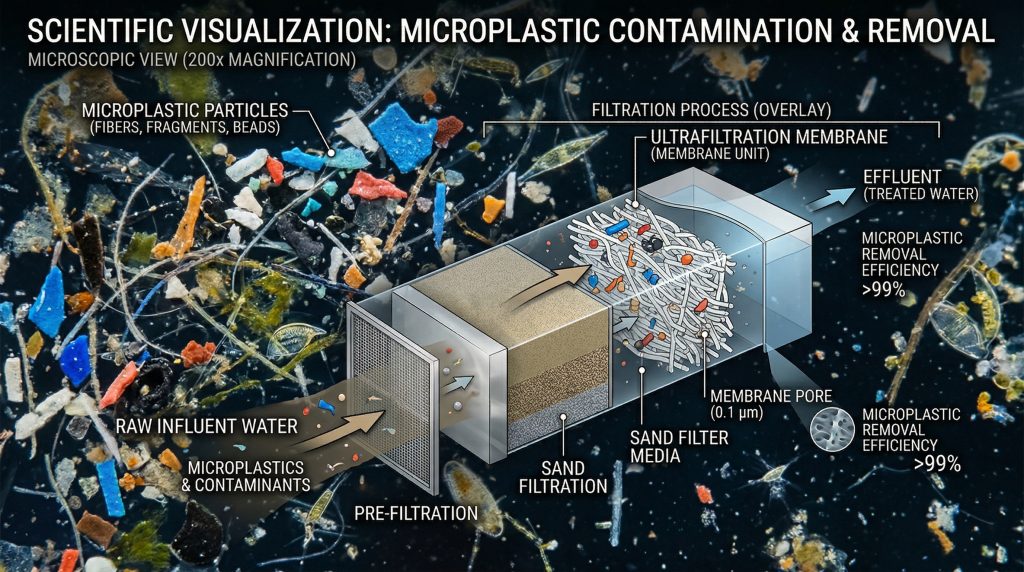
Not all treatment technologies are equally effective at removing microplastics. The particle size distribution matters enormously—technologies that capture particles above 10 micrometers may miss the vast majority of nanoplastics that represent the greatest health concern.
| Treatment Technology | Microplastic Removal Rate | Effective Size Range | Notes |
|---|---|---|---|
| Reverse Osmosis (RO) | 99%+ | All sizes including nanoplastics | Gold standard—membrane pore size is far smaller than any plastic particle |
| Nanofiltration (NF) | 99%+ | All sizes including nanoplastics | Effective due to small pore size; lower pressure than RO |
| Ultrafiltration (UF) | 95–99% | >0.01 μm | Effective for microplastics; may pass smallest nanoplastics |
| Granular Activated Carbon (GAC) | 60–80% | >10 μm | Removes larger particles via physical trapping; not effective for nanoplastics |
| Coagulation + Sand Filtration | 40–70% | >20 μm | Standard conventional treatment; misses most microplastics |
The data is clear: membrane-based treatment, specifically reverse osmosis and nanofiltration, provides the most comprehensive microplastics removal available. RO membranes have effective pore sizes of approximately 0.0001 micrometers (0.1 nanometers), which is orders of magnitude smaller than even the tiniest nanoplastic particles. Nothing gets through.
Why Is RO the Future-Proof Choice for Microplastics Compliance?
When the EPA does set an MCL for microplastics—and the regulatory trajectory strongly suggests it will—water systems will need treatment technologies that can meet whatever standard is established. Here is why RO is the safest investment:
Complete Size Range Coverage
Unlike filtration technologies that have a minimum effective particle size, RO removes contaminants at the molecular level. Whether future regulations target particles at 1 micrometer, 0.1 micrometers, or even nanometer scale, RO already meets the standard. Systems installed today will not need upgrading to meet whatever MCL is eventually promulgated.
Co-Benefit Removal
Microplastics are rarely the only contaminant of concern. AMPAC RO systems simultaneously remove PFAS compounds (which now have federal MCLs), dissolved metals, pharmaceutical residues, and most other organic and inorganic contaminants. A single treatment investment addresses multiple current and emerging regulatory requirements.
Proven, Scalable Technology
RO is not an experimental technology. It has been deployed at scale for decades in municipal water treatment, industrial process water, and desalination applications worldwide. The engineering, operations, and maintenance practices are well-established. Membrane costs have declined approximately 80% over the past 20 years while performance has improved.
What Should Water System Operators Do Now?
Even though federal microplastics MCLs are likely several years away, proactive steps taken now will reduce both compliance costs and health risks when regulations arrive.
1. Baseline Monitoring
Begin voluntary monitoring for microplastics in source water and finished water. This establishes a baseline that will be valuable for regulatory compliance planning and demonstrates due diligence. Several commercial laboratories now offer microplastics analysis using the emerging standardized methods being developed through the STOMP program.
2. Treatment Assessment
Evaluate your current treatment train’s microplastics removal capability. If you are relying on conventional coagulation and sand filtration, understand that significant quantities of microplastics—particularly nanoplastics—are passing through to finished water. Membrane-based technologies (UF, NF, or RO) may need to be added.
3. Capital Planning
Begin including microplastics treatment in capital improvement plans. If membrane treatment is not currently in the facility plan, evaluate where UF or RO could be integrated into the existing treatment train. The lead time for design, permitting, and construction of membrane treatment facilities is typically 2–4 years.
4. Multi-Contaminant Approach
Avoid single-contaminant thinking. An investment in RO or NF for microplastics will also address PFAS, nitrates, heavy metals, and other regulated and emerging contaminants. This multi-contaminant value proposition strengthens the business case for membrane treatment investment.
How AMPAC Systems Address Microplastics Removal
AMPAC Water Systems manufactures commercial and industrial reverse osmosis systems in North America at our facility in Woods Cross, Utah. Every AMPAC RO system inherently provides 99%+ removal of microplastics along with PFAS, dissolved solids, and other contaminants of concern.
Our systems are designed with the understanding that regulatory requirements are evolving. Systems engineered and installed today need to meet not just current standards but anticipated future requirements for PFAS, microplastics, and other emerging contaminants. RO provides that future-proof capability.
For municipal water systems, industrial facilities, and commercial operations looking to get ahead of microplastics regulation, contact our team to discuss treatment options and system sizing for your specific application.
Frequently Asked Questions
What exactly are microplastics?
Microplastics are plastic particles smaller than 5 millimeters in their longest dimension. They include primary microplastics (manufactured at small sizes, such as microbeads in cosmetics) and secondary microplastics (fragments from the breakdown of larger plastic items). Nanoplastics are a subset smaller than 1 micrometer. Microplastics encompass fibers, fragments, films, pellets, and beads made from polymers including polyethylene, polypropylene, polystyrene, PET, and nylon.
Does boiling water remove microplastics?
Partially. A 2024 study published in Environmental Science & Technology Letters found that boiling tap water for 5 minutes and filtering through a simple paper or coffee filter removed up to 90% of microplastics from hard water. The mechanism involves calcium carbonate precipitation, which encapsulates the plastic particles and makes them filterable. However, this approach is not practical for large-scale water treatment, and its effectiveness varies with water hardness and microplastic particle characteristics.
When will the EPA set an enforceable limit on microplastics in drinking water?
Based on the regulatory process timeline, the earliest an enforceable MCL could be in place is approximately 2030–2032. After CCL listing, the EPA must make a regulatory determination (typically 2–3 years), then propose and finalize a rule (another 2–3 years), and then provide a compliance timeline for water systems (typically 3–5 years). However, state-level requirements, particularly in California, Oregon, and New York, may impose testing or treatment requirements sooner.
Can a home water filter remove microplastics?
It depends on the filter type. Point-of-use RO systems are highly effective, removing 99%+ of microplastics. Activated carbon filters remove some larger microplastics but are not effective against nanoplastics. Simple pitcher-style filters provide minimal microplastics removal. For comprehensive protection, a point-of-use or point-of-entry RO system is the most reliable household option.
Are microplastics more concentrated in bottled water or tap water?
Research generally finds higher microplastic concentrations in bottled water than in tap water. The PNAS study mentioned earlier found an average of 240,000 plastic fragments per liter in bottled water, primarily from the PET bottle material and cap. Tap water microplastic concentrations, while variable, are typically reported in the range of 0–60 particles per liter using older detection methods, though newer, more sensitive methods suggest higher levels. The plastic packaging itself is a significant source of contamination in bottled water.
Will microplastics regulations affect industrial water users?
Likely yes, in several ways. Industries that discharge wastewater to municipal systems may face new pretreatment requirements for microplastics. Food and beverage manufacturers may face product safety standards related to microplastics content. And industries that rely on high-purity process water will likely see microplastics added to their incoming water quality specifications. Facilities with RO treatment already in place are well-positioned to meet these emerging requirements.