What Is Brackish Water, and Why Does It Matter for Utah?
Brackish water occupies the salinity range between freshwater and seawater—typically 1,000 to 10,000 parts per million (ppm) total dissolved solids (TDS), compared to less than 500 ppm for drinking water and 35,000 ppm for ocean water. It is too salty to drink or irrigate with, but far less salty than the ocean. And there is an enormous amount of it sitting beneath the Western United States.
The U.S. Geological Survey (USGS) published a landmark assessment of the nation’s brackish groundwater resources, identifying brackish aquifers in 41 states. The total volume is staggering: an estimated 800 times the amount of fresh groundwater pumped in the United States each year. For a region locked in a multi-decade megadrought, this represents a resource that has been almost entirely overlooked.
Utah is particularly well-positioned. The state contains extensive brackish groundwater formations in the Great Basin, the Uinta Basin, the Sevier Desert, and along portions of the Wasatch Front. These aquifers contain water with TDS levels ranging from 1,000 to over 35,000 ppm, with large volumes in the treatable 1,500–5,000 ppm range that is ideal for reverse osmosis desalination.
How Severe Is Utah’s Water Challenge?
Utah is the second-driest state in the nation by average annual precipitation, receiving just 13.2 inches per year according to the Western Regional Climate Center. Despite this, Utah has one of the highest per-capita water consumption rates in the country—approximately 220 gallons per person per day for residential use alone, roughly double the national average.
The math does not work indefinitely. Utah’s population, currently around 3.4 million, is projected to reach 5.4 million by 2060 according to the Kem C. Gardner Policy Institute at the University of Utah. That growth, combined with declining snowpack and the ongoing crisis at the Great Salt Lake, is forcing a fundamental rethinking of the state’s water portfolio.
The Great Salt Lake has declined to historically low levels, losing roughly two-thirds of its water since the late 1980s. The exposed lakebed contains heavy metals including arsenic and mercury, which become airborne dust during wind events, posing a public health risk to the Wasatch Front’s 2.5 million residents. The state legislature has responded with emergency water conservation measures, but conservation alone cannot close the supply-demand gap.
Brackish desalination offers something that conservation, water transfers, and cloud seeding cannot: a new source of supply. And unlike seawater desalination, it does not require building pipelines to the coast.
Where Are Utah’s Brackish Groundwater Resources?
USGS mapping has identified several significant brackish aquifer systems in Utah:
The Great Basin Aquifer System
Covering much of western Utah, the Great Basin contains extensive basin-fill aquifers with brackish water at relatively shallow depths. TDS concentrations typically range from 1,000 to 10,000 ppm, with some areas exceeding 35,000 ppm near the Great Salt Lake. Communities in Tooele County, Millard County, and Box Elder County sit directly above accessible brackish formations.
The Uinta Basin
Northeastern Utah’s Uinta Basin contains brackish water associated with both the basin-fill aquifer system and deeper formations connected to oil and gas producing zones. Water quality varies widely, with TDS from 2,000 to over 20,000 ppm. The significant produced water volumes from the basin’s energy operations also represent a potential feed source for desalination.
The Wasatch Front
Along the urbanized corridor from Ogden to Provo, deeper aquifer zones contain brackish water beneath the shallow freshwater aquifers that currently supply much of the region’s groundwater. As freshwater aquifer levels decline, brackish desalination of these deeper zones becomes an increasingly practical supplement to existing supply.
The Sevier Desert
Central Utah’s Sevier Desert region contains substantial brackish groundwater resources. Several agricultural communities in this area already face water quality challenges from rising salinity in their existing wells, making desalination treatment a near-term necessity regardless of new supply development.
What Does Brackish Desalination Cost Compared to Alternatives?
Cost is where brackish desalination makes its strongest case. Because brackish water has significantly lower salinity than seawater, it requires far less energy to desalinate. Lower operating pressure means smaller pumps, less energy, and longer membrane life.
| Water Source | Cost per Acre-Foot | Energy (kWh/acre-foot) | Practical for Utah? |
|---|---|---|---|
| Brackish groundwater desalination | $357–$782 | 800–2,600 | Yes—local resource, proven technology |
| Seawater desalination | $1,000–$2,500 | 4,000–6,500 | No—Utah is landlocked, pipeline costs prohibitive |
| Colorado River (current allocation) | $150–$400 | Variable | Limited—allocations fully subscribed, declining flows |
| Long-distance pipeline transfer | $1,200–$3,000+ | 2,000–5,000 (pumping) | Possible but extremely expensive and politically complex |
| Agricultural water rights transfer | $500–$2,000+ | N/A | Yes, but limited volume and socioeconomic impacts |
The Bureau of Reclamation’s desalination cost data, drawn from its research program funding 31 projects totaling $29 million, consistently shows brackish desalination as one of the lowest-cost options for developing new water supply in the inland Western states. When compared to the full lifecycle cost of long-distance water transfers or new reservoir construction, brackish desalination is highly competitive.
How Does Brackish RO Technology Work?
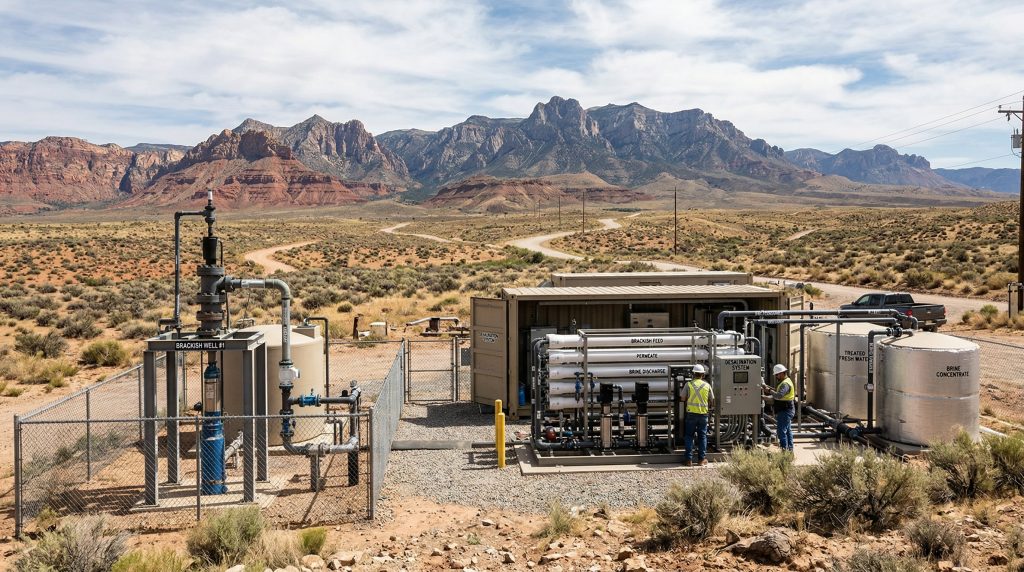
The core technology is reverse osmosis, the same membrane-based separation process used in seawater desalination but operating under significantly different conditions.
Operating Pressure and Energy
Brackish RO systems typically operate at 100–300 psi, compared to 800–1,200 psi for seawater systems. This pressure difference translates directly to energy savings. Specific energy consumption for brackish RO ranges from 0.5 to 2.5 kWh per cubic meter of product water, compared to 3.0–5.0 kWh/m³ for seawater RO (with energy recovery).
For a municipal-scale brackish desalination plant producing 1 million gallons per day (MGD), annual energy costs at $0.08/kWh would be approximately $55,000–$275,000. The same volume from seawater desalination would cost $330,000–$700,000 in energy alone.
Recovery Rates
Brackish RO systems achieve higher water recovery rates than seawater systems—typically 75–90% compared to 40–50% for seawater. This means less concentrate (brine) to manage, which is a significant advantage for inland facilities where ocean discharge is not an option.
High-recovery brackish systems using interstage chemical treatment or concentrate recycling can push recovery to 90–95%, minimizing the volume of concentrate requiring disposal.
Membrane Selection
Brackish water RO membranes are formulated differently than seawater membranes. They use thinner active layers optimized for lower-pressure operation and higher flux rates. Modern brackish membranes from manufacturers like Toray, Dow (DuPont), and Hydranautics achieve salt rejection rates of 99.0–99.7% at operating pressures of 150–225 psi for typical 2,000–5,000 ppm feedwater.
AMPAC brackish RO systems are configured with membrane elements selected specifically for the feedwater chemistry of each installation, accounting for the particular mix of dissolved minerals, silica, and organics present in Western U.S. brackish aquifers.
What Are the Challenges of Inland Brackish Desalination?
Brackish desalination is not without its challenges. The two most significant for inland applications are concentrate management and the specific water chemistry of brackish aquifers.
Concentrate (Brine) Disposal
Coastal desalination plants can discharge concentrate to the ocean. Inland plants have no such option. Concentrate disposal methods for inland brackish desalination include:
- Deep well injection: Pumping concentrate into deep saline aquifers below the freshwater zone. This is the most common method in the Western U.S. and requires a Class I or Class V Underground Injection Control (UIC) permit from the EPA.
- Evaporation ponds: Practical in arid climates with inexpensive land. Evaporation rates in Utah’s western desert range from 40 to 60 inches per year, making this viable for moderate-volume plants.
- Beneficial use of concentrate: In some cases, the concentrate stream can be used for dust suppression, salt production, or aquaculture with salt-tolerant species.
- Zero liquid discharge (ZLD): Thermal or mechanical evaporation of concentrate to produce solid salt and recover all remaining water. Capital-intensive but eliminates the disposal challenge entirely.
The Bureau of Reclamation’s desalination research program has funded several concentrate management studies in the Western states, recognizing this as the primary barrier to wider brackish desalination adoption.
Scaling and Fouling
Brackish groundwater often contains elevated levels of silica, calcium sulfate, barium sulfate, and strontium sulfate—all of which can form hard scale on RO membranes. Utah brackish aquifers in particular tend to have high silica concentrations (sometimes exceeding 50 ppm) and elevated hardness.
Effective antiscalant programs and proper system design—including interstage pH adjustment for silica management—are critical to maintaining membrane performance and longevity in these applications. This is where working with an engineering team that understands Western U.S. water chemistry pays dividends.
What Federal and State Funding Is Available?
Several funding mechanisms exist to support brackish desalination development in Utah and the Western states:
Bureau of Reclamation Programs
The Bureau of Reclamation’s Desalination and Water Purification Research (DWPR) program has allocated $29 million across 31 projects nationwide. The program specifically targets inland desalination technologies and concentrate management solutions. Additionally, the WaterSMART program provides grants for water reuse, recycling, and desalination projects, with recent funding rounds including several brackish desalination projects in the Colorado River Basin states.
Infrastructure Investment and Jobs Act (IIJA)
The 2021 IIJA included $1 billion for water recycling and reuse projects through 2026, with a portion directed toward desalination. Western states have been disproportionate beneficiaries of this funding given the severity of their water challenges.
Utah Water Infrastructure
The Utah Division of Water Resources and the Utah Division of Drinking Water both offer low-interest loan programs for water infrastructure development, including treatment facilities. The state’s Water Infrastructure Restricted Account, established by the legislature, provides additional funding for projects that develop new water supply.
How Is Brackish Desalination Already Being Used in the Region?
Brackish desalination is not theoretical—it is operating at scale across the Western United States right now.
The El Paso Water Utilities Kay Bailey Hutchison Desalination Plant in Texas has operated since 2007, treating 27.5 MGD of brackish groundwater with TDS levels of approximately 2,500 ppm. It was the largest inland desalination plant in the world at the time of its construction and has proven the long-term reliability of brackish RO for municipal supply.
Arizona’s Buckeye Water Reclamation Facility and several other municipal plants in the Phoenix metropolitan area use brackish desalination as a component of their water supply portfolio. California’s Inland Empire Utilities Agency operates brackish desalination as part of its groundwater management strategy.
In Utah, smaller-scale brackish treatment systems are already operating in several communities where well water quality has deteriorated. As water stress intensifies and treatment technology costs continue to decline, larger-scale municipal and industrial installations are expected to follow.
How Can AMPAC Help Develop Brackish Water Resources?
AMPAC Water Systems has been designing and building reverse osmosis systems for brackish water applications for over two decades. Our systems are manufactured in North America at our Woods Cross, Utah facility, giving us direct familiarity with the water chemistry challenges specific to Utah and the broader Western region.
We offer brackish RO systems from small commercial units treating a few thousand gallons per day up to industrial-scale systems for municipal and industrial applications. Each system is engineered around the specific feedwater analysis, with membrane selection, pretreatment design, and antiscalant programs tailored to the local water chemistry.
For communities, water districts, and industrial facilities looking to develop brackish groundwater as a water supply source, contact our engineering team to discuss feasibility, system sizing, and project economics.
Frequently Asked Questions
What salinity range is considered brackish water?
Brackish water is generally defined as water with total dissolved solids (TDS) between 1,000 and 10,000 ppm, though some classifications extend the upper range to 35,000 ppm. For comparison, drinking water standards require TDS below 500 ppm, and seawater averages around 35,000 ppm. Most brackish groundwater targeted for desalination in Utah falls in the 1,500–5,000 ppm range, which is ideal for energy-efficient RO treatment.
Is brackish groundwater a renewable resource?
It depends on the aquifer. Some brackish aquifers receive recharge from surface infiltration and are renewable on human timescales. Others are essentially fossil water that accumulated over geological time and recharge very slowly. Sustainable development of brackish groundwater requires hydrogeological assessment to determine recharge rates and set pumping limits that avoid aquifer depletion. The USGS has conducted assessments of recharge rates for many Western U.S. brackish aquifer systems.
Can brackish desalination meet the needs of a growing city?
Yes, but typically as one component of a diversified water supply portfolio rather than a sole source. The El Paso, Texas desalination plant demonstrates that brackish RO can reliably supply tens of millions of gallons per day for a major city. For Utah communities, brackish desalination is most effective when combined with conservation, water reuse, and traditional surface and groundwater sources to create a resilient, diversified supply.
What happens to the salt and minerals removed from brackish water?
The RO process produces a concentrate stream containing the rejected salts and minerals. For inland plants, this concentrate is typically disposed of through deep well injection into saline aquifers, evaporation ponds, or ZLD systems. Emerging approaches include mineral recovery (extracting valuable minerals like lithium and magnesium from the concentrate) and beneficial reuse. The Bureau of Reclamation is actively funding research into these concentrate management alternatives.
How does brackish desalination compare to seawater desalination for inland states?
For inland states like Utah, brackish desalination is vastly more practical. Seawater desalination would require constructing hundreds of miles of pipeline from the Pacific coast, crossing multiple state boundaries, and pumping water over significant elevation changes. The capital cost for such a project would be tens of billions of dollars. Brackish desalination uses a local resource at 30–60% lower treatment cost per acre-foot, with no long-distance conveyance infrastructure required.
Are there environmental concerns with pumping brackish groundwater?
The primary environmental considerations are aquifer sustainability (avoiding overdraft), potential impacts on connected surface water bodies, and proper management of the concentrate stream. Additionally, some brackish aquifers contain naturally occurring contaminants like arsenic, radium, or fluoride that must be properly addressed in the treatment process and concentrate disposal. Environmental review and permitting processes address these concerns on a project-by-project basis.