Industrial Water Reuse: The Complete Guide for 2026
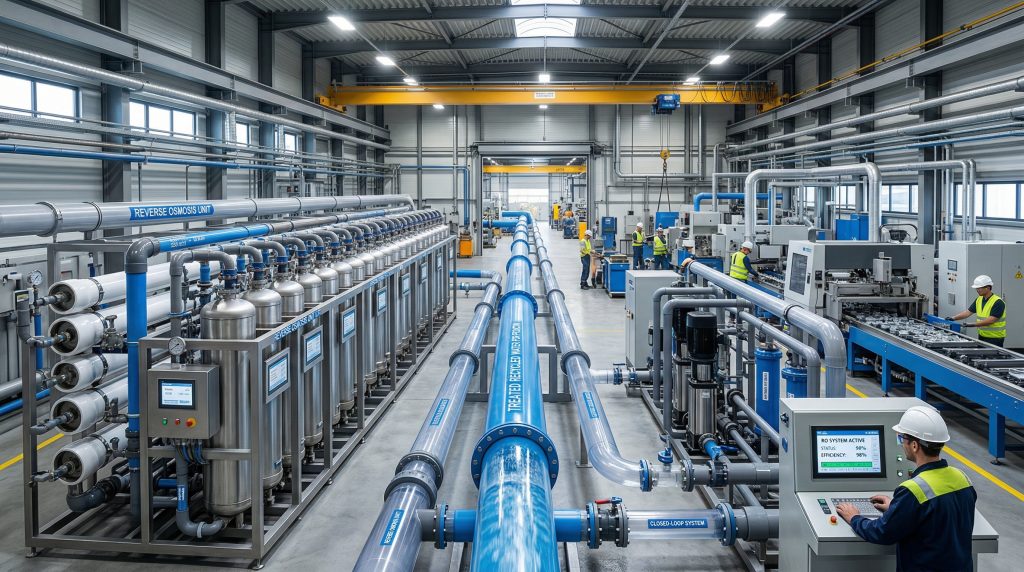
Why Is Industrial Water Reuse Surging in 2026? Water scarcity is no longer a future risk—it is an operating reality. According to the World Resources Institute, 25 countries housing one-quarter of the global population face “extremely high” baseline water stress every year. For manufacturers, this translates directly into supply uncertainty, rising utility rates, and increasingly stringent discharge permits. The numbers tell the story. The global industrial water reuse and recycling market, valued at approximately $14.2 billion in 2022, is on track to reach $23.4 billion by 2028, according to MarketsandMarkets research. That growth is not speculative. It is being driven by three converging forces: tightening environmental regulations, escalating freshwater costs, and the rapid mainstreaming of ESG (Environmental, Social, and Governance) reporting requirements. In the Western United States, the urgency is particularly acute. The Colorado River Basin continues to face historic shortfalls. The Great Salt Lake has lost roughly two-thirds of its water volume since the 1980s, threatening both ecosystems and the regional economy. For industrial operators in Utah and neighboring states, reducing freshwater intake through reuse is becoming less of a sustainability aspiration and more of a license-to-operate requirement. What Are the Main Types of Industrial Water Reuse? Not all reuse is the same. The treatment required, the economics involved, and the regulatory considerations vary significantly depending on which water stream you are targeting. Understanding these distinctions is the first step toward building a system that actually delivers a return. Process Water Recycling Process water—used directly in manufacturing operations like rinsing, washing, and product formulation—represents the largest volume of industrial water consumption in most facilities. In food and beverage manufacturing alone, process water can account for 60–80% of total facility water use. Recycling process water typically requires multi-stage treatment to meet the quality specifications of the original application. A pharmaceutical rinse water, for example, demands different purity than a metal finishing rinse. The treatment train is designed around the specific contaminants present and the quality targets required. Common treatment sequences for process water reuse include: Screening and sedimentation to remove suspended solids Biological treatment (for high-BOD streams) to reduce organic loading Ultrafiltration (UF) to remove particles, bacteria, and colloids down to 0.01 microns Reverse osmosis (RO) to remove dissolved salts, organics, and trace contaminants UV disinfection or ozone for final microbial control Recovery rates of 85–95% are achievable with properly designed UF-RO systems, meaning that for every 100 gallons of wastewater entering the system, 85–95 gallons are returned as reusable process water. Cooling Tower Blowdown Recovery Cooling towers are water-intensive. The Electric Power Research Institute (EPRI) estimates that cooling systems account for approximately 40% of industrial water withdrawals in the United States. As water circulates through a cooling tower, evaporation concentrates dissolved minerals. To prevent scaling and corrosion, a portion of this concentrated water—called blowdown—must be discharged and replaced with fresh makeup water. Treating and recycling blowdown water with RO allows facilities to increase their cycles of concentration, dramatically reducing both freshwater makeup requirements and discharge volumes. A facility operating at 3 cycles of concentration that moves to 6 cycles through blowdown recovery can cut its makeup water demand by roughly 30–40%. The treatment approach is relatively straightforward: chemical softening or antiscalant dosing, followed by RO. The concentrated RO reject can either be sent to a zero liquid discharge (ZLD) system or managed through evaporation ponds, depending on local discharge regulations. Boiler Feed Water Recovery Boiler systems require high-purity water to prevent scaling, corrosion, and carryover. Traditionally, facilities use freshwater treated through softening and deionization. Recovering and treating condensate return and other suitable wastewater streams for boiler feed reduces both water and energy costs, since recovered condensate is already at elevated temperatures. Treatment for boiler feed reuse typically involves UF followed by two-pass RO or RO plus electrodeionization (EDI) to achieve the low TDS and silica levels required. The energy savings from using warm recovered water instead of cold municipal supply can be substantial—often 5–15% of total boiler fuel costs. Which Technologies Drive Modern Water Reuse Systems? The technology landscape for industrial water reuse has matured considerably over the past decade. Today’s systems combine multiple treatment technologies in engineered sequences that are far more reliable and cost-effective than the early-generation reuse plants. Here is a practical overview of the core technologies. Ultrafiltration (UF) UF membranes operate with pore sizes between 0.01 and 0.1 microns, effectively removing suspended solids, bacteria, viruses, and colloidal material. UF serves as the workhorse pretreatment step before RO in nearly all modern reuse systems. By protecting the RO membranes from fouling, UF extends membrane life by 20–40% and reduces cleaning frequency. Modern UF systems use either hollow-fiber or flat-sheet membrane configurations, with hollow fiber being the dominant choice for industrial applications due to higher packing density and easier backwash procedures. Reverse Osmosis (RO) RO remains the gold standard for removing dissolved contaminants from water. Operating at pressures between 100 and 600 psi depending on feedwater salinity, RO membranes reject 95–99.5% of dissolved salts, organic compounds, and most microcontaminants including PFAS, pharmaceuticals, and heavy metals. For industrial reuse applications, AMPAC commercial and industrial RO systems are engineered with the specific feedwater chemistry and target water quality in mind. Single-pass RO achieves permeate TDS suitable for most cooling and general process applications. Two-pass configurations or RO-EDI combinations deliver the higher purity required for boiler feed and semiconductor manufacturing. Nanofiltration (NF) NF membranes sit between UF and RO in terms of rejection capability. They remove divalent ions (calcium, magnesium, sulfate) while allowing a portion of monovalent ions (sodium, chloride) to pass through. This selectivity makes NF ideal for applications where complete demineralization is unnecessary but hardness and specific contaminants must be removed. NF operates at lower pressures than RO—typically 70–150 psi—which translates to 20–40% lower energy consumption. For cooling tower makeup or certain process applications, NF can be the more economical choice. UV Disinfection and Advanced Oxidation For reuse applications requiring microbial control, UV disinfection at 254 nm wavelength provides effective inactivation of bacteria, viruses, and protozoa without
Industrial Water Reuse: The Complete Guide for 2026 Read More »