
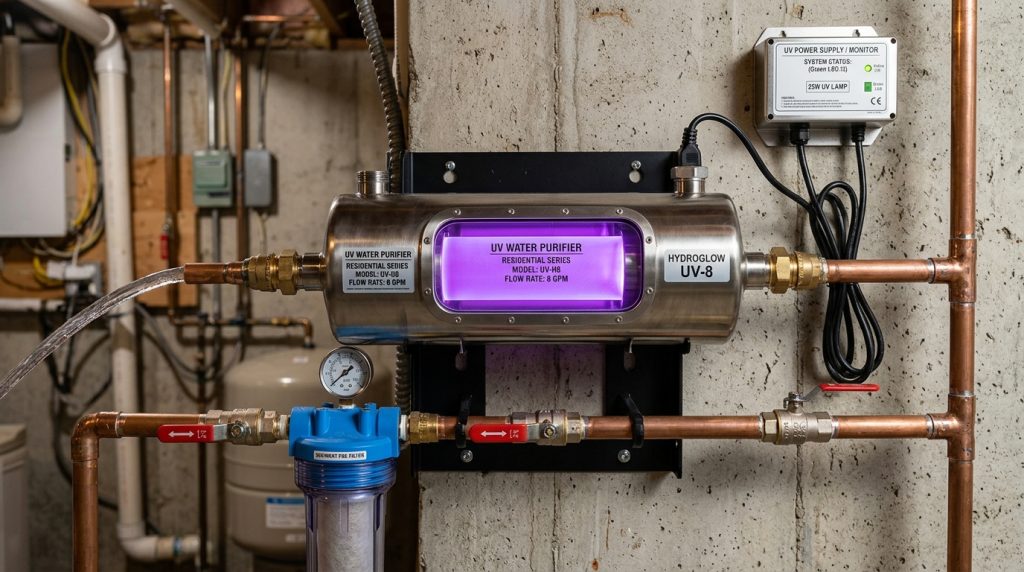
Quick Answer UV water purification uses ultraviolet light at 254 nanometers (UV-C) to inactivate 99.99% of bacteria, viruses, parasites, and other microorganisms without adding chemicals to your water. UV systems are essential for well water, homes on boil water advisories, and any water source at risk of microbial contamination. UV does not remove chemical contaminants or sediment — it is a disinfection-only technology best used as part of a multi-stage treatment system. How UV Water Purification Works Ultraviolet water purification exposes water to UV-C radiation as it flows through a stainless steel chamber containing a UV lamp. The UV light at 254 nm wavelength penetrates the cell walls of microorganisms and disrupts their DNA, preventing them from reproducing and rendering them harmless. UV disinfection is a physical process, not a chemical one. Unlike chlorination, it does not add anything to the water, produce disinfection byproducts, or alter the taste or odor of treated water. The EPA recognizes UV disinfection as an effective treatment for microbial contaminants in drinking water. What UV Purification Removes (and Does Not Remove) Contaminant UV Effectiveness Notes E. coli bacteria 99.99% inactivation Primary indicator of fecal contamination Coliform bacteria 99.99% inactivation Indicates potential pathogen presence Giardia lamblia 99.9% inactivation Common waterborne parasite Cryptosporidium 99.9% inactivation Chlorine-resistant; UV is highly effective Viruses (Hepatitis A, Rotavirus, etc.) 99.99% inactivation Higher UV dose required than bacteria Chlorine, chemicals Not removed Use activated carbon filtration Lead, heavy metals Not removed Use reverse osmosis Sediment, turbidity Not removed Pre-filtration required for UV to work effectively PFAS Not removed Use RO or activated carbon When You Need a UV Water Purification System UV purification is strongly recommended in several scenarios. If you rely on a private well, your water is not treated by a municipal utility, and bacteria can enter from surface runoff, nearby septic systems, or compromised well casings. If you have received a boil water advisory, UV provides equivalent protection without boiling. If your water test shows coliform bacteria or E. coli, UV provides ongoing disinfection after the contamination source is addressed. If you live near agricultural operations, animal waste and fertilizer runoff increase the risk of microbial contamination in groundwater. And if you use surface water (springs, streams), these sources carry significantly higher microbial risk than deep wells. UV System Components and Sizing Key Components UV lamp — Generates UV-C light at 254 nm; must be replaced annually regardless of whether it still illuminates (UV output degrades below effective levels before the lamp burns out) Quartz sleeve — Protects the UV lamp from water contact; must be cleaned periodically and replaced if scratched or etched Reactor chamber — Stainless steel housing that ensures water receives adequate UV exposure time Controller/ballast — Powers the lamp and may include UV intensity monitoring, lamp life countdown, and fault alarms UV sensor (optional) — Monitors actual UV dose delivery; essential for critical applications Sizing Guide Application Flow Rate Needed UV System Size Approx. Cost Single faucet / RV 0.5-1 GPM Small POU unit $100-$200 Small home (1-2 bath) 6-10 GPM Standard residential $300-$700 Large home (3+ bath) 12-18 GPM High-flow residential $500-$1,200 Small commercial 20-40 GPM Commercial grade $1,000-$3,000 Restaurant / food service 15-30 GPM NSF-certified commercial $1,500-$5,000 AMPAC Water Systems provides UV purification systems for residential through commercial applications, with options for every flow rate requirement. Pre-Treatment Requirements for UV UV systems have specific water quality requirements to function effectively. Turbidity must be below 1 NTU (nephelometric turbidity unit) because suspended particles can shield microorganisms from UV light. Iron should be below 0.3 ppm and manganese below 0.05 ppm, as these minerals deposit on the quartz sleeve and block UV transmission. Hardness should be managed to prevent scale buildup on the quartz sleeve. A typical pre-treatment configuration for well water includes a 5-micron sediment filter followed by an iron/manganese filter (if needed), then a water softener (if hard), and finally the UV system as the last stage before distribution. UV System Classes: NSF/ANSI 55 The NSF/ANSI Standard 55 defines two classes of UV systems: Class A (40 mJ/cm2) — Designed to disinfect microbiologically unsafe water. Required for well water, surface water, and any water that may contain pathogens. This is the class you need for primary disinfection. Class B (16 mJ/cm2) — Supplemental treatment for already disinfected water (municipal water). Provides an additional barrier but is not intended as the sole disinfection method for untreated water. For well water and other non-municipal sources, always choose a Class A system. Key Takeaway: UV purification is the most effective chemical-free method for eliminating waterborne pathogens. It is essential for private well owners and anyone relying on non-chlorinated water. However, UV only addresses biological contaminants — pair it with sediment filtration, carbon filtration, and/or reverse osmosis for comprehensive water treatment. Consult AMPAC Water Systems to design a complete treatment system that includes UV disinfection. Frequently Asked Questions How effective is UV water purification? UV purification is 99.99% effective against bacteria, viruses, and parasites when the system is properly sized and maintained. UV is particularly effective against Cryptosporidium, which is resistant to chlorine disinfection. Effectiveness depends on proper pre-filtration, adequate UV dose (40 mJ/cm2 for Class A), and annual lamp replacement. Does UV water purification remove chemicals? No. UV purification is a disinfection technology that targets microorganisms only. It does not remove chlorine, lead, PFAS, arsenic, nitrates, or other chemical contaminants. For chemical removal, pair UV with activated carbon filtration (for chlorine and VOCs) or reverse osmosis (for dissolved solids and heavy metals). How often should UV lamps be replaced? UV lamps should be replaced every 12 months (9,000 hours), even if they still illuminate. UV output degrades over time, and a lamp that produces visible light may no longer deliver the minimum UV dose needed for effective disinfection. The quartz sleeve should be cleaned every 12 months and replaced if scratched or etched. Can UV kill viruses in water? Yes. UV-C at 254 nm effectively inactivates waterborne viruses including Hepatitis A, Rotavirus, Norovirus, and
UV Water Purification: How It Works and When You Need It Read More »