Water Quality

PFAS contamination in tap water testing

PFAS in Tap Water: Is Your Home Water Safe? [Testing and Solutions]

Quick Answer PFAS (per- and polyfluoroalkyl substances) have been detected in the tap water of more than 45% of US water systems tested. The EPA set enforceable limits of 4 parts per trillion (ppt) for PFOA and PFOS in April 2024 under the National Primary Drinking Water Regulation. To remove PFAS from your home water, reverse osmosis is the most effective technology (90-99% removal), followed by granular activated carbon and ion exchange systems. Testing is available through certified labs for $200-$400. What Are PFAS? PFAS are a group of more than 14,000 synthetic chemicals that have been manufactured since the 1940s. They are called “forever chemicals” because the carbon-fluorine bond is one of the strongest in chemistry, making these compounds extremely resistant to breakdown in the environment and the human body. PFAS are used in nonstick cookware, water-resistant clothing, food packaging, firefighting foam (AFFF), and thousands of industrial applications. The two most studied PFAS compounds are PFOA (perfluorooctanoic acid, used in Teflon manufacturing) and PFOS (perfluorooctane sulfonate, used in Scotchgard and firefighting foam). While these specific compounds have been phased out of US manufacturing, they persist in the environment and have been replaced by newer PFAS compounds whose health effects are still being studied. EPA PFAS Regulations In April 2024, the EPA finalized the first-ever National Primary Drinking Water Regulation for PFAS, establishing legally enforceable limits. The EPA set maximum contaminant levels (MCLs) of 4 ppt for PFOA (individually), 4 ppt for PFOS (individually), and 10 ppt for PFHxS, PFNA, and HFPO-DA (GenX), plus a hazard index limit for mixtures of these compounds. Public water systems have until 2029 to comply with these limits. To put 4 ppt in perspective, that is equivalent to 4 drops of water in an Olympic-size swimming pool. These extremely low limits reflect the EPA’s determination that PFAS pose health risks at very low concentrations. Health Concerns Associated with PFAS Research has linked PFAS exposure to increased risk of certain cancers (kidney, testicular), thyroid disease and hormone disruption, immune system effects (reduced vaccine effectiveness), elevated cholesterol levels, reproductive effects (decreased fertility, pregnancy-induced hypertension), liver damage, and developmental effects in children. The World Health Organization and the US Agency for Toxic Substances and Disease Registry (ATSDR) continue to study the full range of PFAS health effects. How PFAS Get Into Tap Water PFAS enter water supplies through multiple pathways. Industrial discharge from manufacturing facilities that use or produce PFAS is a primary source. AFFF firefighting foam used at military bases, airports, and fire training facilities has contaminated groundwater at thousands of sites. Wastewater treatment plants that receive PFAS-containing industrial or household waste discharge treated effluent containing PFAS. Landfill leachate from consumer products containing PFAS seeps into groundwater. And agricultural application of biosolids (treated sewage sludge) containing PFAS contaminates soil and groundwater. Am I at Higher Risk? You may have elevated PFAS in your water if you live near a current or former military base (especially those with fire training areas), near an airport where AFFF firefighting foam has been used, near industrial facilities that manufacture or use PFAS, downstream from a wastewater treatment plant, or near landfills that accept industrial waste. The EPA’s interactive PFAS contamination map and the EWG’s PFAS contamination database can help you assess your local risk. How to Test for PFAS in Your Water PFAS testing requires specialized laboratory equipment (liquid chromatography-mass spectrometry) and cannot be done with DIY home test kits. To test your water, contact a state-certified laboratory that offers PFAS analysis (costs range from $200-$400 per sample), request testing for the full suite of EPA-regulated PFAS compounds, and follow the lab’s sample collection instructions carefully to avoid contamination. If you are on municipal water, check your utility’s Consumer Confidence Report (CCR) or contact them directly about PFAS testing. Under the EPA’s regulation, public systems serving more than 3,300 people must monitor for PFAS by 2026 and all systems by 2027. Best Water Treatment Methods for PFAS Removal Technology PFAS Removal Rate Best For Limitations Reverse Osmosis 90-99% Most effective point-of-use solution; removes long and short-chain PFAS Single faucet; wastewater produced Granular Activated Carbon (GAC) 60-95% Effective for long-chain PFAS (PFOA, PFOS); affordable Less effective for short-chain PFAS; frequent replacement needed Ion Exchange (IX) 90-99% Effective for both long and short-chain; no wastewater More expensive; resin requires periodic replacement Nanofiltration 80-95% Emerging technology; less wastewater than RO Less widely available; variable performance Reverse Osmosis: The Top Choice for Home PFAS Removal For residential applications, reverse osmosis provides the most reliable and thorough PFAS removal. RO membranes reject both long-chain PFAS (like PFOA and PFOS) and the more difficult short-chain PFAS compounds that carbon filters may miss. A quality under-sink RO system from AMPAC Water Systems provides 90-99% PFAS removal along with lead, arsenic, TDS, and dozens of other contaminants. Activated Carbon Filtration Granular activated carbon (GAC) is effective for long-chain PFAS (PFOA, PFOS) but less reliable for short-chain compounds like GenX, PFBS, and PFBA. Carbon block filters generally outperform loose granular carbon. If using carbon alone for PFAS, choose a system with NSF/ANSI P473 certification specifically for PFAS removal, and replace cartridges more frequently than the standard schedule. Key Takeaway: PFAS contamination is widespread and the EPA’s new 4 ppt limits for PFOA and PFOS are among the strictest drinking water standards ever set. If you are concerned about PFAS, get a certified lab test, then install a reverse osmosis system for the most effective point-of-use removal. For whole-house PFAS treatment, consult a water treatment professional about GAC or IX systems sized for your household’s flow rate. Contact AMPAC Water Systems for PFAS treatment recommendations. Frequently Asked Questions Does boiling water remove PFAS? No. Boiling water does not remove PFAS. In fact, boiling can concentrate PFAS as water evaporates while the chemicals remain. PFAS are extremely heat-stable (they are used in nonstick cookware precisely because they withstand high temperatures). Only filtration technologies like reverse osmosis, activated carbon, and ion exchange can remove PFAS from water. Do Brita filters remove

PFAS in Tap Water: Is Your Home Water Safe? [Testing and Solutions] Read More »
Home water quality testing with DIY test kit

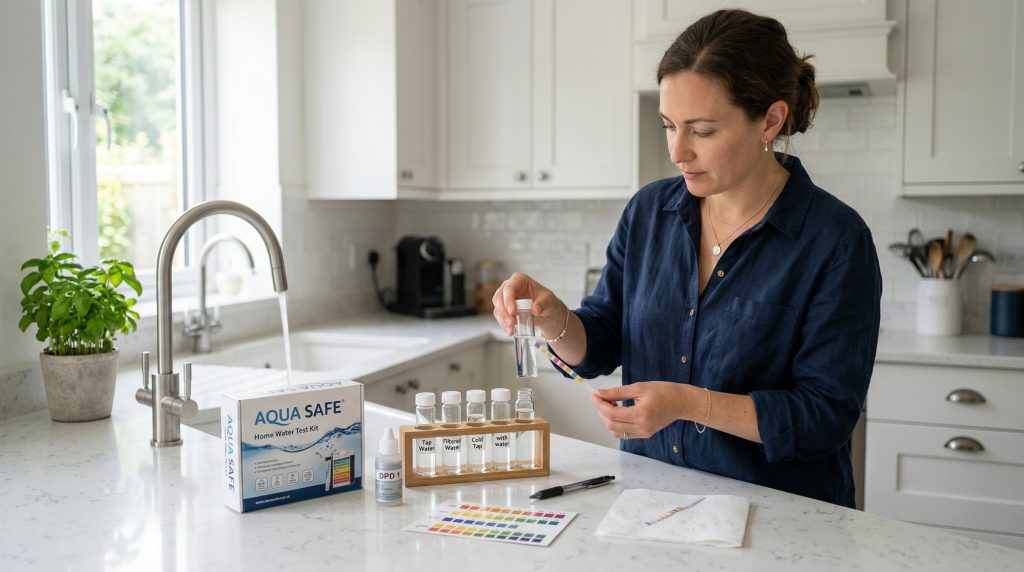
How to Test Your Home Water Quality: DIY and Lab Testing Guide

Quick Answer You can test home water quality using DIY test kits ($15-$50) for quick screening or certified laboratory testing ($50-$300) for comprehensive analysis. At minimum, test for bacteria, lead, nitrates, pH, and hardness. Well water owners should test annually. Municipal water users can start with their utility’s free Consumer Confidence Report, then test for contaminants of concern like lead (at the tap) and PFAS. Always test before purchasing a filtration system to ensure you buy the right one. Why Testing Your Water Matters You cannot determine water quality by looking at, smelling, or tasting your water. Many of the most dangerous contaminants — lead, arsenic, PFAS, nitrates, and bacteria — are invisible, odorless, and tasteless at concentrations that pose health risks. The only way to know what is in your water is to test it. The EPA regulates public water systems but does not regulate private wells. Approximately 23 million US households rely on private wells, and testing is the homeowner’s responsibility. Even on municipal water, contaminants like lead can enter water from household plumbing after it leaves the treatment plant. What to Test For Essential Tests for All Water Sources Contaminant EPA Limit (MCL) Why It Matters Test Frequency Total Coliform / E. coli 0 (zero tolerance) Indicates fecal contamination; immediate health risk Annually (well); as needed (city) Lead 15 ppb action level Neurotoxic; no safe level for children Once; after plumbing work Nitrate 10 mg/L Dangerous for infants; from fertilizer/septic Annually (well) pH 6.5-8.5 (SMCL) Affects corrosivity, pipe leaching Annually TDS (Total Dissolved Solids) 500 mg/L (SMCL) General water quality indicator Annually Hardness No EPA limit Scale buildup; soap efficiency Once; when issues arise Additional Tests Based on Your Situation PFAS — If you live near military bases, airports, or industrial facilities; EPA limit is 4 ppt for PFOA and PFOS Arsenic — Common in well water in certain regions (Southwest, New England); MCL is 10 ppb Iron and Manganese — If you notice staining, metallic taste (well water); SMCL 0.3 ppm / 0.05 ppm Radon — If your area has elevated radon in air; can dissolve into groundwater Volatile Organic Compounds (VOCs) — If you live near gas stations, dry cleaners, or industrial sites Pesticides/Herbicides — If you live in agricultural areas Fluoride — If you want to verify levels or remove it; SMCL is 2.0 mg/L DIY Home Water Test Kits Home test kits provide a quick, affordable screening of your water quality. They are available at hardware stores and online, typically ranging from $15-$50. Types of DIY Test Kits Test strips — Dip in water sample; color change indicates concentration. Quick (1-2 minutes) but least precise. Good for hardness, pH, chlorine, and basic screening. Drop/reagent kits — Add liquid reagents to water sample; color change is compared to a chart. More accurate than strips. Good for iron, hardness, pH, and specific contaminants. Digital TDS meters — Portable electronic devices that measure total dissolved solids. Inexpensive ($10-$20) and useful for monitoring RO system performance but does not identify specific contaminants. Mail-in kits — Collect samples at home and mail to a lab. Combines DIY convenience with lab accuracy. Typically $100-$200 for comprehensive panels. Certified Laboratory Testing For the most accurate and legally defensible results, use a state-certified laboratory. The EPA maintains a list of certified drinking water testing laboratories by state. Many state health departments also offer low-cost well water testing programs. What Lab Testing Costs Test Package What It Covers Typical Cost Basic well water panel Bacteria, nitrate, pH, hardness, TDS, iron $50-$100 Comprehensive panel Basic + lead, arsenic, manganese, fluoride, VOCs $150-$250 PFAS testing PFOA, PFOS, and other PFAS compounds $200-$400 Full environmental panel 100+ contaminants including pesticides, metals, VOCs $300-$600 How to Collect a Water Sample Proper sample collection is critical for accurate results. Follow these steps for the most reliable test. Use containers provided by the lab (or sterile containers for bacteria testing). Run the cold water faucet for 2-3 minutes before collecting to clear standing water. For lead testing, collect a first-draw sample before running water (lead accumulates while water sits in pipes). Do not touch the inside of the bottle or cap. Label each sample with date, time, and collection point. Deliver to the lab within 24-48 hours (bacteria samples within 6-24 hours depending on lab requirements). Keep samples cool during transport. Understanding Your Water Test Results Water test reports can be confusing. Key terms to understand include MCL (Maximum Contaminant Level, the legally enforceable limit set by EPA), MCLG (Maximum Contaminant Level Goal, the non-enforceable health-based goal, often zero for carcinogens), SMCL (Secondary Maximum Contaminant Level, aesthetic guidelines for taste, odor, and appearance), ppb or ug/L (parts per billion), and ppm or mg/L (parts per million, 1 ppm = 1,000 ppb). Compare each result against the EPA’s MCL. If any contaminant exceeds its MCL (or its MCLG for contaminants like lead where no level is truly safe), take action to address the contamination source and install appropriate water treatment. Key Takeaway: Testing is the essential first step before purchasing any water treatment system. A $50-$200 water test ensures you invest in the right filtration technology for your actual contaminants, rather than guessing and potentially spending hundreds of dollars on a system that does not address your specific water quality issues. Contact AMPAC Water Systems with your test results for a free system recommendation. Frequently Asked Questions How can I test my water quality at home for free? If you are on municipal water, request your utility’s Consumer Confidence Report (CCR), which is published annually and available for free. This shows treatment plant results but not conditions at your tap. For a truly free home test, some water treatment companies offer complimentary basic testing (hardness, pH, chlorine, iron, TDS) as part of a consultation. Digital TDS meters are reusable and cost under $15. How accurate are home water test kits? DIY test strips are useful for general screening but have limited precision, typically plus or minus 20-30%. Reagent-based

How to Test Your Home Water Quality: DIY and Lab Testing Guide Read More »

Iron contamination in well water comparison with filtered water

Iron in Well Water: Causes, Health Effects, and Removal Methods

Quick Answer Iron in well water is caused by naturally occurring iron deposits in soil and rock dissolving into groundwater. While iron is not a health hazard at typical well water levels (0.3-10+ ppm), it causes orange/brown staining on fixtures and laundry, metallic taste, clogged pipes, and can support iron bacteria growth. The most effective removal methods include oxidation + filtration (for high iron), water softeners (for low ferrous iron under 2 ppm), and specialized iron filter media like Birm or Greensand Plus. Why Does Well Water Have Iron? Iron is the fourth most abundant element in the earth’s crust, so it is no surprise that groundwater frequently dissolves iron as it percolates through soil and rock formations. The concentration of iron in well water depends on local geology, water table depth, soil composition, and the well’s aquifer characteristics. The EPA has set a Secondary Maximum Contaminant Level (SMCL) of 0.3 mg/L (0.3 ppm) for iron in drinking water. This is not a health-based standard but an aesthetic guideline. Iron above 0.3 ppm causes visible staining, taste changes, and plumbing issues. Many wells produce water with 1-10+ ppm of iron, far exceeding this threshold. Types of Iron in Well Water Understanding which type of iron you have is essential for choosing the correct removal method. Ferrous Iron (Clear-Water Iron) Ferrous iron (Fe2+) is dissolved in water and invisible when first drawn from the well. The water appears clear but turns orange or brown after sitting exposed to air for several minutes as the iron oxidizes. This is the most common form in well water and is the easiest to treat. Ferric Iron (Red-Water Iron) Ferric iron (Fe3+) has already oxidized and appears as visible orange-brown particles or cloudiness immediately when drawn from the well. Ferric iron can be removed with sediment filtration or mechanical filtration, though the underlying ferrous iron source typically also needs treatment. Iron Bacteria Iron bacteria are microorganisms that feed on dissolved iron, creating a slimy, rust-colored biofilm inside pipes, well casings, and fixtures. Signs include a reddish-brown slime in toilet tanks, musty or swampy odor (different from hydrogen sulfide), and reduced well yield over time. Iron bacteria require specific treatment including well shock chlorination and ongoing disinfection. Organic (Complexed) Iron When iron bonds with tannins or other organic compounds in the water, it forms organic iron that gives water a tea-colored or yellow appearance. This form is difficult to treat with standard oxidation methods and may require specialized media, chlorination, or activated carbon treatment. Health Effects and Problems Caused by Iron Iron in drinking water is generally not considered a health risk by the World Health Organization at concentrations commonly found in well water. However, it causes numerous practical problems including orange-brown staining on sinks, toilets, tubs, and laundry (especially whites), metallic taste that affects drinking water and cooking, staining on dishes washed in a dishwasher, buildup inside pipes that reduces water flow over time, shortened lifespan for water heaters and appliances, and promotion of iron bacteria that clog well screens and plumbing. Iron Removal Methods Compared Method Iron Types Removed Effective Range Pros Cons Water Softener Ferrous only 0-2 ppm Also removes hardness; common Iron fouls resin above 2 ppm Birm Filter Ferrous 0-10 ppm No chemicals; long media life Requires pH above 6.8; needs dissolved oxygen Greensand Plus Ferrous, ferric, manganese 0-15 ppm Effective; handles hydrogen sulfide Requires potassium permanganate regeneration Aeration + Filtration Ferrous, ferric 0-30+ ppm Chemical-free; handles very high iron Requires air injection system; more complex Chlorination + Filtration All types including bacteria 0-30+ ppm Most thorough; kills iron bacteria Requires chemical handling; carbon post-filter needed Sediment Filter Ferric (particulate) only Visual particles Inexpensive; simple Does not remove dissolved iron Choosing the Right Iron Removal System Low Iron (Under 2 ppm Ferrous) A standard water softener with iron-rated resin can handle low levels of ferrous iron while simultaneously removing hardness. Use an iron-cleaning resin cleaner monthly to prevent fouling. This is the simplest and most cost-effective approach for low-iron well water. Moderate Iron (2-10 ppm) Install a dedicated iron removal filter upstream of your water softener. Birm or Greensand Plus media systems are the most popular choices. Birm requires no chemicals but needs adequate dissolved oxygen and pH above 6.8. Greensand Plus is more versatile but requires periodic regeneration with potassium permanganate. High Iron (10+ ppm) or Iron Bacteria High iron levels require more aggressive treatment. Air injection (aeration) systems oxidize iron without chemicals and can handle 15-30+ ppm. For iron bacteria, chemical chlorination followed by carbon filtration is the most reliable approach. These systems should be designed by a water treatment professional. Testing for Iron in Well Water Accurate testing is essential. DIY test strips provide a rough estimate but lack the precision needed for system sizing. For the best results, submit a sample to a state-certified laboratory. Request a test that includes total iron, ferrous and ferric iron breakdown, manganese, pH, hardness, and TDS. Many state health departments offer low-cost well water testing programs. Key Takeaway: Iron in well water is a treatable problem, but the right solution depends on the type and concentration of iron, your water’s pH, and whether iron bacteria are present. Always test before buying equipment. A $50 water test can save you from installing a $1,500 system that does not address your specific iron problem. Contact AMPAC Water Systems for help interpreting your well water test results. Frequently Asked Questions Is iron in well water dangerous to drink? Iron in well water at typical concentrations (0.3-10 ppm) is not considered a health risk. The EPA’s 0.3 ppm guideline is based on aesthetic concerns (taste, staining), not health effects. However, very high iron levels can cause digestive discomfort in some individuals, and iron bacteria can indicate unsanitary well conditions that warrant further investigation. Why does my well water turn orange when it sits? This indicates ferrous (dissolved) iron in your water. When water is drawn from the well, the iron is invisible. Exposure to

Iron in Well Water: Causes, Health Effects, and Removal Methods Read More »

We Accept: VISA MasterCard AMEX Discover PayPal Authorize.net

© 2026 AMPAC Water Systems. All rights reserved. Manufactured in North America.

✓ 30+ Years Experience ✓ NSF Certified ✓ 500+ Installations Worldwide
Shopping Cart
A division of AMPAC USA - Commercial & Industrial Water Treatment Systems
Get a Free Quote
☎ Call (909) 548-4900
Ampac  Water Systems
Privacy Overview

This website uses cookies so that we can provide you with the best user experience possible. Cookie information is stored in your browser and performs functions such as recognising you when you return to our website and helping our team to understand which sections of the website you find most interesting and useful.