water-scarcity

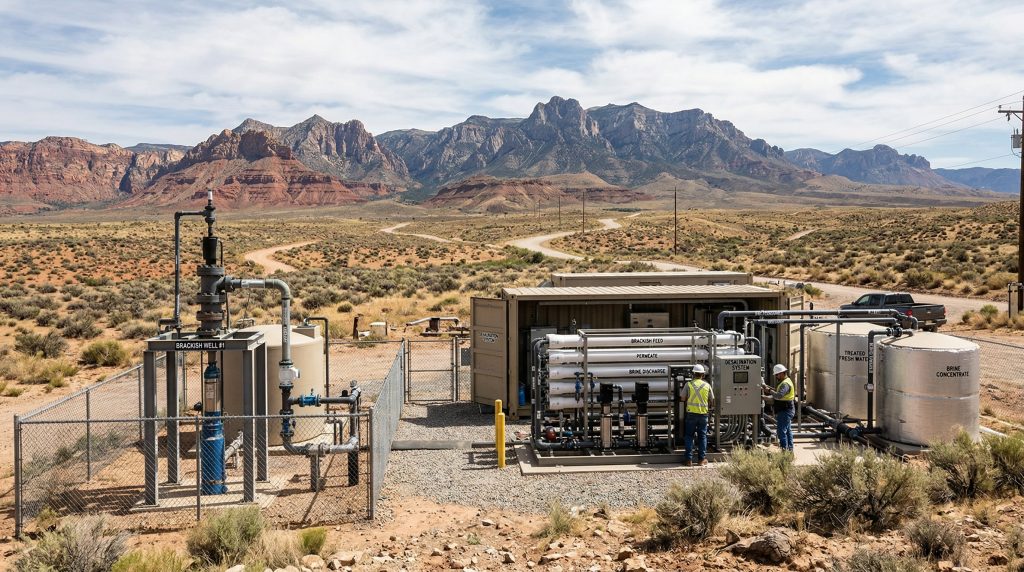
Brackish water desalination in Utah landscape

Brackish Water Desalination: Utah’s Untapped Water Source

What Is Brackish Water, and Why Does It Matter for Utah? Brackish water occupies the salinity range between freshwater and seawater—typically 1,000 to 10,000 parts per million (ppm) total dissolved solids (TDS), compared to less than 500 ppm for drinking water and 35,000 ppm for ocean water. It is too salty to drink or irrigate with, but far less salty than the ocean. And there is an enormous amount of it sitting beneath the Western United States. The U.S. Geological Survey (USGS) published a landmark assessment of the nation’s brackish groundwater resources, identifying brackish aquifers in 41 states. The total volume is staggering: an estimated 800 times the amount of fresh groundwater pumped in the United States each year. For a region locked in a multi-decade megadrought, this represents a resource that has been almost entirely overlooked. Utah is particularly well-positioned. The state contains extensive brackish groundwater formations in the Great Basin, the Uinta Basin, the Sevier Desert, and along portions of the Wasatch Front. These aquifers contain water with TDS levels ranging from 1,000 to over 35,000 ppm, with large volumes in the treatable 1,500–5,000 ppm range that is ideal for reverse osmosis desalination. How Severe Is Utah’s Water Challenge? Utah is the second-driest state in the nation by average annual precipitation, receiving just 13.2 inches per year according to the Western Regional Climate Center. Despite this, Utah has one of the highest per-capita water consumption rates in the country—approximately 220 gallons per person per day for residential use alone, roughly double the national average. The math does not work indefinitely. Utah’s population, currently around 3.4 million, is projected to reach 5.4 million by 2060 according to the Kem C. Gardner Policy Institute at the University of Utah. That growth, combined with declining snowpack and the ongoing crisis at the Great Salt Lake, is forcing a fundamental rethinking of the state’s water portfolio. The Great Salt Lake has declined to historically low levels, losing roughly two-thirds of its water since the late 1980s. The exposed lakebed contains heavy metals including arsenic and mercury, which become airborne dust during wind events, posing a public health risk to the Wasatch Front’s 2.5 million residents. The state legislature has responded with emergency water conservation measures, but conservation alone cannot close the supply-demand gap. Brackish desalination offers something that conservation, water transfers, and cloud seeding cannot: a new source of supply. And unlike seawater desalination, it does not require building pipelines to the coast. Where Are Utah’s Brackish Groundwater Resources? USGS mapping has identified several significant brackish aquifer systems in Utah: The Great Basin Aquifer System Covering much of western Utah, the Great Basin contains extensive basin-fill aquifers with brackish water at relatively shallow depths. TDS concentrations typically range from 1,000 to 10,000 ppm, with some areas exceeding 35,000 ppm near the Great Salt Lake. Communities in Tooele County, Millard County, and Box Elder County sit directly above accessible brackish formations. The Uinta Basin Northeastern Utah’s Uinta Basin contains brackish water associated with both the basin-fill aquifer system and deeper formations connected to oil and gas producing zones. Water quality varies widely, with TDS from 2,000 to over 20,000 ppm. The significant produced water volumes from the basin’s energy operations also represent a potential feed source for desalination. The Wasatch Front Along the urbanized corridor from Ogden to Provo, deeper aquifer zones contain brackish water beneath the shallow freshwater aquifers that currently supply much of the region’s groundwater. As freshwater aquifer levels decline, brackish desalination of these deeper zones becomes an increasingly practical supplement to existing supply. The Sevier Desert Central Utah’s Sevier Desert region contains substantial brackish groundwater resources. Several agricultural communities in this area already face water quality challenges from rising salinity in their existing wells, making desalination treatment a near-term necessity regardless of new supply development. What Does Brackish Desalination Cost Compared to Alternatives? Cost is where brackish desalination makes its strongest case. Because brackish water has significantly lower salinity than seawater, it requires far less energy to desalinate. Lower operating pressure means smaller pumps, less energy, and longer membrane life. Water Source Cost per Acre-Foot Energy (kWh/acre-foot) Practical for Utah? Brackish groundwater desalination $357–$782 800–2,600 Yes—local resource, proven technology Seawater desalination $1,000–$2,500 4,000–6,500 No—Utah is landlocked, pipeline costs prohibitive Colorado River (current allocation) $150–$400 Variable Limited—allocations fully subscribed, declining flows Long-distance pipeline transfer $1,200–$3,000+ 2,000–5,000 (pumping) Possible but extremely expensive and politically complex Agricultural water rights transfer $500–$2,000+ N/A Yes, but limited volume and socioeconomic impacts The Bureau of Reclamation’s desalination cost data, drawn from its research program funding 31 projects totaling $29 million, consistently shows brackish desalination as one of the lowest-cost options for developing new water supply in the inland Western states. When compared to the full lifecycle cost of long-distance water transfers or new reservoir construction, brackish desalination is highly competitive. How Does Brackish RO Technology Work? The core technology is reverse osmosis, the same membrane-based separation process used in seawater desalination but operating under significantly different conditions. Operating Pressure and Energy Brackish RO systems typically operate at 100–300 psi, compared to 800–1,200 psi for seawater systems. This pressure difference translates directly to energy savings. Specific energy consumption for brackish RO ranges from 0.5 to 2.5 kWh per cubic meter of product water, compared to 3.0–5.0 kWh/m³ for seawater RO (with energy recovery). For a municipal-scale brackish desalination plant producing 1 million gallons per day (MGD), annual energy costs at $0.08/kWh would be approximately $55,000–$275,000. The same volume from seawater desalination would cost $330,000–$700,000 in energy alone. Recovery Rates Brackish RO systems achieve higher water recovery rates than seawater systems—typically 75–90% compared to 40–50% for seawater. This means less concentrate (brine) to manage, which is a significant advantage for inland facilities where ocean discharge is not an option. High-recovery brackish systems using interstage chemical treatment or concentrate recycling can push recovery to 90–95%, minimizing the volume of concentrate requiring disposal. Membrane Selection Brackish water RO membranes are formulated differently than seawater membranes. They use thinner

Brackish Water Desalination: Utah’s Untapped Water Source Read More »
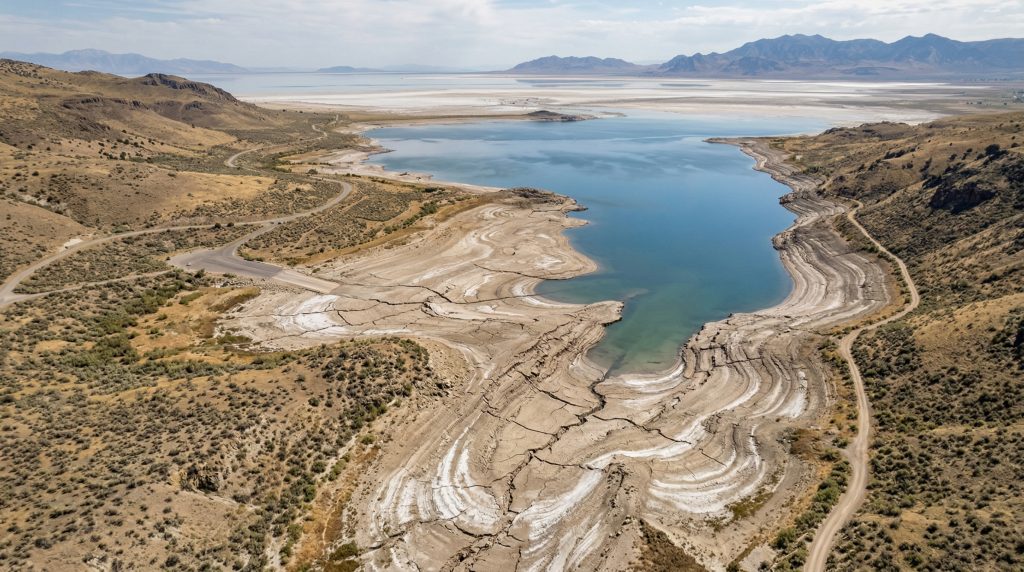
Utah drought conditions affecting water reservoirs

Utah’s Record Drought: What It Means for Commercial Water Systems

How Bad Is Utah’s Drought, and Why Should Businesses Care? Utah’s drought is not a single event. It is a long-duration climate pattern that has been compounding since 2020. The U.S. Drought Monitor has classified large portions of the state under D2 (Severe) to D3 (Extreme) drought conditions for much of the past five years. According to the Utah Division of Water Resources, statewide snowpack levels dropped below 75% of the 30-year median for three consecutive years between 2020 and 2023, and reservoir storage across the state fell to levels not seen since the mid-1960s. For commercial and industrial water users along the Wasatch Front—the corridor stretching from Ogden to Provo that contains over 80% of the state’s population and economic activity—this is not an abstract environmental concern. It is a direct operational risk. Municipal water providers including the Jordan Valley Water Conservancy District, Weber Basin Water Conservancy District, and Salt Lake City Department of Public Utilities have all implemented tiered conservation mandates. Stage 2 advisories require commercial users to cut consumption by 15-25%, with surcharges applied for overuse. Businesses that depend on water—food processing facilities, manufacturing plants, data centers, laboratories, hospitality operations, and healthcare institutions—face a choice: comply with restrictions and reduce output, or invest in water treatment technology that makes them more self-sufficient. What Is Happening to the Great Salt Lake? The Great Salt Lake has become the most visible indicator of Utah’s long-term water crisis. In November 2022, the lake dropped to a historic low of 4,188.5 feet above sea level—the lowest point since record-keeping began in 1847. While modest inflows during the 2023 and 2024 spring snowmelt seasons provided temporary relief, the lake remains well below the ecological health threshold of 4,198 feet identified by the Great Salt Lake Advisory Council. The implications extend far beyond ecology. The exposed lakebed contains arsenic, heavy metals, and fine particulate matter. When wind events mobilize this dust across the Salt Lake Valley, air quality deteriorates, creating public health risks for the 1.2 million people living along the Wasatch Front. A 2023 study published in Nature Geoscience found that arsenic concentrations in lakebed dust exceeded EPA screening levels by a factor of five in some sampling locations. For businesses, the Great Salt Lake crisis reinforces a broader message: water scarcity in Utah is not temporary. The tributaries that feed the lake—the Bear, Weber, and Jordan Rivers—are the same sources that supply municipal and industrial water along the Wasatch Front. When the lake shrinks, it means upstream diversions are consuming nearly everything, and there is less margin for everyone. How Do Water Restrictions Affect Commercial Operations? Commercial water restrictions during drought take several forms, and each one can directly impact a facility’s ability to operate at full capacity: Outdoor Water Bans and Landscape Restrictions Hotels, corporate campuses, and commercial properties are typically the first targets. Landscape irrigation bans can affect property appearance and value, but for most businesses, this is manageable. The harder restrictions follow. Allocation Caps and Surcharges Under Stage 2 and Stage 3 drought advisories, water districts can impose hard allocation caps on commercial accounts based on historical usage baselines. In the Weber Basin district, commercial users exceeding their allocation face surcharges of 200-400% on overage volumes. For a food processing plant using 50,000 gallons per day, a 20% mandatory reduction means either scaling back production or finding alternative water sources. Cooling Tower and Process Water Restrictions HVAC cooling towers and industrial process water circuits represent the largest single category of commercial water consumption. A typical 500-ton cooling tower consumes 1,800-2,400 gallons per hour during peak operation. When water districts restrict once-through cooling or limit blowdown volumes, facilities must either retrofit their systems for higher efficiency or risk thermal shutdowns during peak summer demand. Construction Water Moratoria During severe drought, some jurisdictions limit or suspend water connections for new construction. This has direct consequences for Utah’s fast-growing commercial real estate market, particularly along the Point of the Mountain corridor between Salt Lake City and Provo. What Water Treatment Strategies Build Drought Resilience? The good news is that proven, commercially available water treatment technologies can dramatically reduce a facility’s dependence on municipal water supplies. These are not experimental systems. They are standard industrial equipment that thousands of facilities across the Western US already operate. On-Site Reverse Osmosis for Process Water Commercial reverse osmosis systems can treat a range of alternative source waters—brackish groundwater, collected rainwater, or recycled process water—to produce high-purity water that meets or exceeds municipal standards. For facilities in Utah’s Wasatch Front, brackish aquifer water is often available at depths of 200-500 feet. This water typically has TDS levels of 2,000-5,000 mg/L, well within the treatment range of standard brackish water RO systems. A properly sized commercial RO system producing 10,000-50,000 gallons per day can supply a mid-size manufacturing facility, data center, or hospitality complex with a self-contained water source that is independent of municipal restrictions. The reject stream (concentrate) from brackish water RO is typically 15-25% of feed volume and can often be discharged to sanitary sewer under standard pretreatment permits. Water Recycling and Reuse Systems For facilities that already consume large volumes of water, the most cost-effective drought resilience strategy is often to recycle what they already have. Commercial water reuse systems combine filtration, biological treatment, and RO polishing to recover 70-85% of wastewater streams for non-potable reuse. Common applications include: Cooling tower makeup: Recycled water reduces municipal makeup demand by 50-70%. Rinse water recovery: Manufacturing and food processing facilities can reclaim rinse and wash-down water for reuse in initial wash stages. Boiler feed pre-treatment: RO-polished recycled water meets the quality requirements for medium-pressure boiler feed, reducing both water and chemical costs. Landscape irrigation: Treated greywater can maintain landscaping even during outdoor water bans, provided local permits are in place. Cooling Tower Optimization Because cooling towers represent such a large share of commercial water consumption, optimizing their water efficiency delivers outsized returns during drought. Key strategies include: Increasing cycles of concentration: By improving makeup water

Utah’s Record Drought: What It Means for Commercial Water Systems Read More »

We Accept: VISA MasterCard AMEX Discover PayPal Authorize.net

© 2026 AMPAC Water Systems. All rights reserved. Manufactured in North America.

✓ 30+ Years Experience ✓ NSF Certified ✓ 500+ Installations Worldwide
Shopping Cart
A division of AMPAC USA - Commercial & Industrial Water Treatment Systems
Get a Free Quote
☎ Call (909) 548-4900
Ampac  Water Systems
Privacy Overview

This website uses cookies so that we can provide you with the best user experience possible. Cookie information is stored in your browser and performs functions such as recognising you when you return to our website and helping our team to understand which sections of the website you find most interesting and useful.