
So, you need clean, safe water for your business. Maybe it’s for a busy restaurant, a growing hotel, or a critical manufacturing process. A commercial reverse osmosis (RO) system is often the answer. These powerful units are built for continuous, high-volume water purification in demanding business and industrial settings. Getting the right size—measured in gallons per day (GPD)—is absolutely critical. It hinges on your daily water demand, the quality of your incoming feed water, how much contamination you need to remove, and those peak flow requirements. This guide will give you the straight talk on how to pick the perfect commercial RO system for your operation, without all the tech jargon.
What Is a Commercial RO System?
At its core, reverse osmosis is a membrane separation process. Think of it like a super-fine filter that pushes water under pressure through a semi-permeable membrane. This membrane is smart: it lets clean, purified water (we call that ‘permeate’) pass through, but it blocks dissolved solids, nasty contaminants, and microorganisms. What gets left behind? A concentrated waste stream (brine or concentrate) that’s either sent down the drain or treated further.
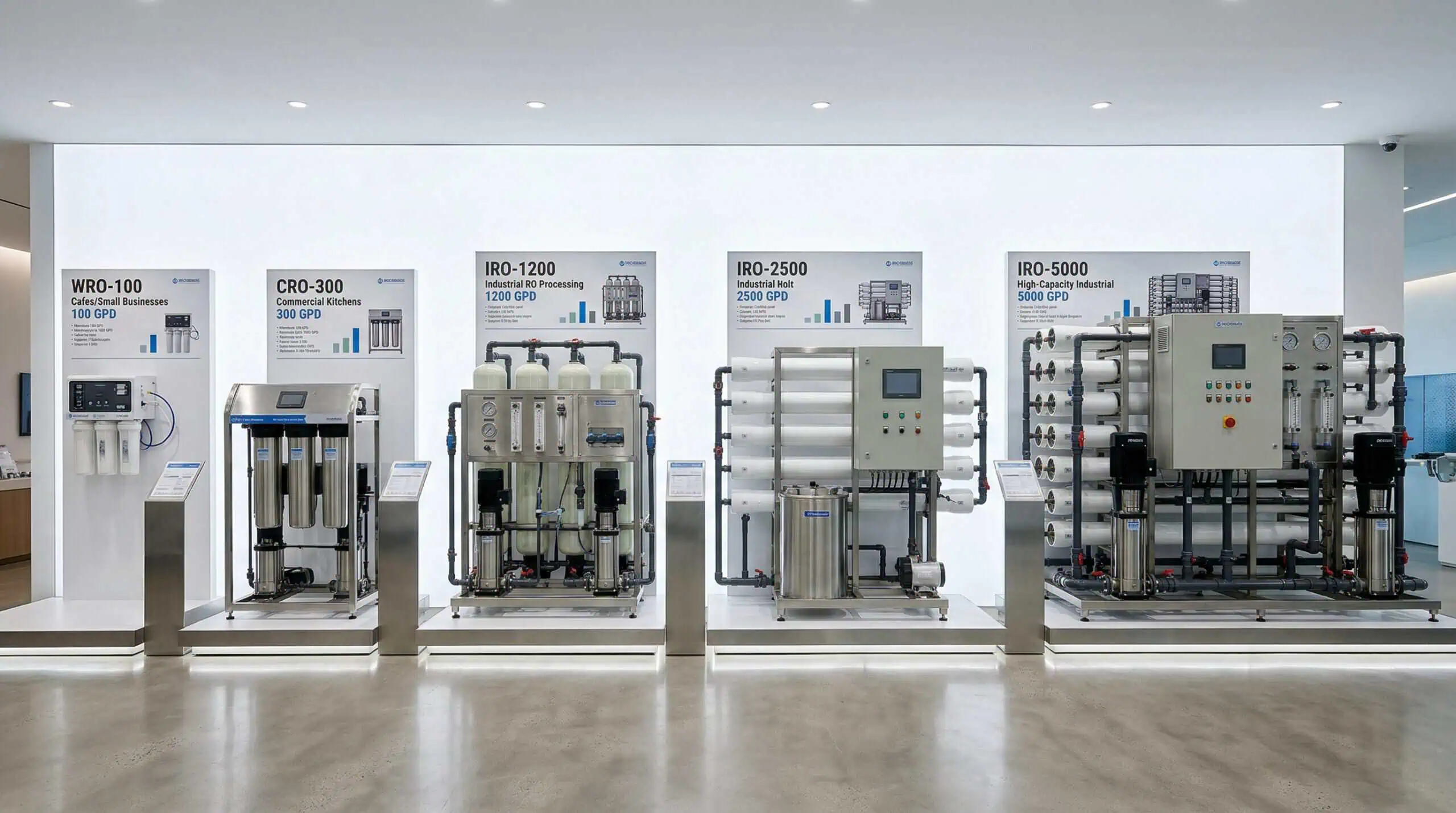
Now, commercial RO systems are a different beast entirely from what you might have under your kitchen sink. They’re bigger, tougher, and designed for heavy-duty work. A home RO unit might crank out 50–100 GPD. Commercial systems? They start around 500 GPD and can easily scale up to millions of GPD for massive industrial sites. These aren’t just scaled-up residential units; they’re engineered from the ground up for continuous, 24/7 operation, with automated controls, remote monitoring capabilities, and built to meet specific industry standards. We’re talking about things like NSF/ANSI 61 for materials that contact drinking water, or the strict FDA cGMP requirements for food and pharmaceutical production.
What makes one of these systems tick? Key components include a robust sediment pre-filter, a carbon pre-filter (especially vital if you have chlorinated water), an antiscalant dosing system to protect membranes, a powerful high-pressure pump, the RO membrane array itself, a permeate storage tank (or a direct-flow setup), and often some post-treatment—think UV sterilization, remineralization, or pH adjustment. Plus, you get an automated control panel with full data logging; it’s like the brain of the whole operation.
How to Size Your Commercial RO System
Honestly, getting the sizing right is the single most important factor. Seriously, it’s where most folks go wrong. An undersized system? It’ll constantly be playing catch-up, creating production bottlenecks, and forcing those expensive membranes to work harder than they should. That means faster fouling and premature failure. On the flip side, an oversized system just wastes your capital, eats up more energy than necessary, and drives up maintenance costs. Nobody wants that.
Here’s the thing: the fundamental sizing calculation isn’t rocket science. It’s: Required GPD = (Daily water demand / System recovery rate) x Safety factor. Let’s say you’re a restaurant that needs 800 gallons of purified water per day, and your RO system operates at a 75% recovery rate. We generally add a 1.25 safety factor for good measure. That means you’d be looking for a system rated at roughly 1,333 GPD. It’s a simple formula, but easy to overlook the details.
The table below offers some general starting points based on application. What we’ve found is that these ranges give you a good idea of where to begin:
| Application | Typical GPD Range | Notes |
|---|---|---|
| Restaurant / Cafe | 500 – 2,000 GPD | Ice machines, coffee, food prep, steam equipment |
| Hotel / Resort | 2,000 – 10,000 GPD | Laundry, kitchen, pool/spa makeup water |
| Car Wash | 1,000 – 5,000 GPD | Spot-free rinse; TDS below 50 ppm typical target |
| Light Industrial | 5,000 – 50,000 GPD | Process water, cooling tower makeup, boiler feedwater |
| Food and Beverage Manufacturing | 10,000 – 500,000 GPD | Product water, CIP, bottling lines |
| Pharmaceutical / Lab | 5,000 – 200,000 GPD | Often followed by DI polishing to USP Purified Water spec |
Keep in mind, these are just starting points. A detailed water audit is non-negotiable. That means actually measuring your daily consumption, noting peak demand periods, and accounting for seasonal variations. This real-world data should always drive the final system specification. In our experience, skipping this step leads to headaches down the road.
Key Specifications to Evaluate
When you’re comparing commercial RO systems, some specifications stand out as absolutely critical. Don’t gloss over these:
TDS Rejection Rate
Most standard commercial RO membranes will achieve a 95–99% TDS rejection. But here’s a crucial point: always verify that these specs are based on standardized test conditions—usually 250 ppm NaCl, 77 degrees F, and 150 psi. In the real world, your rejection rate might be a bit lower. Why? Factors like feed water temperature, overall TDS load, and even the age of your membranes all play a role. For those applications demanding super low permeate TDS—think pharmaceutical or semiconductor manufacturing—you’ll want to specify membranes rated at 99%+ rejection. You might also need to design for a two-pass RO system or add a downstream polishing step.
System Recovery Rate
The recovery rate simply tells you what percentage of your incoming feed water gets converted into usable, purified permeate. Standard commercial RO systems typically run at 65–80% recovery. Pushing for higher recovery sounds great—it means less water waste and lower operating costs—but it also ramps up the potential for scaling on your membranes. If you’re dealing with feed water that’s high in hardness or sulfates, you absolutely need antiscalant dosing. You might even be limited to lower recovery rates to prevent costly membrane damage. (Trust me, replacing a fouled membrane is not a fun job.)
Membrane Count and Array Configuration
Commercial systems almost always use standard 4-inch or 8-inch diameter membrane elements, housed in pressure vessels. The way these elements are arranged—what we call the ‘array configuration’ (like a 2:1 arrangement)—is key. It dictates the flow balance and pressure profile across the entire system. Larger systems will use multiple pressure vessels, often in both parallel and series setups, to optimize recovery and keep energy consumption as low as possible. It’s a delicate balance to get right.
Operating Pressure
The TDS level of your feed water directly impacts how much pressure you’ll need. For brackish water systems (that’s water with 1,000–10,000 ppm TDS), you’re typically looking at 150–400 psi. Seawater desalination, on the other hand, demands a whopping 800–1,200 psi. More pressure means higher energy costs, period. So, a precise feed water analysis isn’t just a suggestion; it’s essential for accurately modeling energy usage and specifying the right pump. This directly impacts your monthly utility bill.
Automated Controls
Any commercial system worth its salt should come with robust automated controls. We’re talking about automated flush cycles, low-pressure shutdowns, high-pressure alarms, continuous permeate quality monitoring (via conductivity sensors), and data logging for regulatory compliance. Modern systems have really stepped up their game, offering remote monitoring through SCADA or cloud-connected HMI interfaces. We’ve had clients, like a hotel manager in Phoenix, who can check their system’s performance and water quality from their phone while on vacation. That’s peace of mind right there.
Industries Using Commercial RO Systems
Commercial RO technology is incredibly versatile. It serves a huge range of industries, each with its own unique water quality demands and operational needs:
Food and Beverage: This is a big one. RO is absolutely essential for process water, beverage production (think beer, soft drinks, bottled water—we’ve installed systems for major bottling plants in California), dairy processing, and clean-in-place (CIP) systems. FDA and NSF compliance isn’t just nice-to-have; it’s mandatory. Consistent, low-TDS water quality is the backbone of product consistency here.
Hospitality: Hotels and resorts use RO for everything from drinking water and ice production to kitchen operations and laundry. It drastically reduces scale buildup in expensive equipment like dishwashers and boilers, extending their lifespan. Plus, improved water quality means better-tasting coffee and cleaner laundry for guests. It’s a win-win for operations and guest experience.
Pharmaceutical and Life Sciences: Here, we’re talking about ultra-high purity. USP Purified Water and Water for Injection (WFI) standards demand incredibly low TDS, strict endotoxin control, and microbial purity. RO is always the primary purification step in these systems, usually followed by electrodeionization (EDI) and UV disinfection to hit those stringent targets.
Manufacturing: Whether it’s boiler feedwater, cooling tower makeup, or process rinsing in electronics, metal finishing, or automotive plants, RO-treated water delivers big benefits. Removing hardness and silica from boiler feedwater, for instance, dramatically cuts down on scale, maintenance costs, and energy consumption. We often see a quick ROI in this sector just from reduced downtime.
Healthcare: Hospitals and dialysis centers rely on high-purity water for critical applications like dialysate preparation, sterilizer feedwater, and laboratory use. AAMI standards strictly govern dialysis water quality, and RO is the go-to, recognized treatment technology for meeting them.
Total Cost of Ownership
Here’s the reality check: the sticker price of a commercial RO system is just the beginning. To truly understand its value, you need to look at the total cost of ownership (TCO). A realistic TCO analysis should factor in everything:
- Capital cost: This covers the equipment itself, installation, and commissioning. Expect anywhere from $5,000 for a smaller system to well over $150,000 for larger, more complex setups.
- Energy: Those high-pressure RO pumps are typically your biggest energy hog. Budget roughly $0.25–$0.75 per 1,000 gallons of permeate produced. This varies quite a bit depending on your feed water TDS and the operating pressure needed.
- Membrane replacement: Membranes aren’t forever. They generally last 3–5 years. Plan on budgeting $150–$400 per 8-inch membrane element. How often you swap them out depends heavily on your feed water quality and how well you operate the system.
- Pre-filter consumables: Sediment and carbon pre-filters are your first line of defense. They need regular replacement—typically every 3–6 months—depending on how dirty your feed water is and its chlorine levels. (Don’t skimp here; it protects your membranes!)
- Chemical costs: Antiscalant, cleaning chemicals for CIP, and pH adjustment reagents can add another $0.05–$0.20 per 1,000 gallons.
- Waste water: This is often overlooked. Your reject stream will account for 20–35% of your total feed water consumption in a well-designed system. You need to factor in the cost of this water and its proper disposal.
Frequently Asked Questions
How do I calculate the right size commercial RO system?
Required GPD = (daily water demand / system recovery rate) x safety factor. For example, an 800 GPD demand at 75% recovery with a 1.25 safety factor works out to roughly 1,333 GPD.
What’s the typical recovery rate for a commercial RO system?
65-80% is standard. Higher recovery reduces water waste but increases scaling risk on membranes, especially with hard or high-sulfate feed water.
How much does a commercial RO system cost?
Capital costs range from about $5,000 for smaller systems to over $150,000 for larger, more complex setups. Budget roughly $0.25-$0.75 per 1,000 gallons of permeate for energy.
How long do commercial RO membranes last?
Typically 3 to 5 years, with replacement costing $150-$400 per 8-inch element depending on feed water quality.
What operating pressure does a commercial RO system need?
150-400 psi for brackish water (1,000-10,000 ppm TDS); seawater desalination needs 800-1,200 psi.