When Disaster Strikes, Clean Water Becomes the First Priority
Within 72 hours of a major disaster—hurricane, earthquake, tsunami, or armed conflict—contaminated water becomes a bigger killer than the event itself. The WHO estimates that waterborne diseases cause roughly 485,000 diarrheal deaths per year globally, with a disproportionate spike during and after emergencies. Cholera outbreaks following the 2010 Haiti earthquake, the 2004 Indian Ocean tsunami, and cyclone-impacted regions of East Africa have demonstrated this pattern repeatedly.
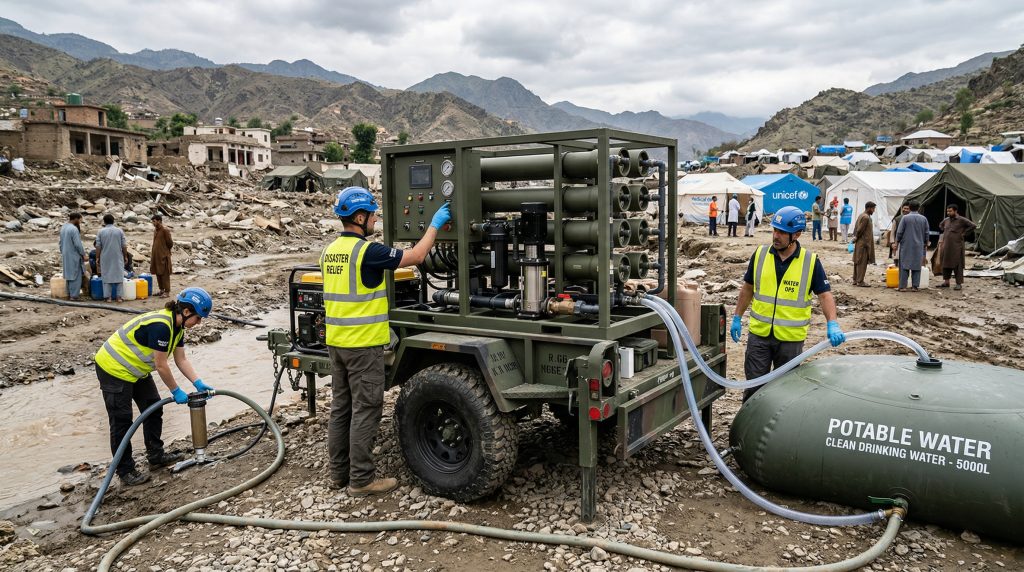
The challenge isn’t theoretical. When municipal water treatment plants are damaged or destroyed, when power grids are down, when sewage systems have failed and contaminated every available freshwater source, you need portable water purification systems that can be deployed fast, operate in austere conditions, and produce enough safe drinking water to sustain a displaced population.
Portable reverse osmosis systems have become the backbone of emergency water response for military forces, humanitarian organizations, and civil defense agencies worldwide. This article covers the technology, the specifications, and the operational realities of deploying RO systems when everything else has failed.
Military ROWPU Systems: The Gold Standard for Portable Desalination
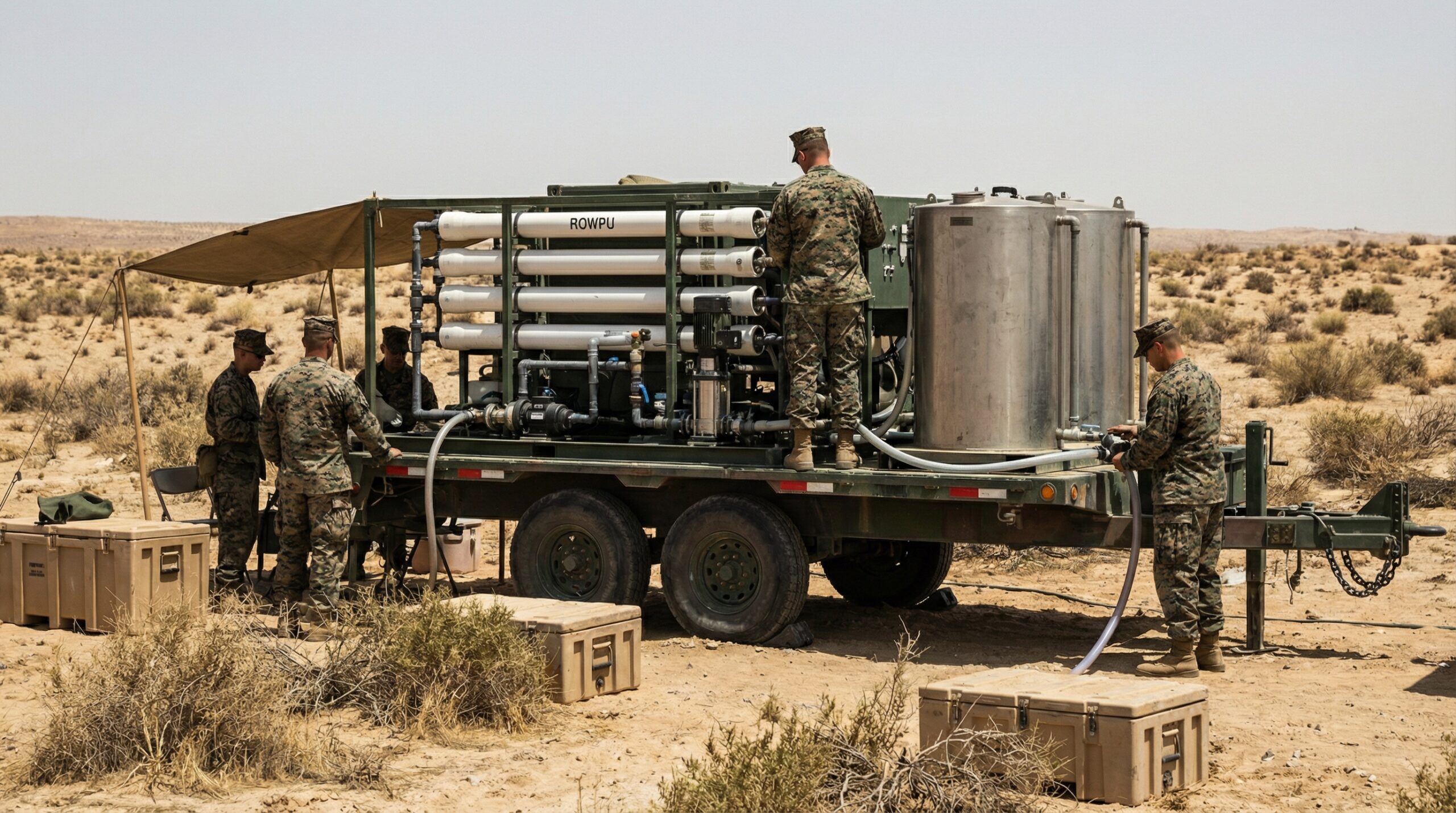
The U.S. military has been operating Reverse Osmosis Water Purification Units (ROWPUs) since the 1980s, and the technology has become standard across NATO and allied forces. Military specifications for these systems are worth understanding because they represent the most demanding requirements for portable water treatment.
Current Military System Classes
Lightweight Water Purifier (LWP): The smallest military RO system, producing 75-125 gallons per hour from freshwater, brackish, or seawater sources. Transportable by two soldiers. Designed for platoon-to-company-level operations (50-200 personnel). Weighs approximately 100-150 lbs for the core unit.
Tactical Water Purification System (TWPS): Mid-range system producing 1,500-3,000 GPH from any water source including nuclear, biological, and chemical (NBC) contaminated water. Trailer-mounted, towable by a HMMWV or equivalent vehicle. Serves battalion-level operations (500-1,500 personnel). The TWPS replaced the older 600 GPH ROWPU and incorporates advanced pre-treatment including ultrafiltration.
Containerized ROWPU: Housed in a standard 20-foot ISO container, these systems produce 10,000-75,000 GPD and can treat virtually any water source. Transportable by truck, rail, ship, or C-130/C-17 aircraft. Intended for brigade-level and above operations, refugee camps, and semi-permanent installations.
Military Water Quality Standards
Military field water quality standards are defined in TB MED 577 and are actually more stringent than EPA drinking water standards in several parameters:
- Total dissolved solids: <1,000 ppm (short-term), <500 ppm (long-term)
- Turbidity: <1 NTU
- Free chlorine residual: 2 ppm (maintained for distribution)
- Zero detectable coliforms
- NBC contaminant removal capability (for TWPS and larger systems)
These specs provide a useful benchmark for civilian disaster relief operations as well. If a portable RO system meets military field water standards, it’s more than adequate for any humanitarian application.
Civilian Disaster Relief: Rapid Deployment RO Systems
Military ROWPUs are purpose-built and expensive. For civilian disaster relief organizations, NGOs, and municipal emergency management agencies, the focus is on systems that balance capability with cost, logistics simplicity, and operator skill requirements.
Containerized Systems
The most versatile format for disaster relief is the containerized water treatment plant—a complete treatment system housed in a standard shipping container. A 20-foot container can hold a system producing 10,000-50,000 GPD from seawater or 20,000-100,000 GPD from brackish/contaminated freshwater, including all pre-treatment, the RO unit, post-treatment (chlorination and UV), and a control panel.
Containerized systems offer several critical advantages for disaster response:
- Pre-configured and pre-tested: The system is built, tested, and ready to operate before it ships. On-site commissioning takes hours, not days.
- Transportable by standard logistics: Fits on a flatbed truck, a C-130 cargo aircraft, or a standard container ship. No special handling equipment needed beyond a forklift or crane for offloading.
- Self-contained: Includes all piping, electrical, and controls within the container. External connections are limited to power supply, feedwater intake, and permeate/concentrate discharge.
- Climate-protected: The container provides weather protection, security, and climate control for the equipment.

Trailer-Mounted Mobile Systems
For inland disaster response where seawater desalination isn’t needed, trailer-mounted RO systems treating contaminated freshwater or brackish water offer faster deployment to remote locations. These systems typically produce 5,000-25,000 GPD, can be towed behind a standard pickup truck or SUV, and operate from a single generator or utility power connection.
AMPAC builds seawater desalination systems and commercial RO systems that can be configured for rapid-deployment applications, including containerized and skid-mounted formats suitable for emergency response operations.
Power Options for Emergency Deployment
A water purification system is only useful if you can power it. In disaster zones, grid power is usually the first casualty. Here are the realistic options:
Diesel Generators
Still the workhorse for emergency water operations. A 10,000 GPD seawater RO system requires approximately 15-25 kW of continuous power, which a 30 kW diesel genset handles comfortably with margin for startup surges. Fuel consumption runs 2-4 gallons per hour depending on load.
Advantage: Immediate, reliable power regardless of weather or location.
Disadvantage: Requires continuous fuel resupply, which is often the biggest logistical challenge in disaster zones. Fuel convoy operations can be dangerous in conflict areas.
Solar PV with Battery Storage
For sustained operations beyond the initial emergency phase, solar power eliminates the fuel dependency. A 10,000 GPD seawater system needs roughly 30-50 kW of PV capacity with battery storage for 4-6 hours of operation beyond daylight. Some organizations pre-stage deployable solar arrays alongside their containerized water systems.
Advantage: No fuel logistics after initial deployment. Lower long-term operating cost.
Disadvantage: Heavier logistics footprint for initial deployment. Weather-dependent. Not suitable for the first 24-72 hours when speed is paramount.
Hybrid Solar-Diesel
The pragmatic approach for extended emergency operations: diesel generator for immediate startup and nighttime operation, with solar panels progressively reducing fuel dependency as the response stabilizes. The generator runs at full capacity initially, then transitions to backup/supplement role as solar infrastructure is established.
WHO Water Quality Standards for Emergencies
The World Health Organization’s Guidelines for Drinking-water Quality define minimum standards for emergency water supply. These are the benchmarks that humanitarian organizations work to:
Minimum Quantity
- Survival: 7.5 liters (2 gallons) per person per day minimum
- Short-term emergency: 15-20 liters (4-5 gallons) per person per day (drinking, cooking, basic hygiene)
- Medium-term (refugee camps): 20-40 liters (5-10 gallons) per person per day
- Health care facilities: 40-60 liters per patient per day minimum
Minimum Quality
- E. coli or thermotolerant coliforms: not detectable in any 100 ml sample
- Turbidity: <5 NTU (ideally <1 NTU for effective disinfection)
- Free chlorine residual: 0.2-0.5 mg/L at point of delivery
- pH: 6.5-8.5
RO systems easily exceed these standards. A well-functioning RO system producing water with <100 ppm TDS and followed by UV disinfection and chlorination produces water that exceeds WHO emergency standards by a wide margin. The challenge is not water quality but water quantity—deploying enough treatment capacity to serve large displaced populations.
Scaling for Population
To put this in perspective: a refugee camp of 10,000 people at the WHO short-term standard of 20 liters/person/day requires 53,000 gallons per day of treated water. That’s achievable with two containerized seawater RO systems or a single large unit, but it requires significant logistics coordination for intake infrastructure, storage, and distribution.
Operational Realities: What Actually Happens in the Field
Having a system that works in a factory test lab and having one that works in a disaster zone are two very different things. Here’s what experienced emergency water operators know:
Feedwater Is Unknown and Variable
In a disaster zone, you rarely have the luxury of a detailed water analysis before you start pumping. The feedwater might be flood-contaminated municipal water, brackish coastal water mixed with sewage, or clear-looking river water with unknown chemical contamination from damaged industrial facilities. Systems need to handle this variability without constant adjustment.
This is why multi-barrier treatment (sediment filtration + UF + RO + UV + chlorination) is standard for emergency systems. Each barrier catches what the others might miss, providing defense-in-depth against unknown contaminants.
Operators May Have Minimal Training
Military ROWPUs are operated by trained water treatment specialists (MOS 92W in the U.S. Army). Civilian disaster relief systems are often operated by local workers or volunteers with days, not months, of training. System design needs to account for this:
- Automated controls with clear alarm indicators
- Simple operational procedures (ideally, start/stop and basic monitoring)
- Fail-safe shutdown on critical parameter exceedances (pressure, TDS, flow)
- Pictorial operating instructions that don’t depend on language
Spare Parts and Consumables
Pre-stage enough spare parts and consumables for 90 days of operation. The minimum emergency kit should include replacement cartridge filters (2-3 sets), a spare high-pressure pump seal kit, spare membrane elements (10-20% of total), CIP chemicals, and chlorine for post-treatment. AMPAC stocks a full range of parts and consumables including replacement membranes and UV lamps for rapid resupply.
Planning Your Emergency Water Capability
Whether you’re a municipal emergency manager, an NGO logistics planner, or a military unit commander, the time to configure your emergency water purification capability is before the disaster, not during it.
Key planning considerations:
- Threat assessment: What types of water sources will be available in your likely deployment scenarios? Seawater? Contaminated freshwater? Brackish groundwater?
- Population served: What’s the maximum population you need to support, and for how long?
- Logistics envelope: How will you transport the system? What power sources are available?
- Operator capability: What training level can you rely on?
- Maintenance support: How far is the nearest technical support? How quickly can parts be resupplied?
AMPAC has experience building water treatment systems for military, government, and humanitarian applications. If you’re planning emergency water treatment capability, contact AMPAC’s team or request a quote to discuss system configurations that match your operational requirements.
Key Takeaways
- Portable RO systems are the primary technology for emergency water purification, capable of treating seawater, brackish water, and contaminated freshwater to exceed WHO drinking water standards.
- Containerized systems in standard 20-foot ISO containers offer the best balance of capability, transportability, and rapid deployment for disaster response.
- Diesel generators provide immediate power, but hybrid solar-diesel configurations reduce fuel logistics burden for sustained operations beyond the initial 72-hour window.
- WHO emergency standards require 15-20 liters per person per day minimum; a 10,000 GPD system can serve approximately 2,000-3,500 people at this rate.
- Pre-staging systems, spare parts, and trained operators before disaster events is the single most important factor in successful emergency water response.
Frequently Asked Questions
=== CONTENT END ===