Quick Answer
You can test home water quality using DIY test kits ($15-$50) for quick screening or certified laboratory testing ($50-$300) for comprehensive analysis. At minimum, test for bacteria, lead, nitrates, pH, and hardness. Well water owners should test annually. Municipal water users can start with their utility’s free Consumer Confidence Report, then test for contaminants of concern like lead (at the tap) and PFAS. Always test before purchasing a filtration system to ensure you buy the right one.
Why Testing Your Water Matters
You cannot determine water quality by looking at, smelling, or tasting your water. Many of the most dangerous contaminants — lead, arsenic, PFAS, nitrates, and bacteria — are invisible, odorless, and tasteless at concentrations that pose health risks. The only way to know what is in your water is to test it.
The EPA regulates public water systems but does not regulate private wells. Approximately 23 million US households rely on private wells, and testing is the homeowner’s responsibility. Even on municipal water, contaminants like lead can enter water from household plumbing after it leaves the treatment plant.
What to Test For
Essential Tests for All Water Sources
| Contaminant | EPA Limit (MCL) | Why It Matters | Test Frequency |
|---|---|---|---|
| Total Coliform / E. coli | 0 (zero tolerance) | Indicates fecal contamination; immediate health risk | Annually (well); as needed (city) |
| Lead | 15 ppb action level | Neurotoxic; no safe level for children | Once; after plumbing work |
| Nitrate | 10 mg/L | Dangerous for infants; from fertilizer/septic | Annually (well) |
| pH | 6.5-8.5 (SMCL) | Affects corrosivity, pipe leaching | Annually |
| TDS (Total Dissolved Solids) | 500 mg/L (SMCL) | General water quality indicator | Annually |
| Hardness | No EPA limit | Scale buildup; soap efficiency | Once; when issues arise |
Additional Tests Based on Your Situation
- PFAS — If you live near military bases, airports, or industrial facilities; EPA limit is 4 ppt for PFOA and PFOS
- Arsenic — Common in well water in certain regions (Southwest, New England); MCL is 10 ppb
- Iron and Manganese — If you notice staining, metallic taste (well water); SMCL 0.3 ppm / 0.05 ppm
- Radon — If your area has elevated radon in air; can dissolve into groundwater
- Volatile Organic Compounds (VOCs) — If you live near gas stations, dry cleaners, or industrial sites
- Pesticides/Herbicides — If you live in agricultural areas
- Fluoride — If you want to verify levels or remove it; SMCL is 2.0 mg/L
DIY Home Water Test Kits
Home test kits provide a quick, affordable screening of your water quality. They are available at hardware stores and online, typically ranging from $15-$50.
Types of DIY Test Kits
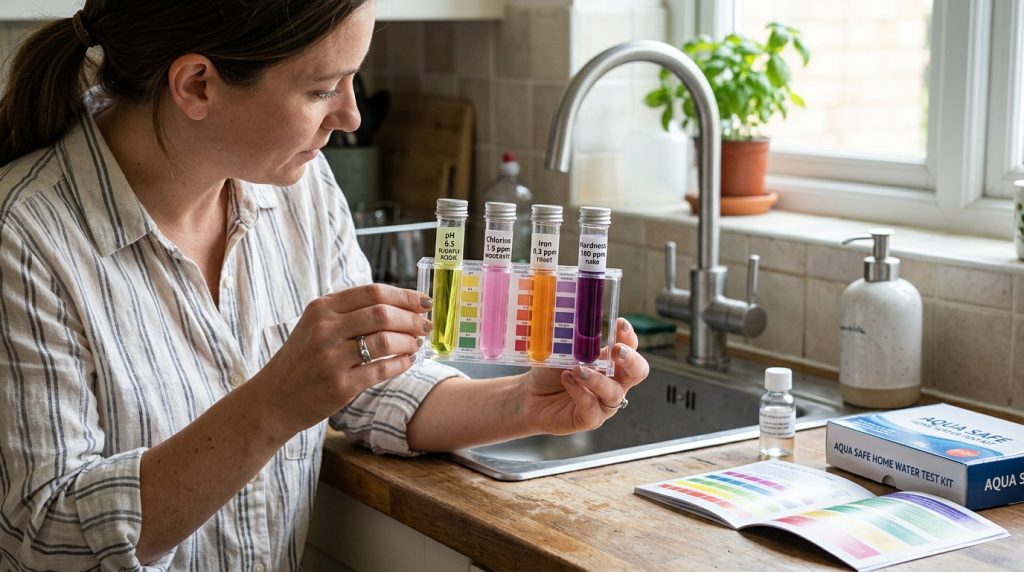
- Test strips — Dip in water sample; color change indicates concentration. Quick (1-2 minutes) but least precise. Good for hardness, pH, chlorine, and basic screening.
- Drop/reagent kits — Add liquid reagents to water sample; color change is compared to a chart. More accurate than strips. Good for iron, hardness, pH, and specific contaminants.
- Digital TDS meters — Portable electronic devices that measure total dissolved solids. Inexpensive ($10-$20) and useful for monitoring RO system performance but does not identify specific contaminants.
- Mail-in kits — Collect samples at home and mail to a lab. Combines DIY convenience with lab accuracy. Typically $100-$200 for comprehensive panels.
Certified Laboratory Testing
For the most accurate and legally defensible results, use a state-certified laboratory. The EPA maintains a list of certified drinking water testing laboratories by state. Many state health departments also offer low-cost well water testing programs.
What Lab Testing Costs
| Test Package | What It Covers | Typical Cost |
|---|---|---|
| Basic well water panel | Bacteria, nitrate, pH, hardness, TDS, iron | $50-$100 |
| Comprehensive panel | Basic + lead, arsenic, manganese, fluoride, VOCs | $150-$250 |
| PFAS testing | PFOA, PFOS, and other PFAS compounds | $200-$400 |
| Full environmental panel | 100+ contaminants including pesticides, metals, VOCs | $300-$600 |
How to Collect a Water Sample
Proper sample collection is critical for accurate results. Follow these steps for the most reliable test. Use containers provided by the lab (or sterile containers for bacteria testing). Run the cold water faucet for 2-3 minutes before collecting to clear standing water. For lead testing, collect a first-draw sample before running water (lead accumulates while water sits in pipes). Do not touch the inside of the bottle or cap. Label each sample with date, time, and collection point. Deliver to the lab within 24-48 hours (bacteria samples within 6-24 hours depending on lab requirements). Keep samples cool during transport.
Understanding Your Water Test Results
Water test reports can be confusing. Key terms to understand include MCL (Maximum Contaminant Level, the legally enforceable limit set by EPA), MCLG (Maximum Contaminant Level Goal, the non-enforceable health-based goal, often zero for carcinogens), SMCL (Secondary Maximum Contaminant Level, aesthetic guidelines for taste, odor, and appearance), ppb or ug/L (parts per billion), and ppm or mg/L (parts per million, 1 ppm = 1,000 ppb).
Compare each result against the EPA’s MCL. If any contaminant exceeds its MCL (or its MCLG for contaminants like lead where no level is truly safe), take action to address the contamination source and install appropriate water treatment.
Key Takeaway: Testing is the essential first step before purchasing any water treatment system. A $50-$200 water test ensures you invest in the right filtration technology for your actual contaminants, rather than guessing and potentially spending hundreds of dollars on a system that does not address your specific water quality issues. Contact AMPAC Water Systems with your test results for a free system recommendation.
Frequently Asked Questions
How can I test my water quality at home for free?
If you are on municipal water, request your utility’s Consumer Confidence Report (CCR), which is published annually and available for free. This shows treatment plant results but not conditions at your tap. For a truly free home test, some water treatment companies offer complimentary basic testing (hardness, pH, chlorine, iron, TDS) as part of a consultation. Digital TDS meters are reusable and cost under $15.
How accurate are home water test kits?
DIY test strips are useful for general screening but have limited precision, typically plus or minus 20-30%. Reagent-based kits are more accurate, within 10-15%. For actionable results that you can use to size a treatment system, certified laboratory testing is recommended. Lab results are precise, legally defensible, and include contaminants that DIY kits cannot detect.
How often should I test my well water?
The EPA recommends testing private well water annually for bacteria (total coliform, E. coli), nitrates, pH, and TDS. Test more frequently if you have a history of contamination, notice changes in taste/odor/appearance, the well is near potential contamination sources, or after flooding, well repairs, or changes to nearby land use.
What should I do if my water test shows lead?
If lead exceeds 15 ppb (EPA action level) or any detectable level for households with young children, use only cold water for drinking and cooking, run the tap for 30 seconds to 2 minutes before use, and install an NSF-certified lead-removal filter (RO or carbon block certified to NSF 53). Long-term, consider replacing lead service lines and lead-containing plumbing fixtures.
Can I test for PFAS at home?
No reliable DIY test exists for PFAS. Testing requires specialized laboratory equipment (liquid chromatography-mass spectrometry). Send water samples to a certified lab that offers PFAS testing. Costs range from $200-$400. Check the EPA’s PFAS testing resources and your state’s environmental agency for lab recommendations and potential subsidized testing programs.
Next Steps After Testing
Once you have your water test results, AMPAC Water Systems can recommend the most effective and cost-efficient treatment system for your specific contaminants. We manufacture residential and commercial water treatment systems including reverse osmosis, UV purification, carbon filtration, and water softening — all designed to address specific water quality challenges identified by testing.
Send us your water test results for a free analysis and system recommendation.