In Power Generation, Water Purity Isn’t a Preference—It’s an Engineering Requirement
A modern combined-cycle gas turbine plant can consume 500,000 gallons of treated water per day just for boiler makeup. Every drop of that water needs to meet exacting purity standards. Dissolved silica above 0.02 ppm will deposit on turbine blades. Conductivity above 0.1 µS/cm signals dissolved solids that cause corrosion and scale in boiler tubes. Sodium, chloride, iron—even trace amounts measured in parts per billion—can shorten equipment life and trigger forced outages that cost $500,000 or more per day in lost generation revenue.
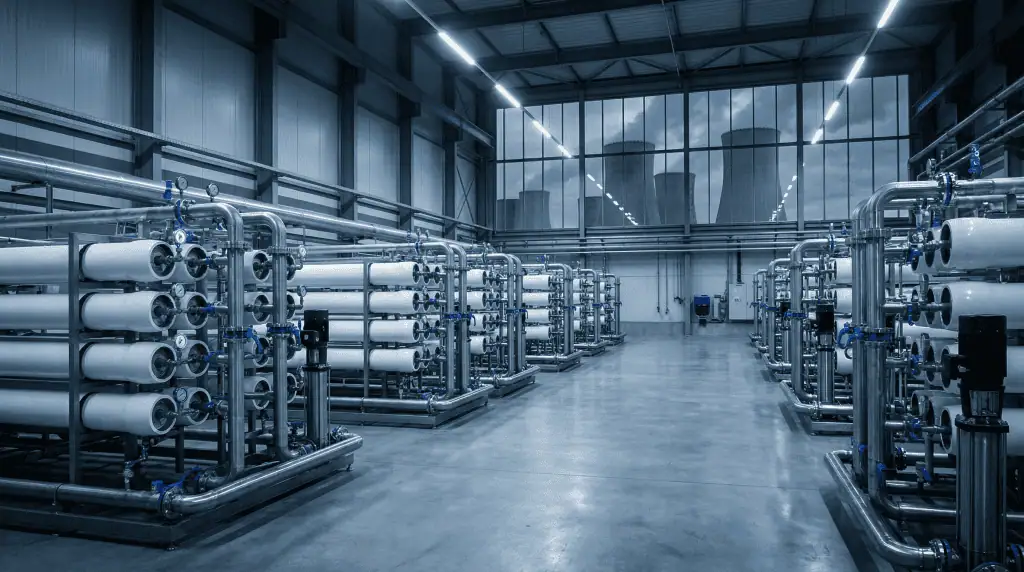
Industrial reverse osmosis is the backbone of modern boiler feed water treatment. It removes 95-99% of dissolved solids in a single pass, producing permeate that feeds downstream polishing systems (mixed-bed deionizers or electrodeionization units) for final ultra-pure water production. For power plant operators, the choice of RO system directly impacts plant reliability, chemistry compliance, and operating costs.
This article covers the technical requirements for boiler feed water, how AMPAC’s industrial RO systems address those requirements, and the design considerations that separate a good installation from a problem-plagued one.
Why Boiler Feed Water Purity Matters So Much
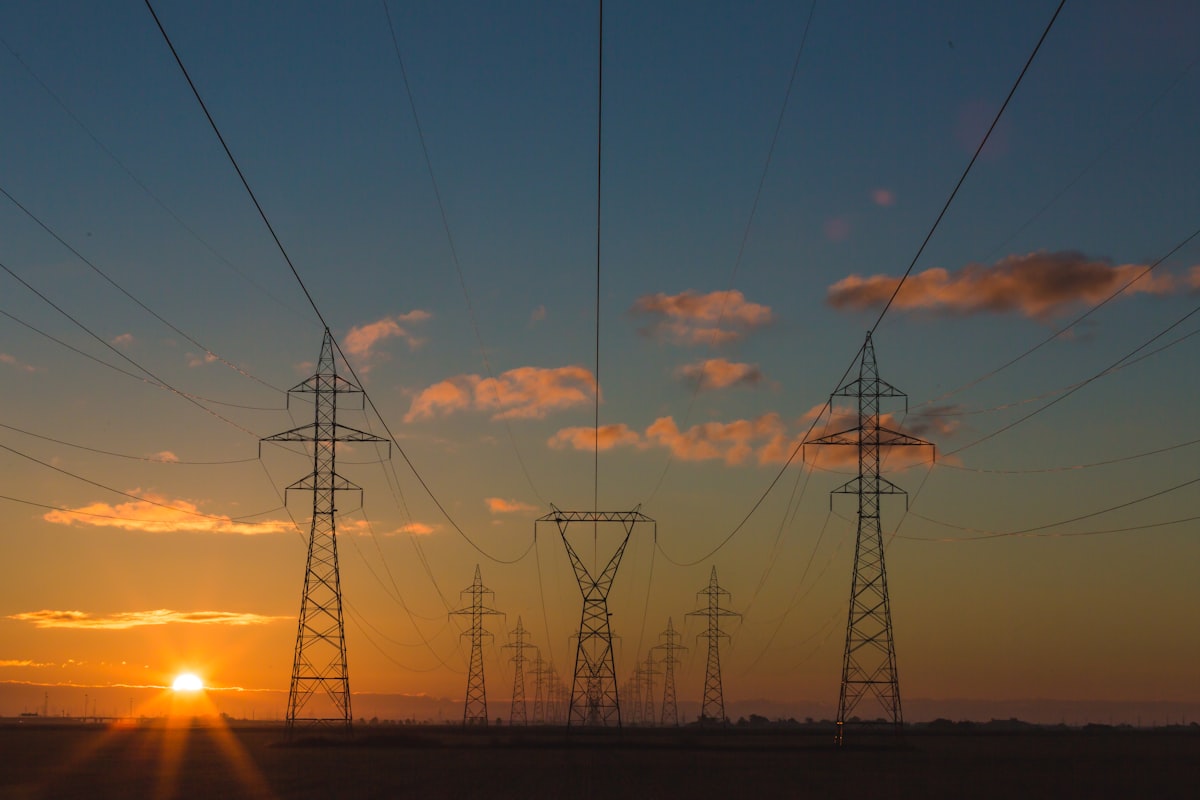
The physics are unforgiving. Water in a high-pressure boiler (1,500-3,500 psi operating pressure in supercritical units) behaves differently than water at atmospheric conditions. Dissolved minerals that seem insignificant at ambient temperatures concentrate as water converts to steam, precipitating as scale on heat transfer surfaces or becoming volatile and carrying over into the steam turbine.
Silica: The Primary Concern
Silica is the contaminant that keeps power plant chemists up at night. At boiler operating temperatures, silica becomes volatile and carries over with steam even when boiler drum water chemistry is within spec. Once it reaches the turbine, it deposits on blades as a glassy, nearly insoluble coating that reduces turbine efficiency and can cause mechanical imbalance.
ASME and EPRI guidelines call for boiler feed water silica below 0.02 ppm (20 ppb) for high-pressure boilers. Raw water sources typically contain 5-50 ppm of silica, meaning the treatment system needs to achieve 99.9%+ silica removal. Standard RO membranes reject 95-98% of reactive silica; a two-pass RO system followed by mixed-bed polishing reaches the required levels reliably.
Conductivity and Total Dissolved Solids
Boiler feed water conductivity targets depend on operating pressure:
- Low-pressure boilers (150-300 psi) — Conductivity < 25 µS/cm acceptable
- Medium-pressure boilers (300-900 psi) — Conductivity < 2 µS/cm required
- High-pressure boilers (900-2,500 psi) — Conductivity < 0.1 µS/cm mandatory
- Supercritical boilers (3,500+ psi) — Conductivity < 0.055 µS/cm (essentially 18 megohm-cm resistivity)
Single-pass RO typically produces permeate at 5-20 µS/cm, depending on feed water quality. Two-pass RO gets that below 1 µS/cm. Final polishing with EDI (electrodeionization) or mixed-bed resin achieves the ultra-pure levels that high-pressure and supercritical boilers demand.
Dissolved Oxygen and Carbon Dioxide
Dissolved gases pass through RO membranes freely. Carbon dioxide in RO permeate forms carbonic acid, depressing pH and promoting corrosion. Dissolved oxygen is the primary cause of pitting corrosion in boiler tubes and feedwater piping. Mechanical deaerators and vacuum degassifiers remove dissolved gases before the water enters the boiler circuit, working in tandem with chemical oxygen scavengers.
The Treatment Train: From Raw Water to Ultra-Pure
A complete boiler feed water treatment system for a modern power plant typically follows this sequence:
1. Clarification and Prefiltration
Raw water from wells, rivers, or municipal supplies first passes through clarification (for surface water with high turbidity) and multimedia filters. The goal is to reduce the Silt Density Index (SDI) to below 3.0—the threshold for reliable RO membrane operation. Greensand filters or iron removal systems may be needed for groundwater sources with elevated iron and manganese.
2. Water Softening or Antiscalant Dosing
Calcium and magnesium hardness will scale RO membranes if left untreated. Two approaches: softening resin beds exchange calcium and magnesium ions for sodium (preferred for high-hardness feed), or antiscalant chemicals are dosed inline to inhibit crystal formation on membrane surfaces. For feed water above 200 ppm hardness as CaCO³, softening is usually more cost-effective than antiscalant alone.
3. Primary Reverse Osmosis
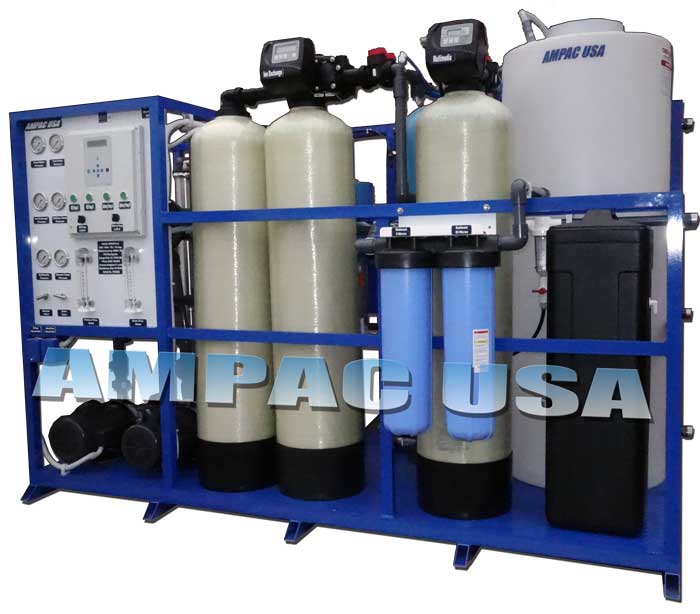
This is where the heavy lifting happens. Industrial RO systems designed for power plant service use high-rejection thin-film composite membranes in pressure vessels configured for 75-85% recovery. A 100,000 GPD system might use 36-48 membrane elements in a 2:1 or 3:2 array configuration.
AMPAC’s industrial RO systems are built specifically for this duty—316L stainless steel frames, Grundfos or Danfoss high-pressure pumps, and PLC-based controls with 4-20mA instrument integration for tie-in to plant DCS systems.
4. Second-Pass RO (for High-Pressure Boilers)
When feed water TDS is high or boiler operating pressure demands ultra-pure water, a second RO pass treats the first-pass permeate. Second-pass systems operate at lower pressure (100-150 psi vs. 200-300 psi for the first pass) because feed water TDS is already low. Recovery rates of 85-90% are typical. The second pass reduces silica, sodium, and boron to single-digit ppb levels.
5. Degasification
Membrane degassifiers or vacuum towers strip dissolved CO&sub2; from the RO permeate, raising pH from roughly 5.5-6.0 to 7.0+ and reducing the load on downstream polishing systems. This step is often overlooked in smaller installations, leading to premature exhaustion of mixed-bed resins.
6. EDI or Mixed-Bed Polishing
Electrodeionization (EDI) has largely replaced traditional mixed-bed deionizer vessels in new power plant installations. EDI uses ion exchange resins regenerated continuously by electrical current rather than batch chemical regeneration, eliminating the need to store and handle hydrochloric acid and sodium hydroxide on site. EDI produces water at 15-18 megohm-cm resistivity consistently.
Membrane Selection for High-TDS Feed Water
Power plants drawing from brackish groundwater, recycled municipal effluent, or cooling tower blowdown may face feed water TDS ranging from 2,000 to 15,000 ppm. Membrane selection matters:
- Standard brackish water membranes (e.g., Dow BW30-400) — Good for feed TDS up to 5,000 ppm, operating at 150-250 psi
- High-rejection membranes (e.g., Dow BW30-400/34i) — 99.5% salt rejection for tighter permeate quality
- Low-energy membranes — Operate at 20-30% lower pressure, reducing pump energy costs by $0.05-$0.10 per thousand gallons
- Fouling-resistant membranes — Wider feed channel spacers (34 mil vs. 28 mil) for feed water with elevated organics or biological activity
AMPAC engineers select membrane configurations based on detailed feed water analysis, running projection software to model rejection rates, permeate quality, and concentrate chemistry at design recovery rates. Request a system design consultation with your feed water analysis in hand for the most accurate system recommendation.
Monitoring and Control: What the Plant DCS Needs to See
Power plant operations teams need real-time visibility into water treatment system performance. Critical monitoring parameters include:
- Feed pressure, permeate pressure, and concentrate pressure — Trending these values reveals membrane fouling before it becomes critical
- Permeate conductivity — The first indicator of membrane degradation or O-ring failure
- Normalized permeate flow — Temperature-corrected flow rates that account for seasonal water temperature changes
- Feed water SDI and turbidity — Upstream pretreatment performance
- Differential pressure across each stage — Rising differential pressure indicates membrane fouling
AMPAC’s PLC-based control systems support Modbus RTU, Modbus TCP, and 4-20mA analog outputs for integration with plant DCS platforms like Emerson DeltaV, Honeywell Experion, or Siemens PCS 7.
Common Pitfalls in Power Plant RO Installations
Under-Sizing the System
Designing for average demand instead of peak demand plus margin is a recipe for problems. The RO system should be sized to handle peak makeup requirements (startup, load swings, blowdown events) with at least 15-20% spare capacity. Running membranes at maximum flux continuously shortens their life.
Ignoring Seasonal Feed Water Changes
Surface water sources change dramatically with seasons—turbidity, organics, temperature, and TDS all fluctuate. A system designed for winter water quality may struggle with summer algae blooms. Robust pretreatment and conservative design margins prevent seasonal surprises.
Inadequate CIP (Clean-In-Place) Capability
Every RO system needs regular chemical cleaning. A properly designed CIP system with a heated mixing tank, recirculation pump, and appropriate chemical storage saves thousands in premature membrane replacement. AMPAC includes CIP systems as standard equipment on industrial installations.
Total Cost of Ownership
For a 200,000 GPD two-pass industrial RO system treating brackish groundwater for boiler feed:
- Capital cost — $250,000-$400,000 depending on materials of construction and automation level
- Annual membrane replacement — $15,000-$25,000 (assuming 5-year membrane life)
- Chemical costs — $8,000-$15,000/year (antiscalant, CIP chemicals, pH adjustment)
- Energy — $20,000-$40,000/year at $0.08/kWh industrial rates
- Maintenance labor — 4-8 hours per week of operator attention
Compare that to the cost of a single forced outage due to boiler tube failure from poor water chemistry—$500,000+ in lost generation revenue plus repair costs—and the investment in proper water treatment pays for itself many times over.
Ready to discuss your power plant’s water treatment requirements? Contact AMPAC’s industrial team for a detailed proposal.
Key Takeaways
- High-pressure boilers demand feed water with conductivity below 0.1 µS/cm and silica below 20 ppb—achievable with two-pass RO and polishing
- Membrane selection should be based on detailed feed water analysis, not guesswork
- Energy recovery and low-energy membranes can reduce RO operating costs by 20-30%
- Proper CIP systems and pretreatment are essential for achieving 5-7 year membrane life
- PLC controls with DCS integration give plant operators real-time visibility into water treatment performance
- The total cost of a well-designed RO system is a fraction of the cost of a single boiler chemistry-related forced outage
Frequently Asked Questions
Do I need single-pass or two-pass RO for my boiler?
It depends on your boiler operating pressure and feed water quality. For low-pressure boilers under 300 psi, single-pass RO followed by softening or basic polishing is usually sufficient. Medium-pressure boilers (300-900 psi) typically need single-pass RO plus EDI polishing. High-pressure and supercritical boilers (900+ psi) almost always require two-pass RO followed by EDI to achieve the required sub-ppb contaminant levels. AMPAC engineers can model your specific scenario based on feed water analysis and boiler specifications.
How often do RO membranes need to be cleaned in power plant service?
Cleaning frequency depends on feed water quality and pretreatment effectiveness. Well-pretreated brackish groundwater may only require CIP cleaning every 3-6 months. Surface water or recycled water sources may need monthly cleaning. The key indicators that trigger a CIP are a 10-15% decline in normalized permeate flow, a 10-15% increase in salt passage, or a 15% increase in differential pressure. Staying ahead of fouling with proactive cleaning extends membrane life significantly compared to waiting until performance has degraded severely.
Can industrial RO treat cooling tower blowdown for reuse as boiler makeup?
Yes, and this is becoming increasingly common as water costs rise and discharge regulations tighten. Cooling tower blowdown typically has TDS of 3,000-10,000 ppm, elevated silica, and biological contamination—all treatable with proper pretreatment and appropriately designed RO. The RO concentrate can often be returned to the cooling tower, creating a closed loop that dramatically reduces plant water consumption. This approach requires careful chemistry management to prevent scaling in both the RO system and the cooling tower, but it’s a proven strategy used by plants across the U.S. and Middle East.
What is the typical ROI on an industrial RO system for a power plant?
Most power plant RO installations achieve payback within 2-3 years when compared to purchasing deionized water or operating legacy ion exchange systems with high chemical regeneration costs. A 200,000 GPD RO system producing boiler feed water at $2-4 per thousand gallons replaces purchased DI water costing $8-15 per thousand gallons. For plants upgrading from conventional ion exchange, RO reduces chemical costs by 80-90% and eliminates hazardous waste disposal costs associated with acid and caustic regeneration.
What happens if the RO system fails during plant operation?
This is why redundancy matters. Critical power plants design water treatment systems with N+1 redundancy—enough capacity that one RO train can be taken offline for maintenance without reducing total output below peak demand. Treated water storage tanks sized for 8-24 hours of boiler makeup demand provide a buffer during short-term outages. AMPAC designs multi-train industrial RO systems with independent controls for each train, allowing maintenance on one unit while the others continue operating.