What Does Reverse Osmosis Actually Remove from Water?
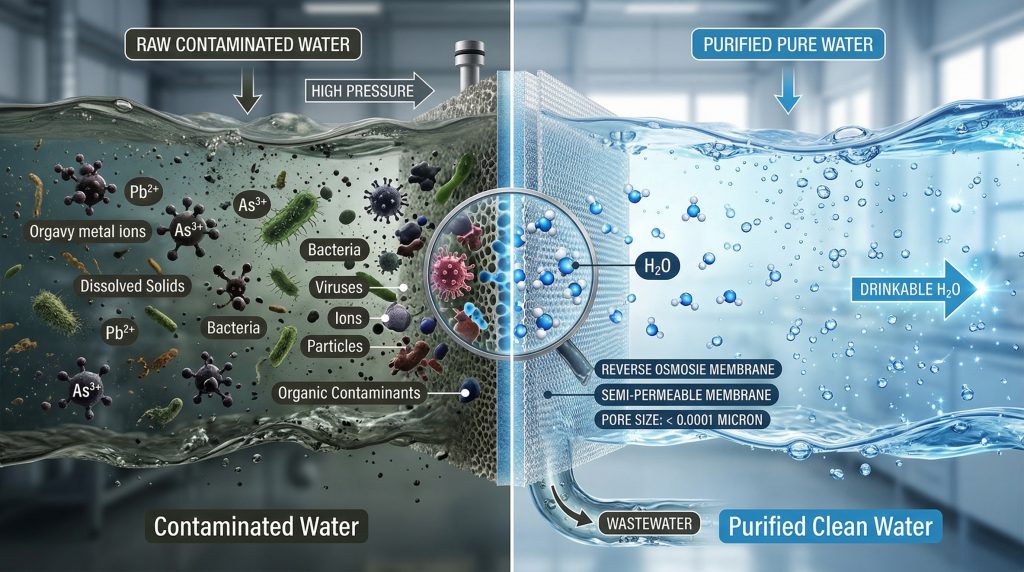
Reverse osmosis is frequently described as a “catch-all” water treatment technology, but that description undersells the precision of what it does. RO membranes function as molecular-level barriers. They are engineered thin-film composite polyamide structures with effective pore sizes in the range of 0.0001 microns (0.1 nanometers)—roughly 500,000 times smaller than a human hair. At this scale, the membrane discriminates between water molecules and virtually everything else dissolved or suspended in the feedwater.
The rejection mechanism is not purely size-based. RO membranes reject contaminants through a combination of three mechanisms: steric (size) exclusion, Donnan (charge) exclusion, and solution-diffusion selectivity. This is why RO can reject dissolved ions like sodium and chloride that are smaller than the membrane’s nominal pore size—the electrostatic charge of the membrane surface repels charged species, and the low diffusion coefficient of most contaminants through the polyamide layer further limits passage.
The practical result is that a properly designed and maintained RO system removes 95-99%+ of nearly every contaminant category that matters for drinking water and process water quality. This article quantifies what RO removes, how effective it is compared to alternative technologies, and what design factors affect real-world performance.
How Effective Is Reverse Osmosis at Removing PFAS?
PFAS (per- and polyfluoroalkyl substances) have become the defining water quality concern of the 2020s. With the EPA establishing enforceable MCLs of 4 parts per trillion for PFOA and PFOS, treatment technology selection is critical for any water system that detects these compounds.
Reverse osmosis is the gold standard for PFAS removal. Peer-reviewed studies published in Environmental Science & Technology and Water Research consistently report the following rejection rates:
- Long-chain PFAS (PFOA, PFOS, PFNA): 99%+ rejection. These compounds have molecular weights of 400-500 daltons and are effectively excluded by both size and charge mechanisms.
- Short-chain PFAS (PFBS, PFHxA, PFHxS): 95-99% rejection. Slightly lower than long-chain due to smaller molecular size, but still well above the performance of GAC or standard carbon filtration.
- Ultra-short-chain PFAS (TFA, PFPrA): 85-95% rejection. These 2-3 carbon compounds represent the most challenging PFAS fraction for any treatment technology. RO still outperforms all alternatives.
- PFAS precursors and transformation products: 90-99% depending on compound structure. RO provides a broader safety margin than targeted technologies because it rejects based on physical properties rather than chemical-specific interactions.
The critical advantage of RO over granular activated carbon (GAC) for PFAS is longevity. GAC beds treating PFAS-contaminated water experience breakthrough of short-chain compounds within weeks to months, requiring frequent and expensive media replacement. RO membranes maintain consistent PFAS rejection throughout their 3-5 year service life, making the total cost of ownership more predictable.
Does Reverse Osmosis Remove Microplastics?
Microplastics—plastic particles smaller than 5 millimeters—have been detected in drinking water supplies worldwide. A 2019 World Health Organization report found microplastics in 90% of bottled water samples and 83% of tap water samples tested globally. More recent studies from the University of Columbia (2024) using advanced Raman spectroscopy detected an average of 240,000 nanoplastic particles per liter of bottled water, far higher than previous estimates that used less sensitive detection methods.
For reverse osmosis, microplastics are one of the easiest contaminant categories to remove. Even the smallest microplastic and nanoplastic particles (down to 1 nanometer) are orders of magnitude larger than the molecular-weight cutoff of RO membranes. Published removal rates:
- Microplastics (>1 micrometer): 99.9%+ removal. These particles are captured by pre-filtration stages before they even reach the RO membrane.
- Nanoplastics (1-1000 nanometers): 99%+ removal. Even the smallest nanoplastic particles are fully rejected by the RO membrane’s sub-nanometer effective pore structure.
- Plastic-associated contaminants: Microplastics act as carriers for adsorbed chemicals including phthalates, bisphenol A, and heavy metals. RO removes both the particles and the dissolved chemical contaminants they carry.
It is worth noting that even ultrafiltration (UF) and nanofiltration (NF) membranes effectively remove microplastics larger than 10 nanometers. However, only RO provides the combined removal of microplastics and the full spectrum of dissolved contaminants (PFAS, heavy metals, TDS) in a single treatment step.
What Other Contaminants Does Reverse Osmosis Remove?
The comprehensive contaminant removal table below summarizes RO performance across all major contaminant categories. These figures are based on published literature, EPA technology assessments, and field performance data from commercial RO systems.
| Contaminant Category | Examples | RO Rejection | Notes |
|---|---|---|---|
| PFAS (forever chemicals) | PFOA, PFOS, PFHxS, GenX | 95-99%+ | Best available technology per EPA |
| Microplastics / nanoplastics | PE, PET, PP, PS particles | 99%+ | Including nanoplastics <1 µm |
| Heavy metals | Lead, arsenic, mercury, cadmium, chromium | 95-99% | Both trivalent and pentavalent arsenic |
| Nitrates / nitrites | NO3, NO2 | 90-97% | Critical for agricultural areas |
| Total dissolved solids | Sodium, calcium, chloride, sulfate | 95-99% | Brackish to seawater range |
| Pharmaceuticals | Ibuprofen, estrogen, antibiotics | 90-99% | Varies by molecular weight |
| Pesticides / herbicides | Atrazine, glyphosate, chlorpyrifos | 92-99% | Higher MW compounds rejected better |
| Bacteria and viruses | E. coli, Giardia, norovirus | 99.99%+ | Physical barrier — no chemical residual |
| Radioactive compounds | Radium, uranium, radon (dissolved) | 95-99% | Important for uranium belt regions |
| Silica | Reactive and colloidal silica | 95-99% | Critical for boiler feed and semiconductor |
How Does RO Compare to Carbon Filtration and Nanofiltration?
Understanding where RO fits relative to other treatment technologies helps water system operators make informed decisions. Each technology has a role, but their contaminant removal capabilities differ significantly.
Granular Activated Carbon (GAC)
GAC is effective for organic contaminants with moderate to high molecular weight, including chlorine, taste-and-odor compounds, some pesticides, and long-chain PFAS. However, GAC is largely ineffective against dissolved inorganic contaminants (heavy metals, TDS, nitrates), microplastics, and short-chain PFAS. GAC beds also require regular replacement or regeneration, with replacement frequency increasing sharply when treating multi-contaminant water.
Nanofiltration (NF)
Nanofiltration membranes have larger pore sizes than RO (typically 0.001 microns vs. 0.0001 microns) and operate at lower pressures, resulting in lower energy costs. NF is effective for removing divalent ions (hardness), larger organic molecules, and some PFAS. However, NF allows passage of monovalent ions (sodium, chloride), smaller organic molecules, and short-chain PFAS that RO rejects. For multi-contaminant treatment scenarios, NF is often insufficient as a standalone technology.
Technology Comparison Summary
| Contaminant | RO | NF | GAC |
|---|---|---|---|
| Long-chain PFAS | 99%+ | 90-95% | 80-95% |
| Short-chain PFAS | 95-99% | 40-80% | 20-60% |
| Microplastics | 99%+ | 99%+ | 50-70% |
| Heavy metals | 95-99% | 60-90% | 30-70% |
| TDS / salinity | 95-99% | 30-70% | <5% |
| Nitrates | 90-97% | 30-50% | <5% |
What Pre-Treatment Does an RO System Need?
RO membranes achieve their remarkable rejection rates only when properly protected from fouling, scaling, and degradation. Pre-treatment is not optional—it is a required component of any commercial RO system design. The specific pre-treatment train depends on feedwater quality, but standard components include:
Sediment Pre-Filtration
Multi-media filters (MMF) or cartridge filters at 5 microns remove suspended solids, silt, and particulate matter that would otherwise foul the membrane surface. For surface water or highly turbid feedwater, ultrafiltration (UF) membranes at 0.01-0.1 microns may replace conventional cartridge filtration.
Activated Carbon Pre-Filtration
Granular activated carbon or carbon block pre-filters remove free chlorine, which degrades polyamide RO membranes rapidly. Carbon pre-filtration also reduces organic fouling potential by adsorbing dissolved organics.
Antiscalant and Chemical Dosing
Antiscalant chemicals prevent mineral scaling (calcium carbonate, calcium sulfate, silica) on membrane surfaces. pH adjustment may be required for high-alkalinity feedwater. These chemicals are dosed continuously at low concentrations upstream of the RO membranes.
Water Softening (Where Required)
For feedwater with very high hardness (>500 mg/L as CaCO3), ion exchange softening upstream of RO reduces calcium and magnesium concentrations that would otherwise cause scaling even with antiscalant.
A properly designed pre-treatment system extends membrane life to 3-5 years and maintains rejection rates within specification throughout the membrane’s service life. Skipping or undersizing pre-treatment is the most common cause of premature membrane failure and degraded water quality in commercial RO installations.
How Do You Size an RO System for Multi-Contaminant Removal?
Sizing a commercial RO system requires more than just matching capacity to demand. For multi-contaminant applications—particularly those targeting PFAS, microplastics, and heavy metals simultaneously—the following design factors must be considered:
- Feedwater analysis: A comprehensive water quality analysis including TDS, individual ion concentrations, PFAS suite, metals, turbidity, TOC, and temperature is the foundation of system design.
- Recovery rate: Higher recovery (more permeate per unit of feedwater) concentrates contaminants in the reject stream. For PFAS applications, recovery rates of 75-85% are typical to maintain high rejection while managing concentrate disposal.
- Membrane selection: Low-energy brackish water RO membranes (e.g., Dow FILMTEC BW30, Toray TMG series) are standard for municipal and commercial applications. High-rejection membranes may be specified when targeting specific contaminants near their MCLs.
- Array configuration: Multi-stage RO arrays (2:1 or 3:2 ratios) improve overall recovery while maintaining per-element flux within design limits.
- Post-treatment: RO permeate is low in minerals and may require pH adjustment and remineralization for potable applications.
AMPAC Water Systems provides complete system design engineering for commercial and industrial RO applications, from initial water quality assessment through system startup and operator training. Systems are Manufactured in North America and available in standard configurations from 1,000 GPD to over 1,000,000 GPD, with custom designs for specialized applications.
For a detailed water quality assessment and system recommendation, contact AMPAC’s engineering team.