Quick Answer
Reverse osmosis (RO) and water softeners solve different water problems and are not interchangeable. RO removes dissolved contaminants like lead, PFAS, arsenic, fluoride, and TDS by forcing water through a semi-permeable membrane. Water softeners remove hardness minerals (calcium and magnesium) through ion exchange. Many homes benefit from both: a softener to protect plumbing and appliances from scale, and an RO system for the purest drinking water. Used together, the softener also extends the life of the RO membrane.
How Reverse Osmosis Works
Reverse osmosis uses hydraulic pressure to push water through a semi-permeable membrane with pores approximately 0.0001 microns in diameter. This membrane rejects 95-99% of dissolved solids, allowing only water molecules and a small percentage of dissolved minerals to pass through. Most residential RO systems include multiple stages of pre- and post-filtration.
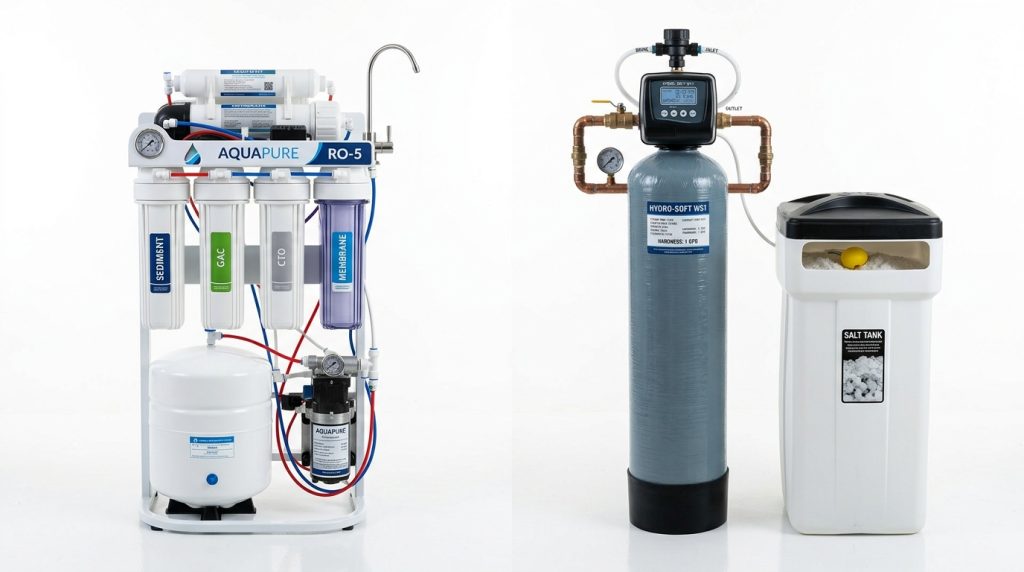
A typical 4-5 stage RO system includes a sediment pre-filter (5 microns) to remove particles, a carbon pre-filter to remove chlorine (which damages RO membranes), the RO membrane (the primary purification stage), a post-carbon or polishing filter for final taste refinement, and optionally a remineralization filter to add beneficial minerals back.
How Water Softeners Work
Water softeners use ion exchange resin to replace calcium and magnesium ions (which cause hardness) with sodium or potassium ions. As hard water flows through the resin tank, hardness minerals are captured by the resin beads. When the resin becomes saturated, the system regenerates by flushing with a brine (salt water) solution, washing the captured minerals to drain and recharging the resin.
Softeners treat all water entering your home (point-of-entry), while RO systems are typically installed at a single point-of-use (usually the kitchen sink).
What Each System Removes
| Contaminant | Reverse Osmosis | Water Softener |
|---|---|---|
| Calcium (hardness) | Yes (95-99%) | Yes (99%+) |
| Magnesium (hardness) | Yes (95-99%) | Yes (99%+) |
| Lead | Yes (95-99%) | No |
| PFAS | Yes (90-99%) | No |
| Arsenic | Yes (90-97%) | No |
| Fluoride | Yes (90-95%) | No |
| Nitrate | Yes (85-95%) | No |
| Chlorine | Yes (via carbon pre-filter) | No |
| TDS (dissolved solids) | Yes (95-99%) | Partially (exchanges ions; TDS stays similar) |
| Iron (ferrous, low levels) | Yes | Yes (under 2 ppm) |
| Bacteria / viruses | Partial (not rated for disinfection) | No |
| Sodium | Yes (90-95%) | No (adds sodium) |
When You Need a Reverse Osmosis System
An RO system is the right choice when your water contains dissolved contaminants that softeners cannot remove. Install RO if your water test shows elevated lead (any detectable level, especially with children), PFAS contamination (EPA health advisory is 4 ppt for PFOA/PFOS), arsenic above 10 ppb (EPA MCL), high TDS giving water a flat or mineral taste, nitrates above 5 mg/L (halfway to the 10 mg/L MCL), or fluoride you wish to reduce.
AMPAC Water Systems offers residential RO systems ranging from compact under-sink units to high-capacity systems for large households.
When You Need a Water Softener
A water softener addresses hard water problems throughout your entire home. Install a softener if you see white scale deposits on faucets and showerheads, your water heater has reduced efficiency or shortened lifespan, soap and shampoo do not lather well, laundry feels stiff or looks dingy, your water test shows hardness above 7 grains per gallon, or you have hard water feeding steam equipment, dishwashers, or ice machines.
Why Many Homes Need Both
RO and softeners complement each other perfectly. The softener treats the entire home’s water supply, preventing scale in pipes, water heaters, and appliances. The RO system at the kitchen sink provides the purest possible drinking and cooking water. Additionally, softened water extends RO membrane life significantly — hard water causes mineral scaling on RO membranes, reducing their effectiveness and lifespan from 3-5 years down to 1-2 years.
The recommended installation order is: incoming water line to water softener to house distribution (and branch) to RO system at kitchen sink. This ensures the RO membrane receives softened, pre-treated water for maximum performance and longevity.
Cost Comparison
| Factor | Reverse Osmosis | Water Softener |
|---|---|---|
| System cost | $200-$800 (residential) | $500-$2,500 |
| Installation | DIY ($0) or $100-$200 | Professional $200-$500 |
| Annual maintenance | $50-$150 (filters/membrane) | $100-$250 (salt + maintenance) |
| Coverage | Single faucet | Whole house |
| Water waste | 1-4 gallons per gallon produced | 50-100 gallons per regeneration |
| Lifespan | 10-15 years (with filter changes) | 15-20 years (with resin replacement) |
Key Takeaway: Reverse osmosis and water softeners are not competing technologies — they address different problems. A softener removes hardness minerals to protect your plumbing and appliances. An RO system removes dissolved contaminants (lead, PFAS, arsenic, TDS) for the cleanest possible drinking water. For comprehensive home water treatment, the ideal setup is a whole-house softener combined with an under-sink RO system. Contact AMPAC Water Systems to design the right combination for your water quality.
Frequently Asked Questions
Does reverse osmosis soften water?
Technically yes — RO removes calcium and magnesium along with other dissolved minerals. However, RO is not practical as a whole-house softening solution because it operates at low flow rates (50-100 gallons per day), produces wastewater, and is far more expensive per gallon than ion exchange softening. Use a softener for whole-house hardness reduction and RO for drinking water purification.
Do I need a water softener if I have reverse osmosis?
If your water is hard (above 7 gpg), yes. Without a softener, hard water will cause scale throughout your home (water heater, pipes, fixtures, appliances) and will also shorten the life of your RO membrane. The RO only protects the one faucet it is connected to. A softener protects your entire plumbing system and pre-treats water for the RO system.
Will a water softener remove lead?
No. Water softeners use ion exchange designed to capture calcium and magnesium ions. They do not effectively remove lead, arsenic, PFAS, nitrates, or other dissolved contaminants. For lead removal, you need either a reverse osmosis system or a carbon block filter specifically certified to NSF/ANSI Standard 53 for lead reduction.
Can I install RO without a softener?
Yes, but if your water is hard, the RO membrane will scale faster and need more frequent replacement. Many RO manufacturers recommend softened feed water or include scale inhibitor cartridges for hard water applications. If your hardness is under 7 gpg, RO without a softener is generally acceptable. Above 10 gpg, a softener is strongly recommended.
Does an RO system remove the sodium added by a water softener?
Yes. RO membranes remove 90-95% of sodium, so if your softener adds sodium to the water, the RO system at your kitchen sink will remove most of it from your drinking water. This is another benefit of using both systems together — you get the whole-house benefits of softening without sodium in your drinking water.
Find the Right Combination for Your Home
AMPAC Water Systems manufactures both residential reverse osmosis systems and works with homeowners to design complete water treatment solutions. Whether you need RO, softening, or both, we can help you select and size the right equipment for your water quality and household size.
Get a free water treatment consultation — send us your water test results and we will recommend the optimal system configuration.