Why Is Salt Lake City Building a $619 Million Water Facility?
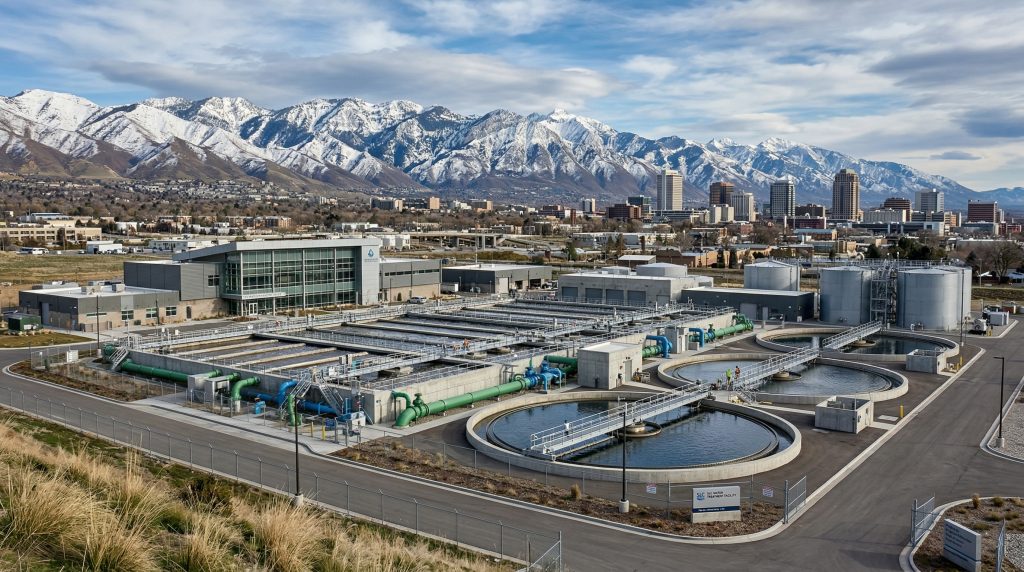
Salt Lake City’s existing wastewater treatment plant was built in the 1960s. It has been expanded and upgraded incrementally over the decades, but the fundamental infrastructure—the concrete basins, the primary treatment processes, the outfall systems—is approaching the end of its engineered service life. The plant currently treats approximately 55 million gallons per day (MGD) of wastewater from a service area that includes Salt Lake City, South Salt Lake, Murray, Millcreek, and portions of unincorporated Salt Lake County, serving over 200,000 residential and commercial customers.
The decision to build a new facility rather than continue patching the old one was driven by three converging factors:
- Age and condition: Critical infrastructure components are 60+ years old. Concrete degradation, corroded piping, and obsolete electrical and control systems create increasing maintenance costs and operational risk.
- Regulatory requirements: The Utah Division of Water Quality and the EPA have tightened nutrient discharge limits for facilities discharging to the Jordan River and ultimately to the Great Salt Lake. The existing plant cannot meet anticipated nitrogen and phosphorus limits without a fundamental process upgrade.
- Population growth: Salt Lake County’s population has grown by over 15% since 2010, with the Wasatch Front projected to add another 500,000 residents by 2050 according to the Kem C. Gardner Policy Institute. The new facility is designed with expandable capacity to serve this growth.
The $619 million project budget includes $175 million in federal funding secured through the Bipartisan Infrastructure Law (Infrastructure Investment and Jobs Act of 2021), with the balance funded through municipal bonds, the State Revolving Fund, and ratepayer revenue. Construction is phased over multiple years, with the first major treatment trains expected to come online in the late 2020s.
What Makes This a “Reclamation” Facility Instead of a Treatment Plant?
The terminology shift from “wastewater treatment plant” to “water reclamation facility” is not just branding. It reflects a fundamental change in how the water industry thinks about municipal wastewater. Traditional treatment plants were designed with a single objective: remove pollutants to meet discharge permit requirements, then release treated effluent to a receiving water body. The treated water was still considered waste.
A water reclamation facility is designed from the ground up to produce effluent that can be reused rather than just discharged. This means:
Advanced Nutrient Removal
The new SLC facility will incorporate biological nutrient removal (BNR) processes that reduce nitrogen and phosphorus to levels far below conventional secondary treatment. Target effluent concentrations of less than 3 mg/L total nitrogen and less than 0.1 mg/L total phosphorus are achievable with modern BNR technology—compared to 15-25 mg/L nitrogen and 3-5 mg/L phosphorus from the existing conventional activated sludge plant.
Tertiary Filtration
Following biological treatment, tertiary filtration (cloth disk filters, membrane bioreactors, or granular media filters) polishes the effluent to extremely low turbidity levels (<1 NTU), making it suitable as feedwater for additional treatment stages or direct non-potable reuse.
Disinfection Without Harmful Byproducts
Modern UV disinfection systems eliminate pathogens without the formation of chlorinated disinfection byproducts (trihalomethanes, haloacetic acids) that are associated with chlorine-based disinfection. This is critical for reuse applications where disinfection byproducts would be problematic.
Reuse-Ready Effluent Quality
The combined effect of advanced nutrient removal, tertiary filtration, and UV disinfection is an effluent quality that meets or approaches the requirements for non-potable reuse applications including irrigation, cooling water makeup, industrial process water, and environmental flows. With the addition of reverse osmosis polishing, reclaimed water can even meet potable reuse standards—a practice already permitted in several states and being evaluated by Utah regulators.
How Does the Federal Investment Fit Into National Water Infrastructure Needs?
The $175 million in federal funding for the SLC Water Reclamation Facility represents one of the largest single allocations under the Bipartisan Infrastructure Law’s water infrastructure provisions. Nationally, the law allocated $55 billion for water and wastewater infrastructure, including the State Revolving Fund, lead pipe replacement, and emerging contaminant treatment.
The EPA’s 2023 Drinking Water Infrastructure Needs Survey and Assessment estimated that U.S. water systems need $625 billion in infrastructure investment over the next 20 years. For wastewater and stormwater systems, the corresponding estimate from the Clean Watersheds Needs Survey is $271 billion. Even with the Bipartisan Infrastructure Law’s historic investment, federal funding covers only a fraction of the total need.
For Utah specifically, the water infrastructure challenge is amplified by drought. Every gallon of wastewater that can be reclaimed and reused is a gallon that does not need to be drawn from increasingly strained surface water and groundwater supplies. The SLC WRF is designed with this dual purpose in mind: meet discharge requirements while producing an effluent quality that enables future reuse.
What Does This Mean for Commercial Facilities in Utah?
The principles driving the SLC Water Reclamation Facility—treating wastewater as a resource, maximizing water recovery, and reducing dependence on fresh water supplies—are not limited to municipal-scale projects. Commercial and industrial facilities can implement the same strategies at smaller scale using packaged treatment systems.
On-Site Water Reclamation for Commercial Buildings
Hotels, office complexes, hospitals, and mixed-use developments can install on-site greywater treatment and recycling systems that recover 60-80% of their wastewater for non-potable reuse. Treated greywater is suitable for toilet flushing, landscape irrigation, cooling tower makeup, and laundry (in commercial settings). A 10,000-GPD greywater recycling system serving a 200-room hotel can reduce municipal water consumption by 40-50%.
Industrial Process Water Reclamation
Manufacturing facilities, food and beverage processors, and pharmaceutical companies generate process wastewater that often contains recoverable water at concentrations that make treatment and reuse economically attractive. Commercial RO systems can treat process wastewater to produce high-quality permeate suitable for reuse as rinse water, boiler feed, or cooling water. Recovery rates of 70-85% are standard, and in some applications, reject concentrates can be further concentrated using high-recovery systems or zero liquid discharge (ZLD) technology.
Cooling Tower Blowdown Recovery
Commercial HVAC systems lose significant water through cooling tower evaporation and blowdown. Blowdown water, which contains concentrated minerals and treatment chemicals, is typically discharged to sewer. By treating blowdown with RO, facilities can recover 70-80% as makeup water, reducing both water consumption and sewer discharge volumes. For large commercial and industrial cooling systems, blowdown recovery RO systems pay for themselves within 2-4 years through water and sewer cost savings.
How Do Packaged RO Systems Compare to Municipal-Scale Treatment?
The treatment principles are identical. The difference is scale, packaging, and operational complexity. Municipal facilities like the SLC WRF process tens of millions of gallons per day using custom-engineered, site-built infrastructure. Commercial packaged systems process thousands to hundreds of thousands of gallons per day using pre-engineered, factory-built equipment that arrives on a skid ready for connection to utilities.
| Parameter | Municipal WRF | Commercial Packaged System |
|---|---|---|
| Capacity | 5-100+ MGD | 1,000 GPD – 1,000,000 GPD |
| Capital cost | $100M – $1B+ | $25,000 – $500,000 |
| Construction time | 3-7 years | 8-16 weeks (delivery to startup) |
| Staffing | Licensed operators, 24/7 | Part-time monitoring, remote SCADA |
| Effluent quality | Secondary/tertiary + disinfection | RO permeate (exceeds potable standards) |
| Recovery rate | 95%+ (of influent volume) | 70-85% (of feedwater volume) |
For commercial facilities in the Salt Lake City metro area and throughout the Wasatch Front, packaged water reclamation systems offer an immediate, practical path to water reuse without waiting for municipal infrastructure expansion. The technology is proven, the economics are favorable (especially under drought surcharge conditions), and the environmental benefits align with both corporate sustainability goals and Utah’s urgent water conservation needs.
What Role Does AMPAC Play in Utah’s Water Future?
AMPAC Water Systems, headquartered in Woods Cross, Utah—just 12 miles north of the Salt Lake City WRF project site—has been designing and manufacturing commercial and industrial water treatment systems for decades. The company’s product line includes reverse osmosis systems, nanofiltration systems, ultrafiltration systems, and water recycling systems for capacities ranging from 1,000 GPD to over 1,000,000 GPD.
AMPAC’s local presence in Utah provides distinct advantages for commercial water reclamation projects:
- Direct familiarity with Utah water sources: The engineering team works with brackish groundwater, Jordan River surface water, and municipal supply water from the same systems that commercial customers use every day.
- Rapid site assessments: On-site water quality testing and system sizing throughout the Wasatch Front without travel overhead from distant manufacturers.
- Regulatory knowledge: Understanding of Utah Division of Water Quality requirements for water reuse permits, pretreatment discharge permits, and groundwater withdrawal authorizations.
- Local service and support: Same-day emergency service availability for commercial systems along the I-15 corridor from Ogden to Provo.
All AMPAC systems are Manufactured in North America, with full engineering, assembly, testing, and quality control performed in-house. To explore water reclamation solutions for your commercial or industrial facility, contact AMPAC’s engineering team for a consultation.