For Thousands of Island Communities, Fresh Water Has Always Been the Hardest Resource to Secure
There are roughly 80,000 inhabited islands on the planet. Most of them share a frustrating irony: surrounded by water on all sides, yet chronically short of the drinkable kind. Rainwater catchment and imported bottled water have been the traditional answers, but neither scales well. A single dry season can empty cisterns. Shipping costs for bottled water to a remote Pacific atoll can push the price past $15 per gallon. And as populations grow and tourism expands, the gap between supply and demand keeps widening.
Seawater reverse osmosis (SWRO) desalination has changed the equation. Over the past two decades, membrane technology has matured to the point where a containerized desalination plant can be shipped to a remote island, connected to a power source, and producing thousands of gallons of fresh water within days of arrival. The economics have improved dramatically too—energy consumption for SWRO has dropped from roughly 20 kWh per cubic meter in the 1970s to under 3 kWh/m³ with modern energy recovery devices.
This article breaks down the real-world challenges island communities face, the engineering solutions that address them, and why AMPAC’s seawater desalination systems have become a go-to choice for coastal and island installations worldwide.
Why Islands Face a Unique Water Challenge
Mainland cities can tap rivers, reservoirs, and underground aquifers. Islands rarely have those luxuries. The geology matters: volcanic islands like Hawaii or Fiji may have some groundwater, but it’s often brackish from saltwater intrusion. Low-lying coral atolls—think the Maldives or the Marshall Islands—have freshwater lenses just a few feet thick, easily contaminated by storm surges or over-pumping.
The Saltwater Intrusion Problem
When freshwater aquifers sit near the coast, over-extraction pulls seawater into the formation. This is already happening across the Caribbean, the Mediterranean, and Southeast Asia. Once an aquifer turns brackish, it can take decades to recover—if it recovers at all. The World Bank estimates that saltwater intrusion affects groundwater supplies for over 1.5 billion people in coastal areas globally.
Climate Volatility
Islands that depend on rainfall are at the mercy of weather patterns. The 2015-2016 El Niño event left parts of Papua New Guinea, Vanuatu, and the Federated States of Micronesia in severe drought. Emergency water shipments cost millions. A permanent desalination installation eliminates that vulnerability entirely.
Tourism and Population Pressure
A resort island in the Maldives might have a resident population of 500 but host 2,000 tourists at peak season. Water demand can quadruple overnight. Hotels, pools, laundry facilities, and landscaping all demand reliable freshwater supplies that rainfall alone cannot guarantee.
How Seawater Reverse Osmosis Works for Island Installations
SWRO forces seawater through semi-permeable membranes at pressures between 800 and 1,000 psi. The membranes reject 99.5% or more of dissolved salts, producing permeate water with TDS levels under 500 ppm—well within WHO drinking water standards. Modern thin-film composite (TFC) membranes from manufacturers like Dow FilmTec and Toray can handle feed water salinities up to 45,000 ppm.
Pretreatment: The Key to Membrane Longevity
Island seawater often carries high levels of suspended solids, algae, and organic matter, especially near coral reefs. Proper pretreatment is non-negotiable. A typical island SWRO system includes:
- Intake screening — Coarse screens and strainers to remove debris, shells, and marine organisms
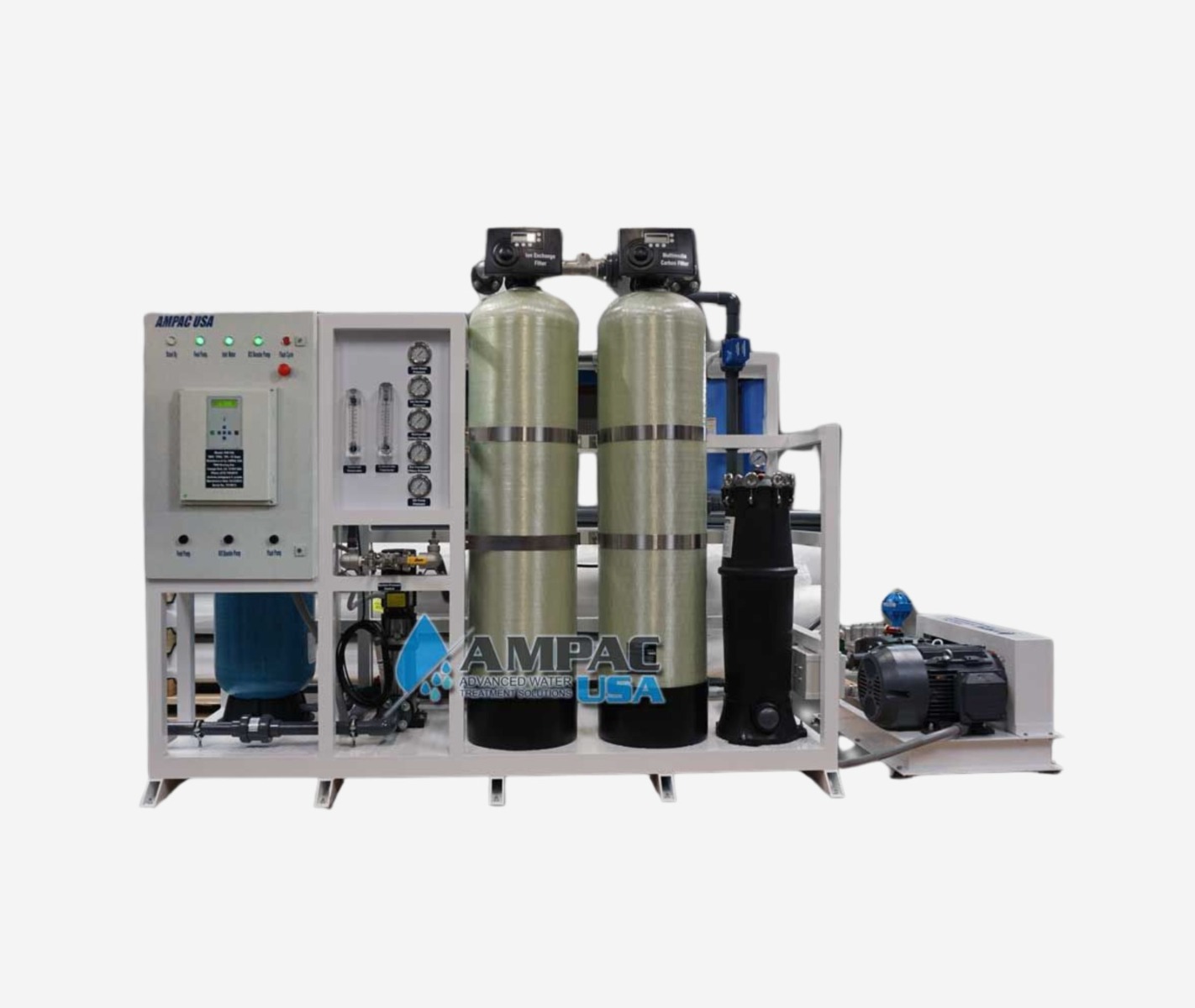
- Multimedia filtration — Sand and anthracite filters to reduce turbidity below 1 NTU
- Cartridge filtration — 5-micron cartridge filters as a final barrier before the membranes
- Chemical dosing — Antiscalant to prevent calcium carbonate and sulfate scaling on membranes
Skipping or under-sizing pretreatment is the single most common reason island desalination projects fail prematurely. Membrane replacement costs $3,000 to $8,000 per element, so protecting them is worth every dollar spent on pretreatment.
Energy Recovery: Bringing Operating Costs Down
The concentrate (brine) stream leaving an SWRO system still contains enormous hydraulic energy—it’s pressurized water, after all. Energy recovery devices (ERDs) like pressure exchangers capture 95-98% of that energy and transfer it to incoming feed water. This single technology has cut SWRO energy consumption nearly in half over the past 15 years.
For island communities where electricity costs $0.30-$0.50 per kWh (common with diesel generation), the difference between 5 kWh/m³ and 2.5 kWh/m³ translates directly to water costs. At $0.40/kWh, that’s a savings of $1.00 per cubic meter—roughly $3.80 per thousand gallons.
Containerized and Modular Systems: Built for Remote Deployment
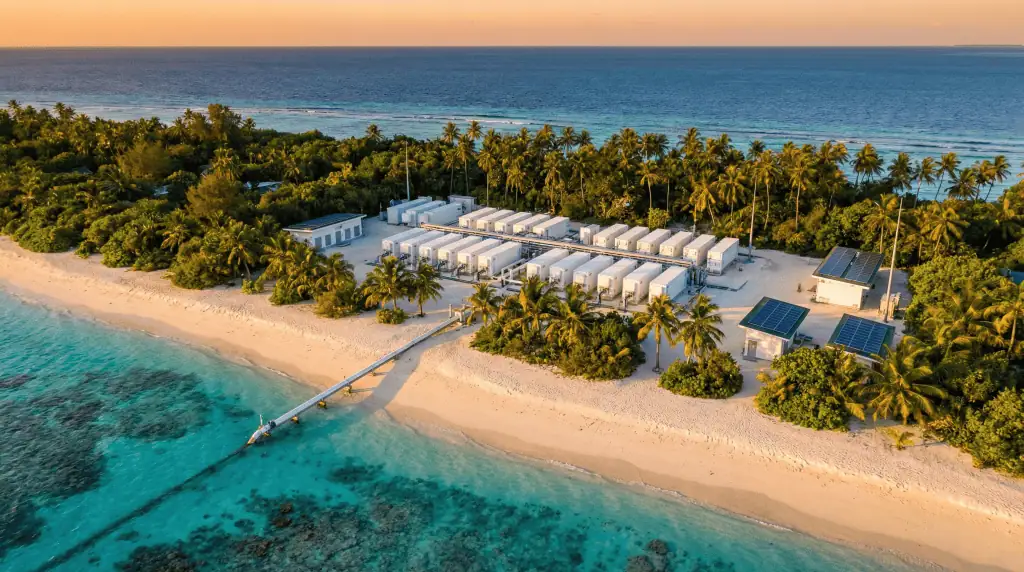
Getting heavy equipment to a remote island is expensive and logistically complex. That’s why containerized desalination systems have become the standard for island installations. AMPAC’s seawater desalination product line includes systems that ship in standard 20-foot or 40-foot ISO containers, fully assembled and factory-tested.
The advantages are straightforward:
- Shipping — Fits on standard container vessels; no special transport needed
- Installation — Can be operational within 48-72 hours of delivery on a prepared pad
- Scalability — Multiple containers can be deployed in parallel to match growing demand
- Maintenance — Standardized components mean spare parts are interchangeable across units
Solar-Powered Desalination: Off-Grid Solutions
Many island communities lack reliable grid electricity. Diesel generators are the default, but fuel costs are brutal—$5 to $8 per gallon on remote atolls after shipping. Solar-powered desalination offers a compelling alternative.
A well-designed solar SWRO system pairs photovoltaic panels with battery storage and variable-frequency drives (VFDs) that adjust membrane operating pressure based on available solar power. During peak sun hours, the system runs at full capacity. As cloud cover reduces output, the VFDs throttle back smoothly rather than shutting down.
The math works out favorably in tropical locations with 5-6 peak sun hours per day. A 10,000 GPD system consuming 2.5 kWh/m³ needs roughly 25 kW of continuous power. With a 60 kW solar array and adequate battery storage, that system can operate entirely off-grid at a levelized water cost under $5 per thousand gallons—less than half the cost of imported bottled water.
Brine Disposal: Doing It Responsibly
For every gallon of fresh water produced, SWRO generates roughly 1.5 gallons of concentrated brine at 60,000-70,000 ppm TDS. On an island, you can’t just pipe it into the nearest ditch. Responsible brine disposal requires planning:
- Diffuser outfalls — Discharging brine through multi-port diffusers 200+ meters offshore ensures rapid dilution to near-ambient salinity within meters of the discharge point
- Deep well injection — On islands with suitable geology, brine can be injected into deep saline formations below the freshwater lens
- Co-discharge — Mixing brine with power plant cooling water or wastewater effluent reduces salinity before ocean discharge
Environmental impact assessments are standard practice, and most jurisdictions require monitoring of marine life near discharge points. When properly designed, SWRO brine disposal has minimal ecological impact.
Real-World Applications
Caribbean Resort Islands
Properties across the Bahamas, Turks and Caicos, and the U.S. Virgin Islands rely on SWRO for 100% of their freshwater needs. A typical 200-room resort requires 50,000-80,000 GPD—well within the capacity of a single containerized SWRO unit.
Pacific Atolls
Nations like Kiribati and Tuvalu, where the highest point is barely 3 meters above sea level, face existential threats from rising seas contaminating their freshwater lenses. SWRO provides a climate-resilient water supply that doesn’t depend on rain or groundwater.
Military and Emergency Deployments
The U.S. Navy and humanitarian organizations deploy portable SWRO units for disaster relief and forward operating bases. After Typhoon Haiyan devastated the Philippines in 2013, portable desalination units provided emergency drinking water within hours of arriving on scene.
Choosing the Right System
Sizing a desalination system for an island community means accounting for peak demand, not just average consumption. Key factors include:
- Population and per-capita consumption — Residential use typically runs 50-100 gallons per person per day
- Commercial and tourism demand — Hotels and resorts consume 150-300 gallons per guest per day
- Agricultural and landscape irrigation — Can double total demand on resort islands
- Storage capacity — At minimum, 3 days of production capacity in storage tanks
AMPAC engineers work with island communities to design systems matched to actual demand patterns, including seasonal tourism fluctuations. Systems range from small watermakers producing 1,000 GPD for a single resort property to multi-unit installations exceeding 500,000 GPD for entire island municipalities.
Need help sizing a system for your project? Request a quote or contact AMPAC’s engineering team directly.
Key Takeaways
- Island communities face compounding water security threats from saltwater intrusion, climate variability, and growing demand
- Modern SWRO systems consume under 3 kWh/m³ with energy recovery, making desalination economically viable even for small islands
- Containerized systems ship in standard ISO containers and can be operational within days of delivery
- Solar-powered desalination eliminates diesel dependency for off-grid island installations
- Proper pretreatment and brine disposal planning are essential for long-term system reliability and environmental compliance
- AMPAC offers seawater desalination systems from 1,000 GPD to 500,000+ GPD, purpose-built for island and coastal applications
Frequently Asked Questions
How much does it cost to desalinate seawater on an island?
Total water production costs for island SWRO systems typically range from $3 to $8 per thousand gallons, depending on energy costs, system size, and local conditions. Solar-powered systems in tropical locations can achieve costs under $5 per thousand gallons. By comparison, imported bottled water on remote islands often costs $10-$20 per thousand gallons equivalent. Larger systems benefit from economies of scale—a 100,000 GPD plant will produce water at roughly half the per-gallon cost of a 10,000 GPD unit.
How long do SWRO membranes last in tropical seawater conditions?
With proper pretreatment and regular cleaning, SWRO membranes typically last 5-7 years in tropical marine environments. Factors that shorten membrane life include inadequate pretreatment (allowing biological fouling), improper chemical cleaning schedules, and operating above recommended recovery rates. AMPAC systems include automated flush and cleaning sequences that help extend membrane life. Replacement membranes are available through AMPAC’s parts and consumables division.
Does brine discharge harm the marine environment around islands?
When properly managed, brine discharge has minimal environmental impact. The key is rapid dilution—diffuser outfalls placed 200+ meters offshore in areas with good current flow can achieve near-ambient salinity within a few meters of the discharge point. Environmental monitoring studies at well-designed SWRO plants consistently show no significant impact on coral health or marine biodiversity. That said, every installation should include an environmental impact assessment and ongoing monitoring, particularly near sensitive reef ecosystems.
Can a desalination system run entirely on solar power?
Yes. Modern variable-frequency drive technology allows SWRO systems to operate across a wide range of power inputs, making them compatible with solar PV arrays. Battery storage provides overnight and cloudy-day capacity. In tropical locations with 5+ peak sun hours, a properly sized solar array with battery backup can run a desalination system 24/7 without any diesel backup. The upfront cost is higher than a diesel-powered installation, but the 20-year total cost of ownership is typically 30-50% lower due to zero fuel costs.
What maintenance does an island desalination system require?
Routine maintenance includes daily monitoring of operating pressures and flow rates, weekly checks of pretreatment filters and chemical dosing systems, monthly cartridge filter replacement, and membrane cleaning every 3-6 months (depending on feed water quality). Most modern systems include remote monitoring via cellular or satellite links, allowing AMPAC engineers to diagnose issues without being on-site. Spare parts kits should be kept on the island to avoid shipping delays for common items like cartridge filters, O-rings, and pump seals.