
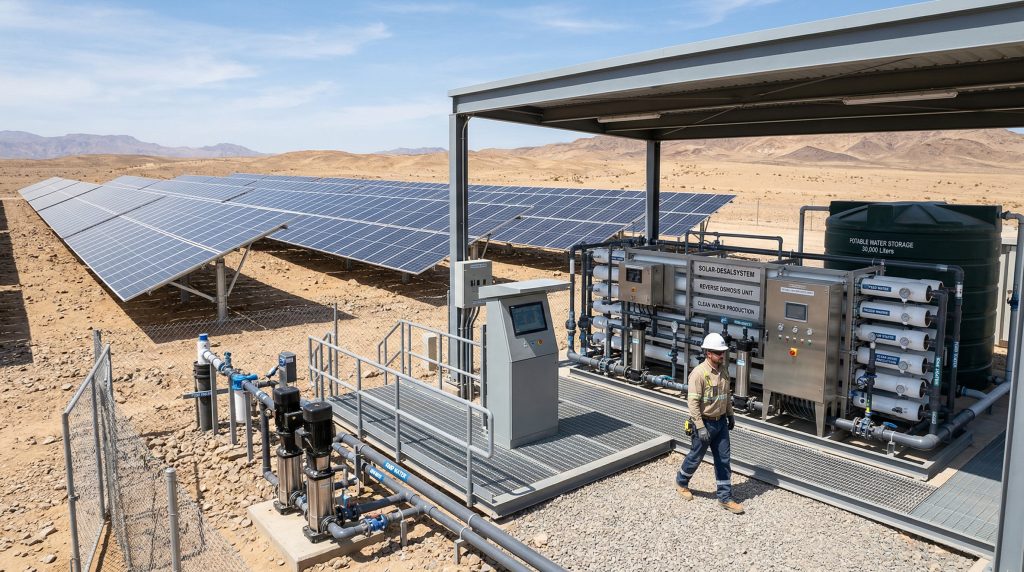
When the Grid Ends, the Water Problem Begins
There are roughly 2.2 billion people worldwide without access to safely managed drinking water. A significant portion of them live in coastal or island communities where seawater is abundant but fresh water is scarce—and where electrical grid infrastructure simply does not exist. For decades, this created an impossible equation: desalination requires energy, energy requires infrastructure, and infrastructure requires capital that remote communities don’t have.
Solar-powered reverse osmosis (Solar-RO) has fundamentally changed that equation. By coupling photovoltaic panels directly with RO desalination units, it’s now possible to produce thousands of gallons of potable water per day in locations with zero grid connectivity. The technology has matured past the pilot-project stage. Real systems are running in the Caribbean, sub-Saharan Africa, Southeast Asia, and disaster zones around the world—producing water at costs that are increasingly competitive with conventional diesel-powered alternatives.
This article breaks down the engineering realities of solar-powered desalination: how the systems work, what they cost, how to size them, and where they make the most sense.
How Solar-RO Systems Actually Work
At its core, a solar-powered desalination system pairs two mature technologies: photovoltaic (PV) panels and reverse osmosis membranes. The PV array generates DC electricity, which either powers the RO high-pressure pump directly through a variable frequency drive (VFD) or charges a battery bank that provides consistent power regardless of solar conditions.
Direct-Drive vs. Battery-Buffered Systems
There are two primary architectures, and the choice between them has significant implications for cost and output:
Direct-drive systems connect the PV array to the RO unit without battery storage. The system ramps up and down with solar irradiance—producing more water at midday and shutting down at night. These systems are simpler, cheaper (no battery cost), and have fewer components to maintain. The tradeoff is variable output. A well-designed direct-drive system in a location with 5-6 peak sun hours can produce water for roughly 8-10 hours per day.
Battery-buffered systems include lithium-ion or lead-acid battery banks that store excess solar energy for use during cloudy periods or nighttime operation. This provides consistent 24-hour output but adds 25-40% to the capital cost. Battery replacement cycles (every 5-8 years for lithium, 3-5 for lead-acid) also increase long-term OPEX.
For most off-grid applications, direct-drive systems with adequately sized water storage tanks offer the best balance of cost and reliability. You store water, not electricity—and water tanks are cheaper and more durable than batteries.

PV Panel Sizing: Getting the Math Right
Undersizing the solar array is the single most common mistake in solar-RO project design. Here’s how to approach the calculation properly.
Energy Requirements by Water Type
The energy needed depends heavily on feedwater salinity:
- Brackish water (1,000-10,000 ppm TDS): 1.0-3.0 kWh per cubic meter of permeate
- Seawater (30,000-45,000 ppm TDS): 3.5-6.0 kWh per cubic meter of permeate
- High-salinity seawater (Arabian Gulf, 45,000+ ppm): 5.5-8.0 kWh per cubic meter
These figures include the high-pressure pump, controls, and pre-treatment. For a seawater system producing 10,000 gallons per day (37.8 m³/day), you’re looking at roughly 130-225 kWh of daily energy demand.
Panel Array Calculation
With modern monocrystalline panels rated at 400-550W each and assuming 5 peak sun hours per day (a reasonable average for tropical and subtropical locations):
- A 10,000 GPD seawater system needs approximately 30-50 kW of installed PV capacity
- That translates to 60-100 panels at 500W each
- Required roof or ground area: approximately 1,500-2,500 square feet
Always add a 20-25% margin to account for panel degradation, soiling, temperature derating, and inverter losses. In dusty environments, budget for regular panel cleaning or consider automated cleaning systems.
Energy Recovery Devices: The Efficiency Multiplier
Modern seawater RO systems reject 55-65% of the feedwater as concentrated brine. That brine stream exits the membrane at high pressure—typically 800-1,000 psi for seawater applications. Energy recovery devices (ERDs) capture that hydraulic energy and transfer it back to the incoming feed stream.
Isobaric ERDs like the PX Pressure Exchanger can recover up to 98% of the hydraulic energy in the brine stream, reducing the overall specific energy consumption of a seawater RO system from 6+ kWh/m³ down to 2.5-3.5 kWh/m³. That means you need 40-50% fewer solar panels for the same output—a massive cost reduction.
For any solar-RO system larger than about 5,000 GPD treating seawater, an ERD is not optional. The payback period on the ERD alone is typically under 18 months when measured against the reduced PV array cost.
Real-World Cost Data
Let’s talk numbers. These are representative installed costs for turnkey solar-RO systems as of 2025-2026:
Capital Costs (CAPEX)
| System Size | Feedwater | Installed Cost (USD) | Cost per GPD |
|---|---|---|---|
| 1,000 GPD | Seawater | $45,000-$75,000 | $45-$75 |
| 5,000 GPD | Seawater | $120,000-$200,000 | $24-$40 |
| 10,000 GPD | Seawater | $200,000-$350,000 | $20-$35 |
| 5,000 GPD | Brackish | $50,000-$90,000 | $10-$18 |
These costs include the RO unit, PV panels, mounting structures, inverters/VFDs, pre-treatment, water storage, and basic installation. Battery storage (if included) adds $15,000-$60,000 depending on capacity.
Operating Costs (OPEX)
This is where solar-RO really shines compared to diesel-powered alternatives. With no fuel costs, annual OPEX for a 10,000 GPD solar-seawater system runs approximately:
- Membrane replacement: $3,000-$6,000/year (assuming 3-5 year membrane life)
- Pre-treatment chemicals and cartridge filters: $1,500-$3,000/year
- Routine maintenance labor: $2,000-$5,000/year
- Panel cleaning and minor repairs: $500-$1,500/year
- Total annual OPEX: $7,000-$15,500
Compare that to a diesel-powered system of the same capacity, where fuel alone can run $25,000-$50,000 per year depending on local diesel prices. The levelized cost of water from solar-RO typically falls between $3-$8 per cubic meter for seawater applications—and below $2/m³ for brackish water.
Applications: Where Solar-RO Makes the Most Sense
Off-Grid Coastal Communities
Island nations and remote coastal villages are the primary market. Systems ranging from 1,000 to 50,000 GPD serve communities of a few hundred to several thousand people. AMPAC’s seawater desalination systems are designed for exactly these conditions—compact, containerizable, and built for harsh marine environments where corrosion resistance and reliability are non-negotiable.
Disaster Relief and Emergency Response
After hurricanes, earthquakes, or tsunamis, municipal water infrastructure is often the first casualty. Solar-RO systems can be pre-staged in shipping containers and deployed within hours. Unlike generator-dependent systems, they don’t require continuous fuel resupply—a critical advantage when supply chains are disrupted. Several humanitarian organizations now maintain fleets of containerized solar-RO units specifically for rapid deployment.
Remote Industrial Sites
Mining operations, oil and gas platforms, military forward operating bases, and agricultural installations in arid regions all need water but lack grid power. Solar-RO provides a self-sufficient water supply without the logistics burden of fuel transport. AMPAC works across these industries with systems engineered for the specific water quality challenges each one presents.
Resort and Hospitality
Eco-resorts on remote islands increasingly use solar-RO to provide fresh water while maintaining their sustainability credentials. A 5,000-10,000 GPD system can comfortably serve a 50-100 room resort, and the “solar-powered” angle is genuinely appealing to environmentally conscious guests.
Design Considerations You Can’t Ignore
Feedwater Intake and Pre-Treatment
Solar variability means the RO system starts and stops frequently (especially direct-drive configurations). This cycling can stress membranes if pre-treatment isn’t properly designed. Beach wells generally provide better, more consistent feedwater quality than open ocean intakes and reduce pre-treatment requirements. At minimum, plan for multimedia filtration, 5-micron cartridge filters, and antiscalant dosing.
Water Storage
Since direct-drive systems only produce water during daylight hours, you need sufficient storage to carry the community through the night and cloudy days. A common rule of thumb is 2-3 days of storage capacity. For a community consuming 5,000 gallons per day, that means 10,000-15,000 gallons of tank capacity.
Remote Monitoring
Off-grid systems are, by definition, in hard-to-reach places. Cellular or satellite-based remote monitoring with automated alerts for pressure drops, flow anomalies, or TDS spikes is essential. Many modern systems include SCADA-lite controllers that can send SMS or email alerts and even allow remote parameter adjustment.
The Future: Falling Costs and Rising Capability
Solar panel prices have dropped roughly 90% over the past 15 years and continue to decline. Lithium-ion battery costs have fallen by approximately 80% in the same period. Meanwhile, RO membrane efficiency continues to improve—newer low-energy membranes from manufacturers like Toray, Hydranautics, and Dow FilmTec are reducing the energy required per gallon of permeate.
The convergence of these trends means that solar-RO is becoming cost-competitive not just with diesel desalination, but increasingly with trucked-in water supply and even some piped water systems in water-scarce regions. The International Desalination Association projects that solar-powered desalination capacity will grow by over 20% annually through 2030.
If you’re evaluating a solar-RO solution for a remote site, request a quote from AMPAC to get system sizing and pricing specific to your feedwater conditions and output requirements. With over 30 years of experience building desalination systems for challenging environments, AMPAC can engineer a solution that matches your site’s solar resources, water demand, and budget.
Key Takeaways
- Solar-RO is a proven, mature technology for producing fresh water in off-grid locations using seawater or brackish water as feedstock.
- Direct-drive systems (no batteries) paired with water storage tanks offer the best cost-performance balance for most applications.
- Energy recovery devices reduce PV array size by 40-50% for seawater systems and are essential for systems above 5,000 GPD.
- Installed costs range from $20-$75 per GPD depending on system size and feedwater salinity, with annual OPEX 50-70% lower than diesel alternatives.
- Proper pre-treatment, adequate water storage, and remote monitoring are critical design requirements for reliable long-term operation.
Frequently Asked Questions
=== CONTENT END ===