How Bad Is Utah’s Drought, and Why Should Businesses Care?
Utah’s drought is not a single event. It is a long-duration climate pattern that has been compounding since 2020. The U.S. Drought Monitor has classified large portions of the state under D2 (Severe) to D3 (Extreme) drought conditions for much of the past five years. According to the Utah Division of Water Resources, statewide snowpack levels dropped below 75% of the 30-year median for three consecutive years between 2020 and 2023, and reservoir storage across the state fell to levels not seen since the mid-1960s.
For commercial and industrial water users along the Wasatch Front—the corridor stretching from Ogden to Provo that contains over 80% of the state’s population and economic activity—this is not an abstract environmental concern. It is a direct operational risk. Municipal water providers including the Jordan Valley Water Conservancy District, Weber Basin Water Conservancy District, and Salt Lake City Department of Public Utilities have all implemented tiered conservation mandates. Stage 2 advisories require commercial users to cut consumption by 15-25%, with surcharges applied for overuse.
Businesses that depend on water—food processing facilities, manufacturing plants, data centers, laboratories, hospitality operations, and healthcare institutions—face a choice: comply with restrictions and reduce output, or invest in water treatment technology that makes them more self-sufficient.
What Is Happening to the Great Salt Lake?
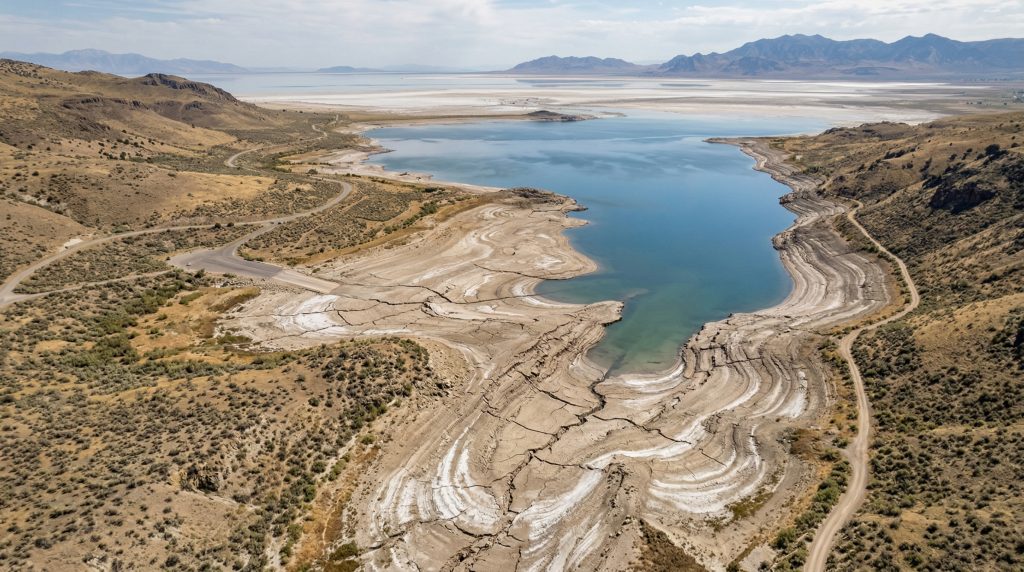
The Great Salt Lake has become the most visible indicator of Utah’s long-term water crisis. In November 2022, the lake dropped to a historic low of 4,188.5 feet above sea level—the lowest point since record-keeping began in 1847. While modest inflows during the 2023 and 2024 spring snowmelt seasons provided temporary relief, the lake remains well below the ecological health threshold of 4,198 feet identified by the Great Salt Lake Advisory Council.
The implications extend far beyond ecology. The exposed lakebed contains arsenic, heavy metals, and fine particulate matter. When wind events mobilize this dust across the Salt Lake Valley, air quality deteriorates, creating public health risks for the 1.2 million people living along the Wasatch Front. A 2023 study published in Nature Geoscience found that arsenic concentrations in lakebed dust exceeded EPA screening levels by a factor of five in some sampling locations.
For businesses, the Great Salt Lake crisis reinforces a broader message: water scarcity in Utah is not temporary. The tributaries that feed the lake—the Bear, Weber, and Jordan Rivers—are the same sources that supply municipal and industrial water along the Wasatch Front. When the lake shrinks, it means upstream diversions are consuming nearly everything, and there is less margin for everyone.
How Do Water Restrictions Affect Commercial Operations?
Commercial water restrictions during drought take several forms, and each one can directly impact a facility’s ability to operate at full capacity:
Outdoor Water Bans and Landscape Restrictions
Hotels, corporate campuses, and commercial properties are typically the first targets. Landscape irrigation bans can affect property appearance and value, but for most businesses, this is manageable. The harder restrictions follow.
Allocation Caps and Surcharges
Under Stage 2 and Stage 3 drought advisories, water districts can impose hard allocation caps on commercial accounts based on historical usage baselines. In the Weber Basin district, commercial users exceeding their allocation face surcharges of 200-400% on overage volumes. For a food processing plant using 50,000 gallons per day, a 20% mandatory reduction means either scaling back production or finding alternative water sources.
Cooling Tower and Process Water Restrictions
HVAC cooling towers and industrial process water circuits represent the largest single category of commercial water consumption. A typical 500-ton cooling tower consumes 1,800-2,400 gallons per hour during peak operation. When water districts restrict once-through cooling or limit blowdown volumes, facilities must either retrofit their systems for higher efficiency or risk thermal shutdowns during peak summer demand.
Construction Water Moratoria
During severe drought, some jurisdictions limit or suspend water connections for new construction. This has direct consequences for Utah’s fast-growing commercial real estate market, particularly along the Point of the Mountain corridor between Salt Lake City and Provo.
What Water Treatment Strategies Build Drought Resilience?
The good news is that proven, commercially available water treatment technologies can dramatically reduce a facility’s dependence on municipal water supplies. These are not experimental systems. They are standard industrial equipment that thousands of facilities across the Western US already operate.
On-Site Reverse Osmosis for Process Water
Commercial reverse osmosis systems can treat a range of alternative source waters—brackish groundwater, collected rainwater, or recycled process water—to produce high-purity water that meets or exceeds municipal standards. For facilities in Utah’s Wasatch Front, brackish aquifer water is often available at depths of 200-500 feet. This water typically has TDS levels of 2,000-5,000 mg/L, well within the treatment range of standard brackish water RO systems.
A properly sized commercial RO system producing 10,000-50,000 gallons per day can supply a mid-size manufacturing facility, data center, or hospitality complex with a self-contained water source that is independent of municipal restrictions. The reject stream (concentrate) from brackish water RO is typically 15-25% of feed volume and can often be discharged to sanitary sewer under standard pretreatment permits.
Water Recycling and Reuse Systems
For facilities that already consume large volumes of water, the most cost-effective drought resilience strategy is often to recycle what they already have. Commercial water reuse systems combine filtration, biological treatment, and RO polishing to recover 70-85% of wastewater streams for non-potable reuse. Common applications include:
- Cooling tower makeup: Recycled water reduces municipal makeup demand by 50-70%.
- Rinse water recovery: Manufacturing and food processing facilities can reclaim rinse and wash-down water for reuse in initial wash stages.
- Boiler feed pre-treatment: RO-polished recycled water meets the quality requirements for medium-pressure boiler feed, reducing both water and chemical costs.
- Landscape irrigation: Treated greywater can maintain landscaping even during outdoor water bans, provided local permits are in place.
Cooling Tower Optimization
Because cooling towers represent such a large share of commercial water consumption, optimizing their water efficiency delivers outsized returns during drought. Key strategies include:
- Increasing cycles of concentration: By improving makeup water quality with RO pre-treatment, facilities can run cooling towers at 6-10 cycles instead of the typical 3-5, reducing blowdown water volume by 30-50%.
- Blowdown recovery: Rather than discharging blowdown to drain, it can be treated with RO and recycled back as makeup water, recovering 70-80% of the blowdown volume.
- Side-stream filtration: Continuous side-stream filtration reduces suspended solids, allowing higher cycles without scaling or fouling.
What Is the Business Case for Investing in Water Treatment During a Drought?
The economics of commercial water treatment shift significantly during drought conditions. When municipal water rates increase by 200-400% for overage usage, or when production curtailments cost tens of thousands of dollars per day in lost output, the return on investment for on-site water treatment accelerates dramatically.
Consider a mid-size manufacturing facility in Salt Lake County that uses 40,000 GPD of municipal water at a blended rate of $5.50 per 1,000 gallons (approximately $80,300/year). Under Stage 2 restrictions with a 20% mandatory reduction:
| Scenario | Annual Water Cost | Production Impact |
|---|---|---|
| Comply with 20% reduction | $64,240 | 15-20% output reduction ($150K-$500K+ lost revenue) |
| Exceed allocation (pay surcharge) | $128,480-$176,660 | Maintain output but at 2-3x water cost |
| Install on-site RO + recycling | $30,000-$45,000 (operating cost) | Maintain full output, reduce municipal draw by 60-80% |
The capital cost for a commercial RO system with water recycling in the 20,000-40,000 GPD range typically falls between $75,000 and $200,000 depending on feedwater quality and system complexity. At drought-condition surcharge rates, payback periods of 18-36 months are common. When production loss avoidance is factored in, the payback can be less than 12 months.
Why Does AMPAC’s Location in Utah Matter?
AMPAC Water Systems is headquartered in Woods Cross, Utah—right in the heart of the Wasatch Front, the region most directly affected by Utah’s drought conditions. This is not a coincidence. The company’s engineering team works with the same water sources, the same municipal systems, and the same regulatory environment that their commercial customers face every day.
This local presence means several things for businesses looking to invest in water treatment for drought resilience:
- Site assessment and water testing: AMPAC engineers can conduct on-site water quality assessments throughout Utah and the Western US without the logistics overhead of a distant manufacturer.
- Local regulatory knowledge: Utah’s water rights system, which is based on prior appropriation doctrine, adds complexity to commercial water projects. AMPAC’s team understands the permitting landscape for well water, recycled water, and discharge that Utah businesses must navigate.
- Rapid service and support: For commercial systems, downtime costs money. Having the manufacturer within driving distance of major Utah commercial corridors means faster commissioning, faster parts delivery, and faster emergency service response.
- Systems designed for Western water chemistry: Utah’s brackish groundwater, high TDS surface water, and seasonal quality variation require specific design considerations. AMPAC’s systems are engineered for these conditions based on decades of direct experience.
AMPAC designs and manufactures commercial and industrial water treatment systems including reverse osmosis, nanofiltration, ultrafiltration, and water recycling systems for capacities ranging from 1,000 GPD to over 1,000,000 GPD. All systems are Manufactured in North America at the company’s facilities.
What Should Utah Businesses Do Right Now?
Drought resilience planning should not wait for the next Stage 3 advisory. The time to assess vulnerability and invest in water independence is before restrictions tighten further. Here is a practical action plan for Utah commercial and industrial water users:
- Audit current water consumption. Identify your facility’s top three water consumers (typically cooling, process, and sanitary) and quantify each stream.
- Assess alternative water sources. Determine whether brackish groundwater, collected rainwater, or process water recycling could replace a portion of your municipal supply.
- Model drought scenarios. Calculate the financial impact of 15%, 25%, and 40% municipal water curtailments on your operations.
- Evaluate on-site treatment options. Contact a commercial water treatment specialist to get system sizing, cost estimates, and ROI projections for your specific situation.
- Plan for phased implementation. Water treatment investments can be staged. Start with the highest-impact system (often cooling tower optimization or process water recycling) and expand as conditions warrant.
Utah’s drought is not going away. The long-term climate models from the University of Utah’s Department of Atmospheric Sciences and the Colorado River Basin forecasting consortium consistently project drier conditions and reduced snowpack for the Intermountain West through mid-century. For businesses along the Wasatch Front, water treatment infrastructure is not just an environmental investment—it is a business continuity investment.