Water Is a Production Input, Not a Disposable Resource
For most of the 20th century, manufacturing plants treated water the same way they treated packaging material—use it once and throw it away. Freshwater came in from the municipal supply or a well, passed through the process, and went out to the sewer or a discharge permit. The cost was negligible, the supply was reliable, and nobody thought twice about it.
That model is breaking down. Municipal water rates in major industrial regions have increased 40-60% over the past decade. Discharge permits are getting stricter and more expensive. Drought conditions and competing agricultural demand are making water allocation less predictable. And in some regions—the American Southwest, parts of the Middle East, Northern China, and Southeast Australia—industrial water availability is genuinely constrained.
The result is a fundamental shift in how manufacturers think about water. Reverse osmosis-based recycling systems are at the center of that shift, enabling plants to recover and reuse 75-90% of their process wastewater. The economics have reached a tipping point where water recycling isn’t just an environmental nice-to-have—it’s a competitive advantage that directly impacts the bottom line.

The Business Case: Real Numbers on Water Recycling ROI
Let’s start with the math, because that’s what drives capital approval in manufacturing.
The Rising Cost of Water
A mid-sized manufacturing plant in Southern California consuming 200,000 gallons per day currently pays roughly:
- Water supply: $6-$10 per 1,000 gallons (including tiered pricing and surcharges)
- Sewer discharge: $8-$14 per 1,000 gallons (depending on strength of discharge)
- Combined water cost: $14-$24 per 1,000 gallons
- Annual water expense: $1,000,000-$1,750,000
Now consider an RO recycling system that recovers 80% of that wastewater for reuse:
- Reduced freshwater purchase: 160,000 GPD saved = $350,000-$584,000/year
- Reduced sewer discharge: 160,000 GPD diverted = $467,000-$817,000/year
- Total annual savings: $817,000-$1,400,000
- RO recycling system OPEX (energy, chemicals, membranes, labor): $150,000-$300,000/year
- Net annual savings: $517,000-$1,100,000
With system capital costs ranging from $400,000 to $1,200,000 for a 200,000 GPD installation (depending on wastewater complexity and required permeate quality), the payback period typically falls between 8 months and 2.5 years. That’s a capital investment decision that sells itself.
How Closed-Loop Water Systems Work in Manufacturing
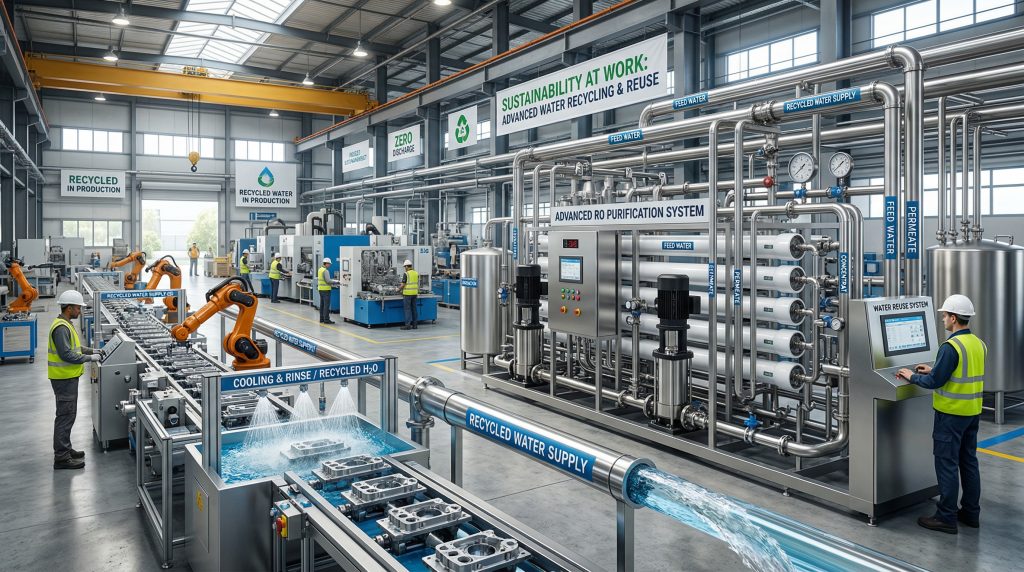
A closed-loop (or near-closed-loop) water recycling system captures process wastewater, treats it to the required quality, and returns it to the process. The basic flow path looks like this:
- Collection and equalization: Wastewater from various process streams is collected in an equalization tank that buffers flow and concentration fluctuations.
- Primary treatment: Removal of suspended solids, oils, and gross contaminants through screening, dissolved air flotation (DAF), or oil-water separation.
- Pre-treatment for RO: Multimedia filtration, activated carbon (for chlorine and organics), and cartridge filtration to protect the membranes. For high-fouling wastewater, ultrafiltration (UF) as a pre-treatment step significantly improves RO performance.
- Reverse osmosis: The core treatment step. The RO system removes 95-99%+ of dissolved salts, organics, and contaminants, producing permeate that meets or exceeds process water quality requirements.
- Post-treatment: pH adjustment, remineralization, or UV disinfection as needed for the specific reuse application.
- Concentrate management: The 10-25% reject stream (concentrate) still needs disposal—typically to the sewer, an evaporator, or in some cases, further concentration through a high-recovery RO or zero-liquid-discharge (ZLD) system.
Industry Case Studies: Water Recycling in Action
Automotive Manufacturing
Automotive plants are water-intensive. A typical vehicle assembly plant with painting, metal finishing, and cooling operations consumes 500,000-1,000,000 gallons per day. Paint shop rinse water, in particular, contains metals, phosphates, and surfactants that require treatment before discharge.
A Midwest assembly plant installed a 300,000 GPD industrial RO system to treat combined rinse water from their electrocoat and phosphate pretreatment lines. The system achieves 80% recovery, producing permeate with less than 50 ppm TDS—cleaner than their incoming municipal supply. Annual water and sewer savings exceeded $900,000, with additional savings from reduced chemical consumption in their paint pretreatment (since the recycled water has lower mineral content than the original supply). The system paid for itself in 14 months.
Food and Beverage Processing
Food plants face unique challenges: high organic loading (BOD/COD), seasonal production variability, and strict hygiene requirements for process water. Dairy processing, in particular, generates large volumes of whey-laden wastewater with high protein and lactose content.
A cheese manufacturer in Wisconsin installed a UF + RO system to treat CIP (clean-in-place) rinse water and separator wastewater. The UF stage removes fats and proteins; the RO stage removes dissolved minerals and remaining organics. Recovery rate: 85%. The recycled water is used for non-product-contact applications (floor washing, boiler makeup, cooling tower makeup), offsetting 170,000 GPD of freshwater purchase. The bonus: the UF concentrate is rich in whey protein and is sold as animal feed supplement, creating a secondary revenue stream.
Textile and Dyeing
Textile dyeing operations consume enormous amounts of water—typically 25-100 gallons per pound of fabric processed. The wastewater is highly colored, contains residual dyes, salts (often 2,000-5,000 ppm TDS from sodium sulfate or sodium chloride used in the dye process), surfactants, and sizing chemicals.
A denim finishing plant in North Carolina installed a multi-stage treatment system: biological treatment (to remove BOD), ozonation (for color removal), UF, and then RO. The RO system recovers 75% of the treated wastewater for reuse in the dye process. Since the recycled water has very low TDS, it actually improves dye uptake efficiency, reducing dye chemical consumption by 8-12%. Annual combined savings in water, sewer, and chemicals: approximately $650,000.
Pre-Treatment: The Make-or-Break Factor
Industrial wastewater is far more challenging to treat with RO than municipal water or groundwater. The single biggest reason industrial water recycling projects fail isn’t the RO system—it’s inadequate pre-treatment.
Common Pre-Treatment Failures
- Oil and grease carryover: Even trace amounts of oil (>0.1 ppm) will foul RO membranes. If your wastewater contains any oil, you need oil-water separation followed by organoclay or activated carbon polishing upstream of the RO.
- Silica concentration: As RO concentrates the reject stream, silica can reach supersaturation and precipitate on the membrane. If feedwater silica exceeds 20-30 ppm, you need to limit recovery rate or add silica-specific antiscalant.
- Biological growth: Warm, nutrient-rich industrial wastewater is an ideal breeding ground for bacteria. Without adequate biocide treatment, biofilm will form on the membranes within weeks.
- Variable feedwater quality: Manufacturing processes often change, and with them, the wastewater composition. An equalization tank with adequate retention time (4-8 hours) is essential to dampen concentration spikes that could shock the RO system.
AMPAC engineers industrial RO systems with pre-treatment packages matched to the specific wastewater characteristics. Getting this right requires a thorough wastewater characterization study—not just a single grab sample, but composite sampling over several production cycles to capture the full range of variability.
Regulatory Drivers and Compliance
Regulations are pushing manufacturers toward water recycling from two directions simultaneously:
Tighter Discharge Limits
The EPA and state agencies continue to ratchet down permitted discharge limits for metals, nutrients (nitrogen and phosphorus), total dissolved solids, and emerging contaminants like PFAS. Each round of tightening makes end-of-pipe treatment more expensive and water recycling more economically attractive by comparison.
Water Allocation Restrictions
In drought-prone regions, industrial water allocations are being cut. California’s industrial water use restrictions, for example, have driven significant adoption of recycling systems. Plants that invest in water recycling are less vulnerable to allocation cuts and drought-related production shutdowns.
ESG and Corporate Sustainability Commitments
Many large manufacturers have made public commitments to reduce water consumption intensity. Companies like Coca-Cola, Unilever, and GM have set targets to replenish more water than they consume. These commitments trickle down through supply chains, with OEMs increasingly requiring their Tier 1 and Tier 2 suppliers to demonstrate water stewardship practices.
Sizing and Planning Your Water Recycling System
If you’re considering an RO-based water recycling system for your plant, here’s the practical starting point:
- Audit your water balance. Map every water input and output. You’ll typically find that 60-80% of incoming water can theoretically be recycled.
- Characterize your wastewater. Composite sampling across multiple production cycles. Test for TDS, TSS, BOD, COD, oil and grease, specific metals, silica, hardness, pH, temperature, and any process-specific contaminants.
- Define permeate quality requirements. Different reuse applications (cooling tower, boiler makeup, process rinse, irrigation) have different quality requirements. You don’t need ultra-pure water for cooling tower makeup.
- Design the pre-treatment train based on wastewater characterization. This is where most of the engineering judgment resides.
- Size the RO system for your target recovery rate and permeate quality. AMPAC’s industrial RO systems range from 6,000 GPD to 500,000+ GPD and can be configured for the specific requirements of industrial wastewater recycling.
- Plan for concentrate disposal. The reject stream is concentrated wastewater. Verify that your sewer discharge permit can handle the increased concentration (lower volume but higher strength).
For a customized assessment of water recycling potential at your facility, request a quote from AMPAC. Their engineering team can evaluate your wastewater data and provide system recommendations with projected ROI.
Key Takeaways
- Industrial water recycling with RO typically achieves 75-90% recovery rates, reducing both freshwater purchase and sewer discharge costs.
- Payback periods for industrial RO recycling systems commonly range from 8 months to 2.5 years, depending on local water and sewer rates.
- Pre-treatment is the critical success factor—inadequate pre-treatment is the #1 reason water recycling projects underperform.
- Comprehensive wastewater characterization (composite sampling across production cycles) is essential before system design begins.
- Tightening discharge regulations, rising water costs, and corporate sustainability commitments are accelerating industrial adoption of water recycling.
Frequently Asked Questions
=== CONTENT END ===