Ask Any Experienced Brewer What the Most Important Ingredient in Beer Is, and the Answer Won’t Be Hops or Malt—It’ll Be Water
Beer is roughly 90-95% water. Every ion dissolved in that water affects enzyme activity during mashing, yeast health during fermentation, hop perception in the finished product, and the overall mouthfeel and drinkability of the beer. The great brewing cities of history—Pilsen, Burton-on-Trent, Munich, Dublin—became famous for specific beer styles largely because of their local water chemistry. Pilsner was born in Pilsen because the local water is incredibly soft. Burton’s high sulfate water made pale ales bright and hop-forward. Munich’s carbonate-rich water was perfect for dark lagers.
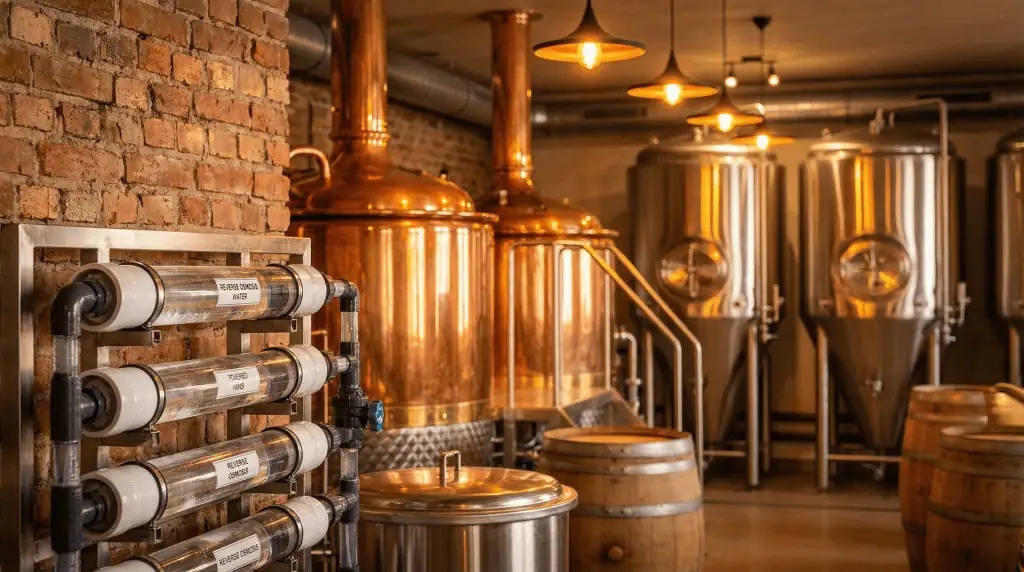
Modern craft brewers don’t have to accept whatever comes out of the tap. With a commercial reverse osmosis system, any brewery can start with a nearly blank canvas—water stripped of virtually all dissolved minerals—and build the exact water profile needed for any beer style. It’s the same principle that has made commercial RO systems from AMPAC standard equipment in craft breweries from San Diego to Portland to Asheville.
This article walks through the water chemistry fundamentals every brewer needs to understand, the practical treatment options, and why RO has become the go-to approach for serious craft producers.

The Ions That Matter: A Brewer’s Water Chemistry Primer
Six ions dominate brewing water chemistry. Understanding what each one does is the foundation for building any water profile.
Calcium (Ca²+)
The most important brewing ion, period. Calcium lowers mash pH (critical for enzyme activity), promotes yeast flocculation, improves beer clarity, and acts as a yeast nutrient. Target range: 50-150 ppm for most styles. Below 50 ppm, mash pH is hard to control. Above 200 ppm, water tastes harsh and mineral-forward.
Magnesium (Mg²+)
A yeast nutrient in small amounts (10-30 ppm). Above 50 ppm, magnesium contributes a sour, astringent bitterness. Most brewing water naturally contains enough magnesium without supplementation. Epsom salt (MgSO&sub4;) is the standard addition salt when more is needed.
Sodium (Na+)
In small amounts (10-70 ppm), sodium rounds out malt sweetness and adds body. Above 150 ppm, beer tastes salty and unpleasant. Above 200 ppm combined with high sulfate, the combination produces a harsh, metallic bitterness that no amount of recipe tweaking can fix.
Sulfate (SO&sub4;²−)
The hop ion. Sulfate accentuates hop bitterness, making it crisper and more pronounced. West Coast IPAs and English bitters often target 150-350 ppm sulfate. For malt-forward styles like Scottish ales or Oktoberfest, sulfate should stay below 50 ppm. The sulfate-to-chloride ratio is one of the most powerful tools in a brewer’s water chemistry toolbox.
Chloride (Cl−)
The malt ion. Chloride enhances malt sweetness, body, and mouthfeel. Stouts, porters, and malt-forward styles benefit from 50-150 ppm chloride. The sulfate-to-chloride ratio tells you where the beer will land on the spectrum: a ratio above 2:1 favors hop character; below 1:2 favors malt character; 1:1 is balanced.
Bicarbonate (HCO&sub3;−) / Alkalinity
The pH buffer. Bicarbonate raises mash pH, which is desirable for dark beers (dark malts are acidic and need alkalinity to hit the 5.2-5.6 target mash pH range) but problematic for pale beers. Munich’s high-bicarbonate water is why dark lagers thrived there. Pilsen’s near-zero bicarbonate is why pilsner mash chemistry works with pale malt alone. Most craft brewers want alkalinity below 50 ppm for pale styles and 100-200 ppm for dark styles.
The Problem with Municipal Tap Water
Municipal water supplies are treated for safety, not brewing. Two characteristics make tap water problematic for craft production:
Chlorine and Chloramine
Virtually all municipal water in the United States is disinfected with either free chlorine or chloramine (a chlorine-ammonia compound). Both react with phenolic compounds in malt to form chlorophenols—compounds detectable at concentrations as low as 1-2 parts per billion. The flavor is unmistakable: medicinal, Band-Aid-like, plasticky. A single batch contaminated with chlorophenols is a batch down the drain.
Free chlorine is relatively easy to remove—activated carbon filtration or a campden tablet (potassium metabisulfite) handles it quickly. Chloramine is more stubborn. It requires catalytic carbon or longer contact time with standard carbon. Many brewers who think they’ve removed chlorine are actually still passing chloramine through their system because their carbon filter isn’t rated for it.
Variable Water Chemistry
Municipal water quality changes seasonally, sometimes dramatically. A brewery that dials in a perfect water profile in January may find the tap water chemistry has shifted by March as the utility switches source water or adjusts treatment. Spring snowmelt dilutes dissolved minerals. Summer demand increases chlorine dosing. Blending from different wells changes the mineral profile entirely.
For a brewery producing the same IPA year-round, this variability is a consistency killer. Customers expect the beer to taste the same every time. If the water chemistry changes, so does the beer.
RO as a Blank Canvas: The Modern Brewery Approach
This is why reverse osmosis has become the standard approach for quality-focused craft breweries. An RO system removes 95-99% of all dissolved minerals, producing permeate water at 5-20 ppm TDS regardless of what the feed water looks like. That permeate is your blank canvas.
From there, building any water profile is straightforward. Brewing salts are cheap and precisely measurable:
- Calcium chloride (CaCl&sub2;) — Adds calcium and chloride
- Calcium sulfate / gypsum (CaSO&sub4;) — Adds calcium and sulfate
- Magnesium sulfate / Epsom salt (MgSO&sub4;) — Adds magnesium and sulfate
- Sodium chloride (NaCl) — Adds sodium and chloride (use sparingly)
- Sodium bicarbonate (NaHCO&sub3;) — Adds sodium and alkalinity for dark beers
- Calcium carbonate (CaCO&sub3;) / chalk — Adds calcium and alkalinity (dissolves poorly; slaked lime is often preferred)
A 10-barrel craft brewery using RO water and salt additions can replicate the water profile of Pilsen on Monday, Burton-on-Trent on Wednesday, and Dublin on Friday. That flexibility is impossible with any other treatment approach.
Sizing an RO System for a Brewery
Water usage in a craft brewery goes beyond just the beer itself. The industry rule of thumb is 5-7 barrels of water for every barrel of beer produced, accounting for:
- Brewing water (mash + sparge) — 1.3-1.5 barrels per barrel of beer
- Cleaning and sanitation (CIP) — 2-3 barrels per barrel of beer
- Boiler and glycol systems — 0.5-1 barrel per barrel of beer
- Packaging line rinse water — 0.5-1 barrel per barrel of beer
Not all of that water needs RO treatment. Brewing water and final rinse water should be RO-treated. CIP water and utility water can often use carbon-filtered municipal water. A 15-barrel brewhouse producing 4 batches per week needs roughly 3,000-5,000 gallons of RO water per week, or 500-800 GPD average with peak days significantly higher.
AMPAC commercial RO systems in the 2,000-10,000 GPD range are the sweet spot for most craft breweries. Systems include pre-filtration, carbon pre-treatment for chlorine/chloramine removal, and storage tank level controls that keep the RO tank full without operator intervention.
Water Profiles for Popular Beer Styles
Here are target water profiles that experienced brewers use, built from RO permeate plus salt additions:
| Style | Ca | Mg | Na | SO&sub4; | Cl | HCO&sub3; | SO&sub4;:Cl |
|---|---|---|---|---|---|---|---|
| West Coast IPA | 100 | 15 | 10 | 275 | 60 | 0 | 4.6:1 |
| Hazy / NE IPA | 75 | 10 | 20 | 75 | 150 | 0 | 1:2 |
| Czech Pilsner | 10 | 3 | 3 | 5 | 5 | 15 | 1:1 |
| English Bitter / ESB | 130 | 20 | 25 | 300 | 40 | 40 | 7.5:1 |
| Dry Irish Stout | 100 | 10 | 15 | 50 | 100 | 150 | 1:2 |
| German Lager / Helles | 60 | 15 | 5 | 60 | 60 | 100 | 1:1 |
All values in ppm. These are starting points—experienced brewers adjust based on grain bill, hop schedule, and personal preference.
Beyond Minerals: Water Quality Factors Brewers Overlook
Total Organic Carbon (TOC)
Organic compounds in water can cause off-flavors, interfere with yeast health, and increase chlorophenol formation potential. RO reduces TOC by 95-98%, which is another reason it outperforms simple carbon filtration for brewing applications.
Iron and Manganese
Even low levels (0.1-0.3 ppm) of iron or manganese cause metallic off-flavors, haze problems, and staling. Groundwater sources are particularly prone to elevated iron. RO removes both to below detection limits.
Silica
Silica above 20 ppm can contribute to permanent haze in finished beer and interfere with diatomaceous earth (DE) filtration. RO reduces silica by 95-98%.
Installation Considerations for Breweries
A few practical points that brewery owners should consider when planning an RO installation:
- Storage tank sizing — RO systems produce water continuously at a fixed rate. Brew day demand is intermittent and high. Size your treated water storage tank for at least one full brew day’s water demand (mash + sparge water). A 15-barrel system needs 600-800 gallons of storage minimum.
- Reject water recovery — RO produces 20-25% reject water. Smart breweries route this to CIP hot liquor tanks, boiler feed, or landscape irrigation rather than sending it down the drain. This dramatically improves overall water efficiency.
- Temperature — RO membrane performance varies with water temperature. Cold winter water (40°F) produces 30-40% less permeate than warm summer water (70°F) at the same pressure. Size the system for worst-case winter conditions, or install a water heater ahead of the RO to maintain consistent feed temperature around 60-70°F.
- Drain capacity — The reject water stream needs adequate drainage. A 5,000 GPD RO system generates roughly 1,200-1,500 GPD of concentrate that needs somewhere to go.
Need help sizing an RO system for your brewery? Request a quote from AMPAC with your average weekly production volume, and their team will recommend the right system.
Key Takeaways
- Water chemistry directly affects mash pH, hop perception, mouthfeel, and beer stability—it’s not optional knowledge for serious brewers
- Municipal tap water introduces chlorine/chloramine (chlorophenol risk) and variable mineral content (batch inconsistency)
- RO water provides a blank canvas with 5-20 ppm TDS, allowing precise mineral building for any beer style
- The sulfate-to-chloride ratio is the single most impactful water chemistry lever for flavor profile
- Most craft breweries need 2,000-10,000 GPD RO systems, sized for peak brew day demand
- Reject water should be recovered for CIP, utility use, or other non-brewing applications to minimize waste
Frequently Asked Questions
Can I just use a carbon filter instead of RO for my brewery?
A carbon filter will remove chlorine and chloramine (if properly sized), but it won’t change the dissolved mineral content of your water. If your municipal water happens to have a favorable mineral profile for the styles you brew, carbon filtration might be sufficient. But most brewers want the ability to brew multiple styles with different water profiles, and that requires starting from a low-mineral baseline. Carbon filtration also doesn’t remove nitrates, silica, or dissolved metals that can affect beer quality. For a brewery that produces diverse styles and values consistency, RO is the better investment.
How much does a brewery RO system cost to operate?
Operating costs for a commercial brewery RO system include membrane replacement (every 3-5 years, $500-$1,500), pre-filter replacement (quarterly, $50-$150), and electricity (minimal—a 5,000 GPD system draws roughly 1-2 kW). The biggest “cost” is reject water—but as discussed above, smart breweries reuse this for non-brewing purposes. All told, RO adds roughly $0.005-$0.01 per gallon to your water cost. For a 15-barrel batch using 500 gallons of brewing water, that’s $2.50-$5.00 per batch—less than a single bag of base malt.
Do I need to add minerals back to RO water, or can I brew with straight RO?
You should always add at least some calcium back to RO water. Brewing with zero-mineral water causes problems: mash pH will be too high (typically 5.8-6.0+ with pale malt and pure water), yeast health suffers from mineral deficiency, and the finished beer tastes flat and lifeless. A minimum of 50 ppm calcium from gypsum or calcium chloride solves most of these issues. Beyond that minimum, your salt additions depend on the beer style. Software tools like Bru’n Water or Brewfather make the calculations straightforward.
What about blending RO water with tap water instead of building from scratch?
Blending is a valid approach if your tap water has desirable characteristics that you want to dilute rather than eliminate. For example, if your tap water is 400 ppm TDS with a good calcium-to-sulfate ratio, blending 50/50 with RO permeate gives you 200 ppm TDS water that may be close to your target. The downside is that blending still ties you to your tap water profile—you’re scaling it down, not reshaping it. And when your municipal supply changes seasonally, your blended water changes too. Most breweries that start with blending eventually move to full RO plus salt additions for better control.
How long does it take a brewery RO system to fill a hot liquor tank?
It depends on the system size and tank volume. A 5,000 GPD (roughly 3.5 GPM) RO system fills a 500-gallon tank in about 2.5 hours. A 10,000 GPD (7 GPM) system does it in about 1.2 hours. Most breweries run their RO system overnight or between brew days to fill storage tanks, so the water is ready when the brewer arrives. AMPAC commercial systems include float-valve or electronic level controls that automatically stop the system when the tank is full and restart when water is drawn down.