Zero Liquid Discharge Was Once Considered Prohibitively Expensive. Tightening Regulations and Rising Water Costs Are Changing That Calculation Fast.
The concept sounds absolute: zero liquid discharge. No wastewater leaves the facility. Every drop of water is either reused in the process or recovered as clean distillate, and the only byproduct is a dry solid—typically a cake or crystallized salt that can be landfilled or, in some cases, sold as a commodity chemical.
Ten years ago, ZLD was a niche technology reserved for situations where discharge was physically impossible or regulators left no alternative. The economics were brutal—treatment costs of $10-$25 per thousand gallons versus $2-$5 for conventional treat-and-discharge. But the landscape has shifted. Inland facilities in water-stressed regions are running out of discharge options. The EPA’s 2024 Effluent Limitations Guidelines for steam electric power plants mandate zero discharge of flue gas desulfurization wastewater. States like California, Texas, and Colorado are imposing tighter discharge permits that push industries toward ZLD whether they planned for it or not.
Meanwhile, the technology has gotten more efficient. Modern ZLD systems built around high-recovery reverse osmosis, mechanical vapor compression, and brine crystallization can achieve total water recovery at costs that, while still premium, are increasingly competitive with the alternative: losing your discharge permit and shutting down production.
This article covers how ZLD systems work, where RO fits into the treatment train, which industries are adopting ZLD, and what the economics actually look like in 2025.

What Zero Liquid Discharge Actually Means
ZLD is exactly what it sounds like: an industrial facility that generates wastewater treats it to the point where no liquid effluent is discharged to surface water, groundwater, or the municipal sewer system. The treatment process separates wastewater into two streams:
- Clean water (distillate or permeate) that’s recycled back into the industrial process
- Solid residuals (salts, metals, or mineral concentrates) that are disposed of as solid waste or recovered for reuse
ZLD is distinct from “minimal liquid discharge” (MLD), which reduces discharge volume by 90-95% but still produces a small concentrate stream that requires disposal. MLD is often a more cost-effective intermediate step for facilities that can’t justify full ZLD economics but need to dramatically reduce discharge volumes.
The ZLD Treatment Train: Where RO Does the Heavy Lifting
A modern ZLD system is not a single piece of equipment—it’s a carefully sequenced treatment train where each technology handles a specific concentration range. Here’s how the stages typically break down:
Stage 1: Pretreatment
Raw wastewater first undergoes chemical softening (lime/soda ash) to remove calcium, magnesium, silica, and metals that would foul downstream membranes and evaporators. Clarification and filtration follow. This step is critical—skipping or under-designing pretreatment is the fastest way to turn a ZLD project into a maintenance nightmare.
Stage 2: Primary Reverse Osmosis (70-85% Recovery)
The workhorse of water recovery. Standard industrial RO treats the pretreated wastewater at 70-85% recovery, producing clean permeate for reuse and a concentrate stream at 3-5x the feed water TDS. For a feed water at 5,000 ppm TDS, primary RO produces permeate at under 100 ppm TDS and concentrate at 15,000-25,000 ppm.
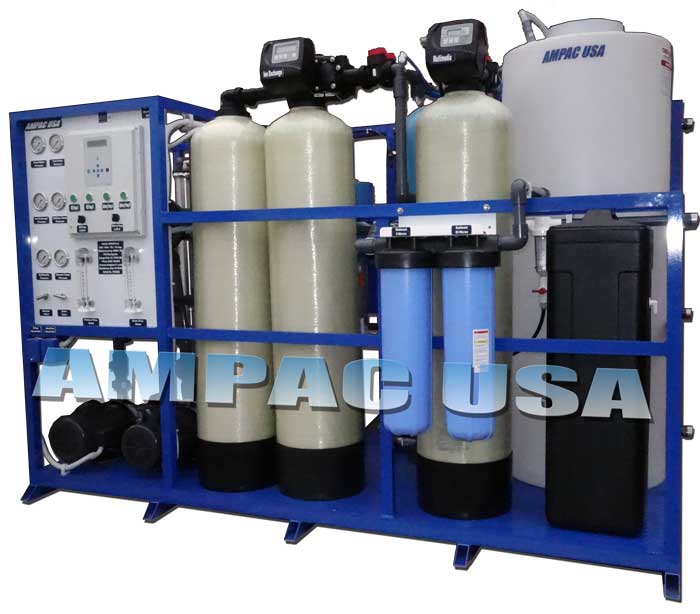
AMPAC industrial RO systems are designed for this duty, with high-recovery configurations, chemical-resistant wetted materials, and PLC controls that handle the variable feed water quality typical of industrial wastewater applications.
Stage 3: High-Recovery RO or Brine Concentrator (85-95% Total Recovery)
The primary RO concentrate still contains recoverable water. High-recovery RO systems using specialized membranes (disc-tube or vibrating membrane systems like VSEP) can push recovery to 90-95% by managing the scaling and fouling that conventional RO cannot handle at high TDS levels. These systems operate at elevated pressures (600-1,200 psi) with specialized antiscalant programs.
Alternatively, mechanical vapor compression (MVC) evaporators can concentrate the RO reject to 200,000-250,000 ppm TDS. MVC evaporators use a compressor to recycle the latent heat of evaporation, achieving thermal efficiency of 90%+ and energy consumption of 20-30 kWh per thousand gallons of distillate produced.
Stage 4: Crystallizer or Evaporation Pond
The final concentration step takes the brine from 200,000+ ppm to a dry solid. Forced-circulation crystallizers are the standard technology—they heat the brine to boiling in a recirculation loop, producing steam (recovered as clean distillate) and a slurry of crystallized salts that are dewatered in a filter press or centrifuge.
Crystallizers are the most energy-intensive component of a ZLD system, consuming 50-80 kWh per thousand gallons of feed. This is precisely why maximizing RO recovery in Stages 2 and 3 is so important—every gallon that RO recovers is a gallon that doesn’t need to be evaporated at 3-5x the energy cost.
The Economics: What ZLD Actually Costs
Let’s put real numbers on this. For a 500,000 GPD industrial ZLD system treating wastewater with 5,000 ppm TDS:
| Component | Capital Cost | Operating Cost ($/1000 gal) |
|---|---|---|
| Pretreatment (softening, clarification) | $500K – $1M | $1.50 – $2.50 |
| Primary RO (80% recovery) | $400K – $800K | $1.00 – $2.00 |
| High-recovery RO / Brine concentrator | $1M – $3M | $3.00 – $6.00 |
| Crystallizer | $2M – $5M | $8.00 – $15.00 |
| Total ZLD System | $4M – $10M | $13.50 – $25.50 |
Those operating costs look steep until you consider the alternatives. Deep well injection (where geologically feasible) costs $5-$15 per thousand gallons and requires permits that take 2-5 years to obtain. Trucking wastewater to an offsite disposal facility runs $0.05-$0.15 per gallon ($50-$150 per thousand gallons). And the cost of non-compliance—fines, production shutdowns, legal liability—dwarfs all of these numbers.
The MLD Option: 90% of the Benefit at 50% of the Cost
For facilities where regulations allow a small-volume discharge, minimal liquid discharge (MLD) eliminates the crystallizer—the most expensive component. An MLD system using pretreatment, primary RO, and high-recovery RO achieves 90-95% water recovery at $5-$10 per thousand gallons. The remaining 5-10% concentrate can often be disposed of through deep well injection, evaporation ponds, or permitted discharge at dramatically reduced volumes.
Industries Driving ZLD Adoption
Power Generation
The EPA’s 2024 steam electric ELG revisions require zero discharge of flue gas desulfurization (FGD) wastewater, coal ash transport water, and flue gas mercury control wastewater. This affects coal and gas-fired power plants nationwide. Compliance deadlines extend to 2028-2029, and utilities are actively designing and installing ZLD systems to meet them.
Mining and Mineral Processing
Mining operations generate massive volumes of wastewater contaminated with heavy metals, sulfates, and process chemicals. In regions like the American West and Australian Outback, there are simply no suitable surface water bodies for discharge. ZLD allows mines to operate in water-scarce environments while meeting environmental requirements. Recovered water is reused in processing, reducing freshwater intake by 85-95%.
Pharmaceutical Manufacturing
Active pharmaceutical ingredients (APIs) in wastewater are increasingly regulated. Conventional biological treatment doesn’t reliably remove all APIs, and residual compounds in discharged effluent pose risks to aquatic ecosystems. ZLD eliminates discharge entirely, containing APIs in solid residuals that can be incinerated. The pharmaceutical industry’s high product margins also make ZLD economics more palatable than in lower-margin industries.
Semiconductor and Electronics Manufacturing
Semiconductor fabs use ultra-pure water in enormous quantities—a large fab consumes 2-5 million gallons per day. The rinse water picks up trace metals, solvents, and fluoride compounds. In water-stressed regions like Arizona and Taiwan, ZLD allows fabs to recycle 95%+ of their water while eliminating discharge permits as a constraint on production expansion. TSMC’s Arizona fab, for example, is designed with near-ZLD water recycling as a condition of its water use permits.
Oil and Gas
Produced water from oil and gas extraction is the largest wastewater stream in the U.S. by volume—roughly 21 billion barrels per year. In the Permian Basin, where produced water volumes have overwhelmed disposal well capacity, operators are investing in treatment-for-reuse systems that approach ZLD. Treated produced water is reused for hydraulic fracturing, reducing freshwater demand and disposal costs simultaneously.
RO’s Critical Role in ZLD Economics
Here’s the key insight that drives ZLD system design: RO recovers water at $1-$3 per thousand gallons. Evaporation recovers water at $8-$15 per thousand gallons. Crystallization costs $15-$25 per thousand gallons. Every percentage point of additional RO recovery that you can achieve before resorting to thermal processes saves significant money.
This is why high-recovery RO technology has been the most important area of innovation in ZLD over the past decade. Advances in antiscalant chemistry, membrane materials, and system configurations (closed-circuit desalination, pulse-flow RO, vibrating membrane systems) have pushed achievable RO recovery from the traditional 75-80% to 90-95% in many applications.
For a 500,000 GPD system, increasing RO recovery from 80% to 92% reduces the volume sent to thermal concentration from 100,000 GPD to 40,000 GPD. At an evaporator operating cost differential of $10/thousand gallons, that saves $600/day or $219,000/year—enough to pay for the upgraded RO system within 2-3 years.
AMPAC’s industrial RO systems are engineered for high-recovery wastewater applications, with corrosion-resistant materials, heavy-duty pump assemblies, and controls designed for the variable feed water quality that industrial wastewater presents. For ZLD projects, AMPAC engineers work with system integrators to optimize the RO stage for maximum recovery and minimum downstream thermal load.
Regulatory Drivers: What’s Coming Next
The regulatory trajectory is clear: discharge standards are tightening, and the trend isn’t going to reverse. Key developments:
- EPA ELG revisions — Beyond steam electric, EPA is reviewing effluent guidelines for metal finishing, petroleum refining, and organic chemicals manufacturing
- State-level zero discharge mandates — California’s State Water Board has imposed zero discharge requirements on several inland facilities. Colorado’s produced water regulations are pushing oil and gas operators toward beneficial reuse
- Emerging contaminant regulations — PFAS, 1,4-dioxane, and pharmaceutical compounds are driving demand for advanced treatment that conventional discharge permits don’t adequately address
- ESG and sustainability commitments — Major corporations are voluntarily adopting water-positive commitments (Microsoft, Google, Meta), driving ZLD adoption at data centers and manufacturing facilities
Getting Started with ZLD Planning
ZLD is not a plug-and-play technology. Every installation requires detailed wastewater characterization, pilot testing, and engineering design. The first step is always a comprehensive water analysis that goes beyond basic TDS to include:
- Full ion analysis (Ca, Mg, Na, K, Ba, Sr, Fe, Mn, Si, SO&sub4;, Cl, HCO&sub3;, F)
- Heavy metals (if applicable)
- Organic compounds (TOC, BOD, COD, specific contaminants)
- Scaling potential calculations (Langelier, Stiff & Davis, BaSO&sub4; saturation)
- Temperature and flow variability (hourly, daily, seasonal patterns)
With that data in hand, engineers can design a treatment train optimized for your specific wastewater chemistry and recovery targets. Contact AMPAC’s industrial water treatment team to discuss your wastewater characterization and treatment goals, or request a quote for an industrial RO system as the foundation of your ZLD or MLD project.
Key Takeaways
- ZLD eliminates all liquid discharge from industrial facilities, recovering water for reuse and producing only solid residuals
- RO is the most cost-effective water recovery step in a ZLD system at $1-$3/thousand gallons versus $8-$25 for thermal processes
- Maximizing RO recovery (90-95%) before resorting to evaporation and crystallization is the key to controlling ZLD costs
- Total ZLD system costs run $13-$26 per thousand gallons—expensive, but often cheaper than the regulatory, legal, and reputational costs of non-compliance
- Minimal Liquid Discharge (MLD) achieves 90-95% recovery at roughly half the cost of full ZLD by eliminating the crystallizer
- Regulatory trends—tighter discharge limits, PFAS rules, and corporate sustainability commitments—are accelerating ZLD adoption across power, mining, pharma, and semiconductor industries
Frequently Asked Questions
What is the difference between ZLD and MLD?
Zero Liquid Discharge (ZLD) means absolutely no liquid wastewater leaves the facility—all water is recovered and only dry solids remain. Minimal Liquid Discharge (MLD) recovers 90-95% of water but produces a small-volume concentrated brine that still requires disposal (deep well injection, evaporation pond, or permitted discharge). MLD typically costs 40-60% less than ZLD because it eliminates the need for a crystallizer, which is the most capital-intensive and energy-intensive component. Many facilities start with MLD and upgrade to full ZLD as regulations tighten or disposal costs increase.
How much energy does a ZLD system consume?
Energy consumption varies by system design and wastewater characteristics but typically ranges from 20-40 kWh per thousand gallons of wastewater treated. The RO stages consume 3-8 kWh/thousand gallons, the brine concentrator adds 15-25 kWh/thousand gallons, and the crystallizer adds 50-80 kWh per thousand gallons of crystallizer feed (but processes only 5-10% of the original volume). Maximizing RO recovery minimizes the volume reaching energy-intensive thermal stages, which is why RO optimization is the most impactful design decision in a ZLD project.
Can the solid waste from ZLD be recycled or sold?
It depends on the composition. ZLD systems treating cooling tower blowdown or boiler blowdown often produce sodium chloride and sodium sulfate salts that can be sold to chemical distributors if purity is sufficient. Mining ZLD systems may produce gypsum (useful in construction) or recover valuable minerals like lithium from brine. However, many industrial ZLD systems produce mixed-salt solids contaminated with heavy metals or organic compounds that must be disposed of in lined landfills as industrial waste. The economics of solid residual management should be evaluated during the ZLD feasibility study—salt recovery can offset operating costs, while hazardous waste disposal adds to them.
Is ZLD feasible for small and mid-size industrial operations?
Full ZLD with crystallization is generally economical only at flows above 50,000-100,000 GPD due to the high capital cost of thermal equipment. However, MLD using high-recovery RO is increasingly accessible for smaller operations at 10,000-50,000 GPD. For even smaller flows, batch evaporators and mechanical vapor recompression units are available in modular configurations. The key question isn’t just system size—it’s the cost of alternatives. If your disposal costs exceed $10 per thousand gallons or if discharge permits are threatened, ZLD or MLD may be justified even at modest flow rates. Request a quote from AMPAC for a preliminary assessment based on your flow rate and wastewater characteristics.
How long does it take to design and install a ZLD system?
From initial wastewater characterization to system commissioning, a full ZLD project typically takes 18-36 months. The timeline breaks down roughly as: wastewater characterization and feasibility study (2-3 months), pilot testing (3-6 months for complex wastewaters), detailed engineering design (3-6 months), equipment procurement and fabrication (6-12 months), and installation and commissioning (3-6 months). The RO components typically have shorter lead times than thermal equipment, so phased implementation—installing RO first for immediate volume reduction, then adding thermal stages—is a common approach that delivers benefits sooner while spreading capital expenditure.