
Quick Answer
So, you want to test your home water? Here’s a summary: For a quick check, grab a DIY kit – these typically cost $15-$50. But for real answers, the kind you can build a solution around, you’ll need a certified lab test, which can cost $50-$300. At a bare minimum, always test for bacteria, lead, nitrates, pH, and hardness. If you’re on well water, annual testing is mandatory. City water users? Start with your utility’s free Consumer Confidence Report – it’s an invaluable resource. Then, focus on what really matters at your tap, like lead and concerning PFAS chemicals. And here’s our golden rule: Never buy a filtration system until you’ve tested. You need to know what you’re actually treating!
Why Testing Your Water Matters
To be clear: You can’t tell if your water is safe just by looking at it, sniffing it, or taking a sip. That’s a myth we hear all the time. Many of the truly dangerous contaminants—think lead, arsenic, PFAS, nitrates, and bacteria—are completely invisible, odorless, and tasteless, even at levels that are seriously risky for your health. The truth is, the only way to truly know what’s lurking in your water is to test it.
Now, the EPA effectively regulates public water systems. But here’s a critical point: they don’t regulate private wells. Studies show that roughly 23 million U.S. households rely on private wells, and for them, testing isn’t just a suggestion—it’s the homeowner’s absolute responsibility. Even if you’re hooked up to municipal water, contaminants like lead can still sneak into your drinking glass right from your own household plumbing, after that water has already left the treatment plant. It happens more often than you’d think.
What to Test For
Essential Tests for All Water Sources
Given the importance of testing, what exactly should you be looking for? In our experience, some things are non-negotiable, no matter where your water comes from. This table lays out the basics we always recommend:
| Contaminant | EPA Limit (MCL) | Why It Matters | Test Frequency |
|---|---|---|---|
| Total Coliform / E. coli | 0 (zero tolerance) | Indicates fecal contamination; immediate health risk | Annually (well); as needed (city) |
| Lead | 15 ppb action level | Neurotoxic; no safe level for children | Once; after plumbing work |
| Nitrate | 10 mg/L | Dangerous for infants; from fertilizer/septic | Annually (well) |
| pH | 6.5-8.5 (SMCL) | Affects corrosivity, pipe leaching | Annually |
| TDS (Total Dissolved Solids) | 500 mg/L (SMCL) | General water quality indicator | Annually |
| Hardness | No EPA limit | Scale buildup; soap efficiency | Once; when issues arise |
Additional Tests Based on Your Situation
Beyond those essentials, your specific location and home setup might call for a deeper dive. Here are some common situations and what to consider testing for:
- PFAS — If you live near military bases, airports, or industrial facilities; EPA limit is 4 ppt for PFOA and PFOS
- Arsenic — Common in well water in certain regions (Southwest, New England); MCL is 10 ppb
- Iron and Manganese — If you notice staining, metallic taste (well water); SMCL 0.3 ppm / 0.05 ppm
- Radon — If your area has elevated radon in air; can dissolve into groundwater
- Volatile Organic Compounds (VOCs) — If you live near gas stations, dry cleaners, or industrial sites
- Pesticides/Herbicides — If you live in agricultural areas
- Fluoride — If you want to verify levels or remove it; SMCL is 2.0 mg/L
DIY Home Water Test Kits
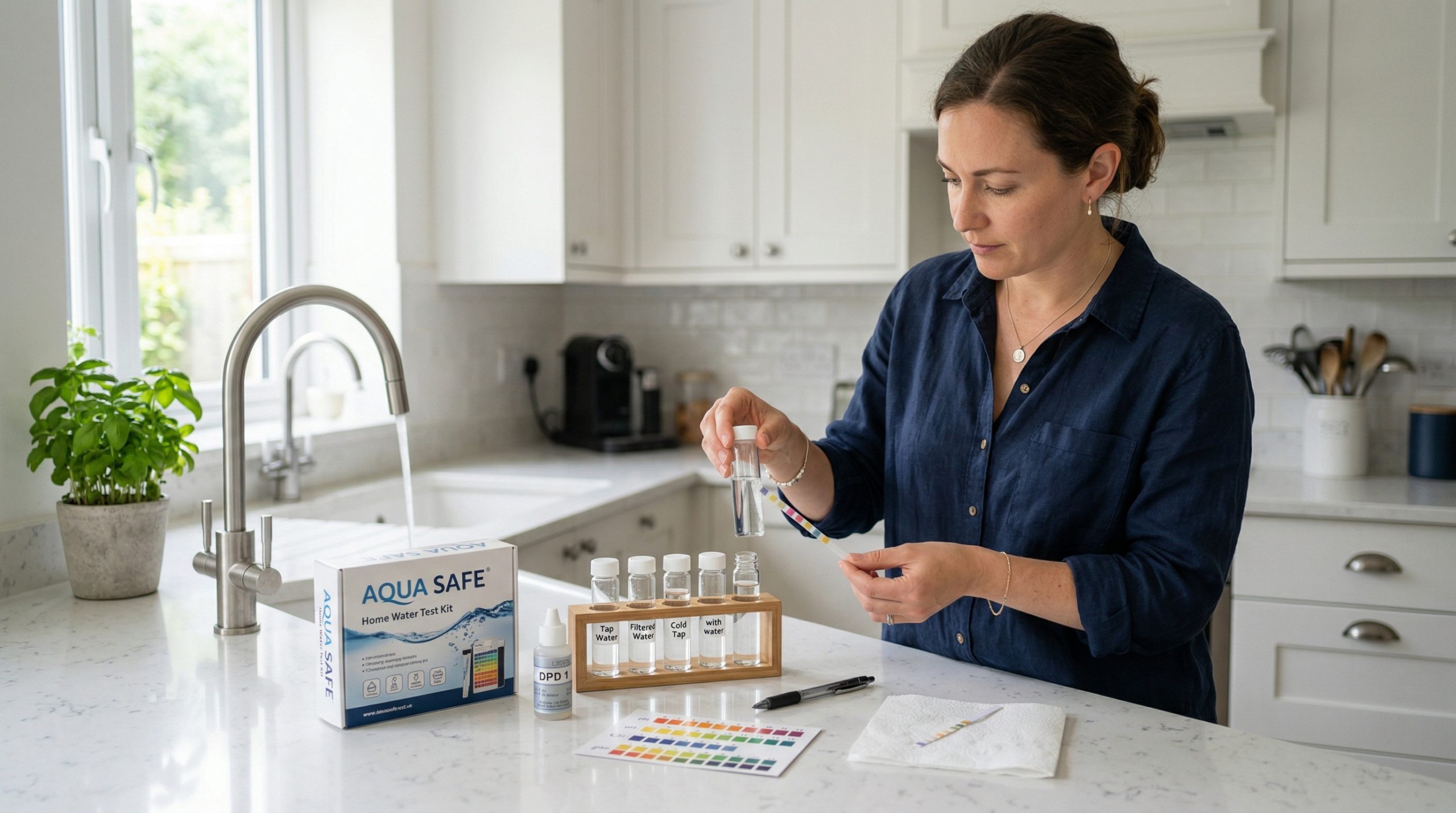
We understand the desire for quick, affordable answers without breaking the bank. Home test kits are excellent for a rapid, affordable screening of your water quality. These are readily available at most hardware stores or online retailers, usually for $15-$50. However, it’s crucial to understand that they are a screening tool, not a definitive diagnosis.
Types of DIY Test Kits
What are the available DIY testing options?
- Test strips — Simply dip them into your water sample. A color change tells you roughly what’s there. They are very quick, typically yielding results in 1-2 minutes, but they are the least precise option. They are useful for general indicators like hardness, pH, chlorine, or a preliminary ‘red flag’ check.
- Drop/reagent kits — These offer improved accuracy. You add liquid reagents to your water sample, then compare the resulting color to a chart. They’re more accurate than strips and are effective for iron, hardness, pH, and some specific contaminants.
- Digital TDS meters — These compact electronic devices measure your total dissolved solids. They’re inexpensive ($10-$20) and highly useful for monitoring how well your RO system is performing. But remember, they won’t tell you what those dissolved solids are—just that they’re there.
- Mail-in kits — These kits combine the convenience of DIY collection with the accuracy of professional analysis. You collect your samples at home, then ship them off to a lab. You get the convenience of doing it yourself, plus the accuracy of professional analysis. Expect to pay $100-$200 for a comprehensive panel with these.
Certified Laboratory Testing
When you need the absolute truth about your water—results that are accurate enough to stand up in court, if it ever came to that—you need a state-certified laboratory. We often recommend this route for homeowners making big decisions about treatment. The EPA maintains a comprehensive list of certified drinking water testing laboratories, organized by state. Additionally, many state health departments even offer low-cost well water testing programs. We recommend exploring these options.
What Lab Testing Costs
Regarding the cost of lab tests, here’s a general idea of what you can expect to pay for the kind of thorough analysis we’re talking about:
| Test Package | What It Covers | Typical Cost |
|---|---|---|
| Basic well water panel | Bacteria, nitrate, pH, hardness, TDS, iron | $50-$100 |
| Comprehensive panel | Basic + lead, arsenic, manganese, fluoride, VOCs | $150-$250 |
| PFAS testing | PFOA, PFOS, and other PFAS compounds | $200-$400 |
| Full environmental panel | 100+ contaminants including pesticides, metals, VOCs | $300-$600 |
How to Collect a Water Sample
Proper sample collection is crucial. Even the most advanced lab test yields inaccurate results if the sample is not collected correctly. Here’s how we tell our clients to do it for the most reliable test:
First, always use containers provided by the lab. (They’re sterile and specifically designed for this.) For bacteria testing, sterile containers are non-negotiable. Before collecting, run your cold water faucet for 2-3 minutes. This flushes out any standing water in the pipes. For lead testing, though, you want a “first-draw” sample—meaning, collect it before running any water. Lead tends to accumulate while water just sits in your pipes, making that initial sample critical.
Do not, under any circumstances, touch the inside of the bottle or its cap. Contamination is a real problem. Label each sample clearly with the date, time, and exactly where you collected it from. Then, transport it to the lab. You’re aiming for delivery within 24-48 hours, but for bacteria samples, that window is even tighter—usually 6-24 hours, depending on the lab’s specific requirements. And always keep those samples cool during transport. A small cooler with ice packs works perfectly.
Understanding Your Water Test Results
Once you receive your report, understanding its contents is the next step. Water test reports can initially appear complex. But understanding a few key terms will make it much clearer.
You’ll see things like MCL (Maximum Contaminant Level)—that’s the legally enforceable limit set by the EPA. Then there’s MCLG (Maximum Contaminant Level Goal), which is the non-enforceable health-based target, often zero for those nasty carcinogens. SMCL (Secondary Maximum Contaminant Level) refers to aesthetic guidelines, affecting taste, odor, and appearance—stuff that’s annoying but usually not a health risk. And for units, you’ll see ppb or ug/L (parts per billion) and ppm or mg/L (parts per million; remember, 1 ppm = 1,000 ppb).
The key is to: Compare each of your results directly against the EPA’s MCL. If any contaminant crosses that MCL threshold—or even its MCLG for things like lead, where no level is truly safe—then you absolutely need to take action. That means figuring out the source of the contamination and installing the right water treatment system. Don’t wait.
In summary: Testing your water is the absolute first step—the only smart step—before buying any water treatment system. Investing $50-$200 on a proper water test ensures you’re investing in the right filtration technology for your specific contaminants. Why guess and potentially waste hundreds of dollars on a system that won’t even fix your actual water quality issues? We’re here to help: Contact AMPAC Water Systems with your test results for a free, no-obligation system recommendation.
Frequently Asked Questions
We frequently receive questions about water testing, which indicates a growing awareness of water quality. Here are some of the most common ones we get:
How can I test my water quality at home for free?
If you’re on municipal water, the easiest “free” test is to obtain your utility’s annual Consumer Confidence Report (CCR). It’s publicly available and shows you what they’re treating for at the plant. Just remember, that report doesn’t tell you what’s happening at your specific tap. For something truly free in your home, some water treatment companies—including us—offer complimentary basic testing (like hardness, pH, chlorine, iron, TDS) as part of a consultation. Beyond that, a digital TDS meter is a reusable tool that costs less than $15.
How accurate are home water test kits?
Our experience indicates that DIY test strips are adequate for a general screening, but their precision is limited—often plus or minus 20-30%. Reagent-based kits offer improved accuracy, usually within 10-15% accuracy. But for truly actionable results, the kind you need to correctly size a treatment system, certified laboratory testing is the gold standard. Lab results are highly precise, legally defensible, and can detect contaminants that DIY kits simply can’t touch.
How often should I test my well water?
The EPA recommends that private well owners test their water annually. You’ll want to check for bacteria, nitrates, and other contaminants specific to your region.