
Quick Answer
RO systems and water softeners tackle entirely different water issues. Don’t mix them up – they’re not interchangeable. A reverse osmosis system, or RO, pulls out dissolved contaminants like lead, PFAS, arsenic, fluoride, and even general TDS by pushing water through an ultrafine membrane. Water softeners, on the other hand, specifically target those pesky hardness minerals: calcium and magnesium. They do this using a process called ion exchange. Most homes achieve the best results from having both: a softener to keep scale out of your pipes and appliances, and an RO system for top-notch drinking water. What we’ve found is that running softened water to your RO unit significantly extends the membrane’s lifespan, saving you money in the long run.
How Reverse Osmosis Works
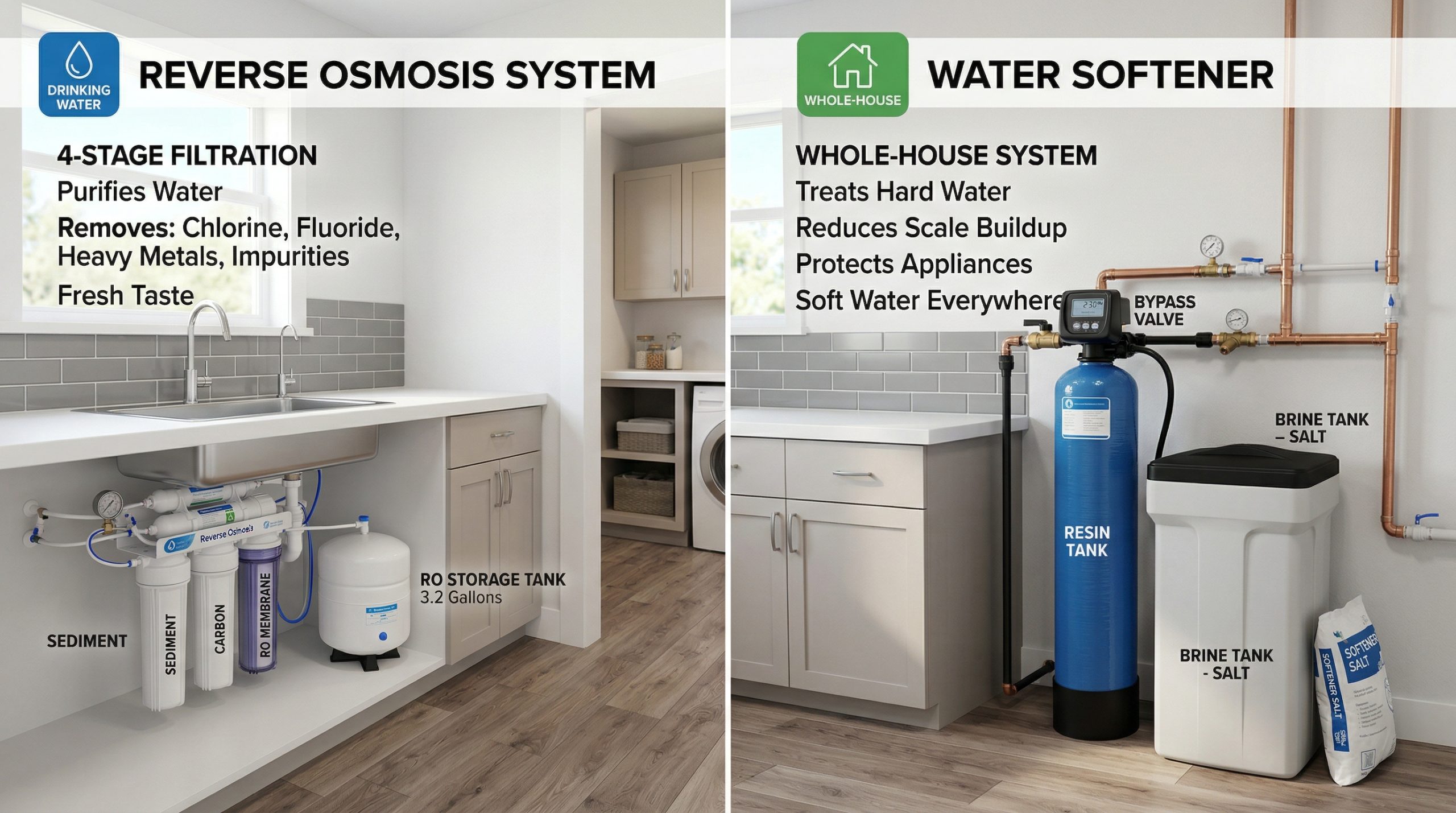
How does RO work? Imagine hydraulic pressure — basically, water pressure — forcing your tap water through a semi-permeable membrane. This membrane is incredibly fine, with pores measuring about 0.0001 microns. That’s microscopic! It’s designed to reject a significant 95-99% of dissolved solids (TDS), letting only the pure water molecules and a tiny fraction of minerals slip through. Most residential RO setups we install are not merely a single filter; they incorporate several stages of pre- and post-filtration for thorough purification.
For example, a typical 4- or 5-stage RO system usually starts with a 5-micron sediment pre-filter; that’s your first line of defense against dirt and grit. Next, a carbon pre-filter is critical for stripping out chlorine. Chlorine is a known membrane killer, and we have observed many prematurely failed membranes due to its presence. Then comes the star of the show: the RO membrane itself, handling the bulk of the purification. After that, a post-carbon or polishing filter fine-tunes the taste, giving you that crisp, clean finish. Some users even opt for a remineralization filter to reintroduce beneficial minerals; this choice depends on personal preference and, at times, local water chemistry.
How Water Softeners Works
Water softeners operate using a process called ion exchange. They’re packed with special resin beads that literally swap out the calcium and magnesium ions — those are the culprits behind hard water — for sodium or potassium ions. As hard water flows into the resin tank, those hardness minerals get snagged by the resin. However, these beads eventually become saturated. When that happens, the system goes into regeneration mode, flushing itself with a brine solution (that’s just salty water). This rinse washes all those trapped minerals down the drain and recharges the resin, getting it ready to soften more water. It’s a continuous cycle.
Softener systems treat every single drop of water coming into your home — we call that ‘point-of-entry’ treatment. RO systems, by contrast, are usually tucked away under a single faucet, most commonly the kitchen sink, serving as a ‘point-of-use’ solution.
What Each System Removes
| Contaminant | Reverse Osmosis | Water Softener |
|---|---|---|
| Calcium (hardness) | Yes (95-99%) | Yes (99%+) |
| Magnesium (hardness) | Yes (95-99%) | Yes (99%+) |
| Lead | Yes (95-99%) | No |
| PFAS | Yes (90-99%) | No |
| Arsenic | Yes (90-97%) | No |
| Fluoride | Yes (90-95%) | No |
| Nitrate | Yes (85-95%) | No |
| Chlorine | Yes (via carbon pre-filter) | No |
| TDS (dissolved solids) | Yes (95-99%) | Partially (exchanges ions; TDS stays similar) |
| Iron (ferrous, low levels) | Yes | Yes (under 2 ppm) |
| Bacteria / viruses | Partial (not rated for disinfection) | No |
| Sodium | Yes (90-95%) | No (adds sodium) |
When You Need a Reverse Osmosis System
When is an RO system most beneficial? It is the ideal solution when your water test reveals dissolved contaminants that a softener cannot remove. For instance, if your water report flags any detectable level of lead — and with children in the house, even a minimal amount is concerning — an RO system is essential. The same applies to PFAS contamination; the EPA’s health advisory for PFOA/PFOS is currently 4 parts per trillion (ppt), which is an incredibly low threshold. Arsenic levels above 10 ppb (the EPA’s Maximum Contaminant Level, or MCL), high TDS that makes your water taste flat or unusually mineralized, nitrates climbing past 5 mg/L (halfway to the 10 mg/L MCL), or a desire to reduce fluoride — these are all strong indicators for an RO system. We’ve seen a huge demand for this, especially with concerns about aging infrastructure.
AMPAC Water Systems offers a comprehensive lineup of residential RO systems. We can set you up with anything from a compact under-sink unit perfect for an apartment to a robust, high-capacity system designed to keep a bustling household or even a small office supplied with plenty of clean water.
When You Need a Water Softener
If you are battling hard water, a softener is the optimal solution for the entire home. You know you need one if you’re constantly scrubbing white scale deposits off your faucets and showerheads. Or maybe your water heater isn’t performing like it used to, or worse, it’s failing prematurely — hard water scale is often the culprit, costing you efficiency and money. Ever notice how your soap and shampoo do not lather effectively? Or your laundry feels stiff and looks dingy? These are classic signs. If your water test indicates hardness above 7 grains per gallon (gpg) — that’s typically considered moderately hard — or if you are supplying hard water to sensitive steam equipment, dishwashers, or commercial ice machines, a softener is essential. What we’ve found is that ignoring hardness can shave years off appliance life.
Why Many Homes Need Both
RO systems and softeners are not rivals; rather, they form an ideal partnership. They complement each other perfectly. Your whole-house softener treats the incoming water, effectively preventing scale buildup in your pipes, water heater, and all your valuable appliances. Meanwhile, that RO system under your kitchen sink delivers the cleanest, purest drinking and cooking water you can get. Furthermore, softened water dramatically extends the life of your RO membrane. Hard water causes mineral scaling on these delicate RO membranes, and in our experience, this can reduce their effectiveness and lifespan from a healthy 3-5 years to a mere 1-2 years. That’s a huge difference in maintenance and cost.
What is the optimal setup? We always recommend the following installation order: the incoming main water line feeds into your water softener. That softened water then goes to your main house distribution (and any branches), and finally, a dedicated line feeds your RO system at the kitchen sink. This ensures your RO membrane always gets softened, pre-treated water. It is crucial for maximum performance and outstanding longevity, a difference we have consistently observed.
Cost Comparison
| Factor | Reverse Osmosis | Water Softener |
|---|---|---|
| System cost | $200-$800 (residential) | $500-$2,500 |
| Installation | DIY ($0) or $100-$200 | Professional $200-$500 |
| Annual maintenance | $50-$150 (filters/membrane) | $100-$250 (salt + maintenance) |
| Coverage | Single faucet | Whole house |
| Water waste | 1-4 gallons per gallon produced | 50-100 gallons per regeneration |
| Lifespan | 10-15 years (with filter changes) | 15-20 years (with resin replacement) |
In summary: Reverse osmosis and water softeners are not competing technologies; rather, they address different problems. A good softener tackles hardness minerals, protecting your entire plumbing system and appliances from damaging scale. An RO system, on the other hand, effectively removes dissolved contaminants like lead, PFAS, arsenic, and general TDS, providing the absolute cleanest drinking water possible. For truly comprehensive home water treatment, the ideal setup, in our professional opinion, is a robust whole-house softener paired with a high-quality under-sink RO system. Contact AMPAC Water Systems today; we’d love to help you design the perfect combination for your specific water quality needs.
Frequently Asked Questions
Does reverse osmosis soften water?
Technically, yes — an RO system does remove calcium and magnesium, along with a host of other dissolved minerals. However, it is not practical for whole-house softening because RO systems operate at relatively low flow rates, typically 50-100 gallons per day (GPD). They also produce wastewater, and on a per-gallon basis, it is considerably more expensive than a dedicated ion exchange softener. Therefore, the advisable approach is to use a softener for whole-house hardness reduction and reserve the RO for pure drinking water.
Do I need a water softener if I have reverse osmosis?
If your water is hard — meaning anything above 7 gpg — then absolutely, yes. Go without a softener, and that hard water will wreak havoc throughout your entire home. Think scale buildup in your water heater, clogged pipes, crusty fixtures, and failing appliances. Plus, it’ll drastically shorten the life of your RO membrane. Remember, your RO system only protects the single faucet it’s hooked up to. A softener, however, safeguards your entire plumbing system and, crucially, pre-treats the water for your RO unit.
Will a water softener remove lead?
No, it does not. Water softeners are specifically engineered for ion exchange to capture calcium and magnesium ions. They simply aren’t designed to effectively remove lead, arsenic, PFAS, nitrates, or other dissolved contaminants. If lead is your concern, you will need either a reverse osmosis system or a specialized lead filter.