
What Is Driving the Smart Water Revolution?
The water treatment industry has historically been one of the slowest sectors to adopt digital technology. For decades, operators relied on periodic grab samples, manual log sheets, and reactive maintenance schedules. A membrane failed, you replaced it. A chemical dosing system drifted out of spec, you corrected it after the next lab test came back.
That approach is becoming untenable. Three forces are converging to make smart water systems not just advantageous but necessary.
The Workforce Gap
The American Water Works Association (AWWA) estimates that 30–50% of the water sector workforce will be eligible for retirement within the next decade. This is not just a hiring problem; it is an institutional knowledge problem. When a veteran operator with 25 years of experience reading membrane behavior walks out the door, that knowledge goes with them. Automated monitoring and AI-driven diagnostics can capture and operationalize that expertise, making it available to less experienced operators around the clock.
Regulatory Complexity
The regulatory landscape is expanding rapidly. New MCLs for PFAS compounds, anticipated standards for microplastics, tightening discharge limits for nitrogen and phosphorus—all require more frequent monitoring and faster response times than manual processes can deliver. Real-time monitoring with automated compliance reporting is becoming a practical necessity for staying ahead of multi-contaminant regulatory requirements.
Economic Pressure
Energy costs, chemical costs, and membrane replacement costs all represent significant operating expenses for water treatment systems. Even modest efficiency improvements—2–5% reductions in energy consumption, 10–15% improvements in chemical utilization, 15–25% extensions in membrane life—translate to substantial savings over a system’s operating life. Smart monitoring and optimization make those improvements achievable and sustainable.
How Does IoT Monitoring Work in Water Treatment?
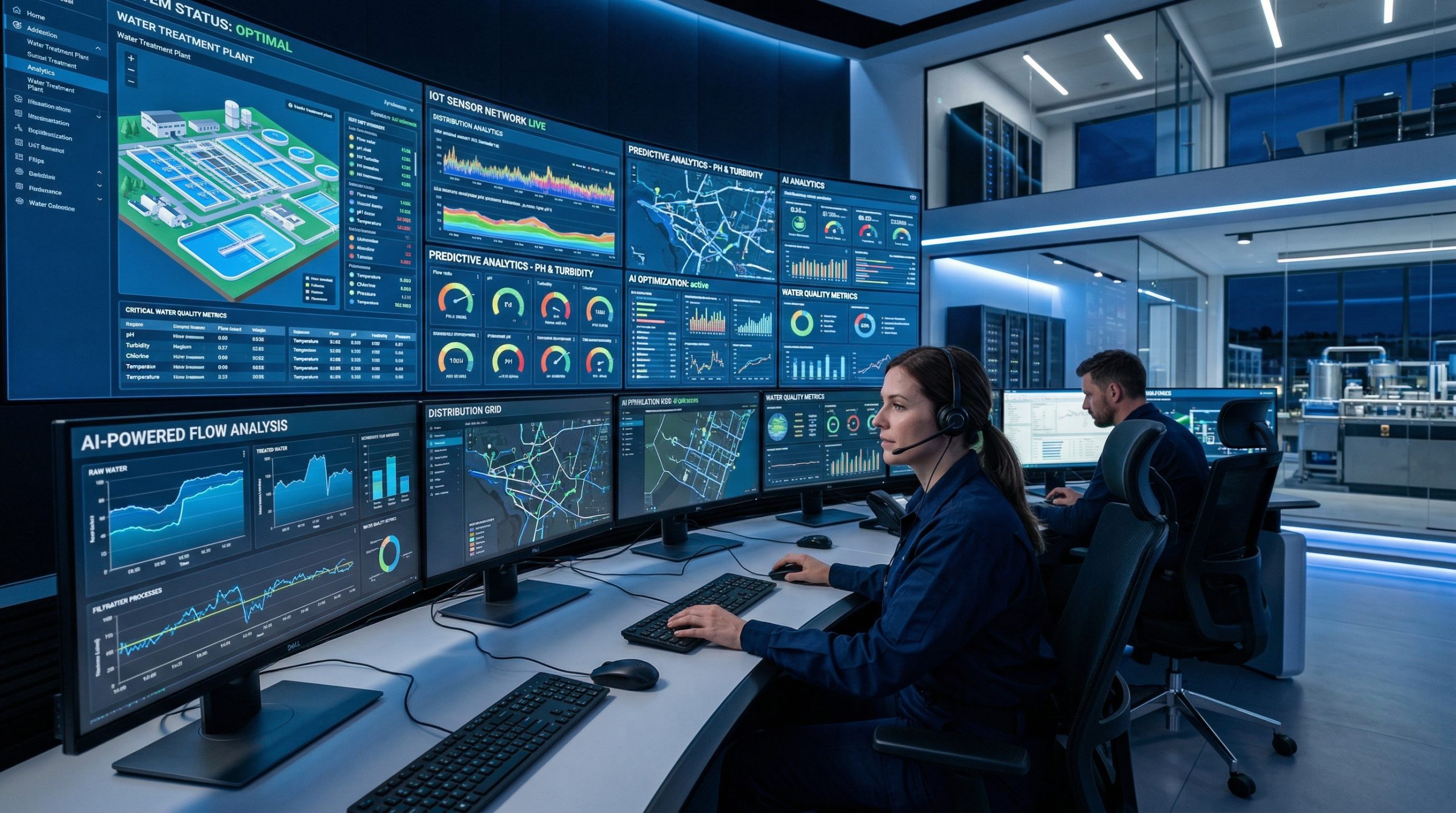
Internet of Things (IoT) monitoring in water treatment refers to the network of connected sensors, controllers, and data platforms that continuously measure, transmit, and analyze operational parameters. The concept is straightforward; the implementation has reached a level of maturity that makes it practical for systems of all sizes.
The Sensor Layer
Modern water treatment sensors measure parameters including:
- Total dissolved solids (TDS) / conductivity: Continuous measurement of permeate and reject quality, replacing periodic grab samples with real-time trending.
- Flow rate: Feed, permeate, and concentrate flows measured with electromagnetic or ultrasonic flowmeters, enabling real-time recovery rate calculation.
- Pressure: Feed, interstage, permeate, and concentrate pressures at each stage, providing the data needed to calculate specific flux and detect membrane fouling.
- Temperature: Feedwater temperature compensation for normalized performance tracking.
- pH and ORP: Critical for pretreatment optimization and membrane protection.
- Turbidity / SDI: Real-time feedwater quality monitoring for UF/RO pretreatment performance.
- Chlorine residual: Essential for membrane protection—free chlorine must be below 0.1 ppm before contacting polyamide RO membranes.
These sensors connect to programmable logic controllers (PLCs) or edge computing devices that aggregate the data locally and transmit it to cloud-based platforms via cellular, Wi-Fi, or Ethernet connections.
The Communication Layer
Data transmission from water treatment systems has evolved significantly. Modern IoT platforms use a combination of protocols:
- MQTT (Message Queuing Telemetry Transport): A lightweight protocol optimized for sensor data that minimizes bandwidth requirements. Ideal for remote installations with cellular connectivity.
- Modbus TCP/IP: The longstanding industrial communication standard, now bridged to cloud platforms through edge gateways.
- OPC UA (Open Platform Communications Unified Architecture): Provides secure, standardized industrial data exchange with built-in encryption and authentication.
- LoRaWAN: Long-range, low-power wireless communication suitable for distributed sensor networks across large treatment facilities or well fields.
Data security is a non-trivial concern. Water treatment infrastructure is classified as critical infrastructure under the Cybersecurity and Infrastructure Security Agency (CISA) framework. Properly implemented IoT systems use encrypted communications, role-based access control, and regular security auditing to prevent unauthorized access.
The Analytics Layer
Raw sensor data is useful. Analyzed sensor data is transformative. Cloud-based analytics platforms process the continuous stream of operational data to generate actionable insights that go far beyond what any operator can extract from manual log sheets.
How Is AI Being Applied to Water Treatment?
Artificial intelligence in water treatment is moving beyond the hype cycle into practical, measurable applications. The most impactful use cases are not exotic—they are practical applications of machine learning to well-understood problems.
Predictive Membrane Replacement
Membrane replacement in RO systems has traditionally been either calendar-based (replace every 3–5 years regardless of condition) or reactive (replace when performance drops below an acceptable threshold). Both approaches are suboptimal. Calendar-based replacement wastes usable membrane life. Reactive replacement risks water quality exceedances and unplanned downtime.
AI-based predictive models analyze the trajectory of normalized permeate flow, salt passage, and differential pressure over time, accounting for seasonal feedwater variations, cleaning events, and operating condition changes. These models can predict when a membrane element will reach its end-of-life threshold with 85–95% accuracy, typically 2–6 months in advance.
According to a 2024 survey by BlueTech Research, facilities using predictive membrane management reported 15–25% longer average membrane life and 30–50% reductions in unplanned membrane-related downtime compared to reactive approaches.
Automated Chemical Dosing
Chemical dosing in water treatment—antiscalants, pH adjustment, coagulants, disinfectants—has traditionally relied on fixed set points or manual adjustment by operators. AI-driven dosing systems continuously adjust chemical feed rates based on real-time feedwater quality, permeate quality, and system performance data.
The results are measurable. Facilities implementing AI-optimized chemical dosing have reported 10–20% reductions in chemical consumption while maintaining or improving treated water quality. For a facility spending $200,000 per year on treatment chemicals, that represents $20,000–$40,000 in annual savings—with the added benefit of more consistent water quality.
Energy Optimization
Energy is the single largest operating cost for most RO systems, typically accounting for 40–60% of total OPEX. AI optimization algorithms adjust pump speeds, system recovery rates, and operating pressures in real time to minimize energy consumption while maintaining production targets and water quality specifications.
Variable frequency drives (VFDs) on high-pressure pumps, controlled by AI algorithms that account for feedwater temperature, salinity, and membrane age, can reduce energy consumption by 5–15% compared to fixed-speed operation. Over a 10-year system life, those savings are substantial.
Anomaly Detection and Early Warning
Perhaps the most valuable application of AI in water treatment is the detection of abnormal conditions before they become problems. Machine learning models trained on historical operational data establish a “normal” operating envelope and flag deviations in real time.
Examples of AI-detected anomalies in practice:
- A gradual increase in specific flux decline rate that indicates membrane biofouling weeks before it would be detected by scheduled performance reviews
- Subtle shifts in feedwater chemistry (rising silica or sulfate) that predict scaling events
- Pump cavitation signatures detected through vibration and pressure pattern analysis
- O-ring failures detected through permeate conductivity profile analysis before they cause significant product water contamination
What Does the Market Data Say About Smart Water Adoption?
The smart water management market is growing rapidly, reflecting both the technology maturity and the economic value being realized by early adopters.
Allied Market Research projects the global smart water management market will reach $50.9 billion by 2033, growing at a 13.4% CAGR from 2024. Key growth drivers include aging water infrastructure requiring modernization, increasing regulatory monitoring requirements, and the declining cost of sensors and connectivity.
A 2025 survey by the Water Research Foundation found that:
- 62% of U.S. water utilities now use some form of IoT-connected monitoring (up from 38% in 2020)
- 48% have deployed or are piloting predictive analytics tools
- 34% are using AI or machine learning in at least one operational area
- 87% reported that their investment in smart water technology had met or exceeded ROI expectations
For commercial and industrial water systems, adoption is accelerating even faster. Manufacturing facilities, data centers, and food processing plants—where water quality and system uptime are directly tied to production output—are among the most aggressive adopters of smart water technology.
What Smart Features Should You Look for in a Commercial RO System?
Not all “smart” systems are created equal. When evaluating commercial or industrial RO systems, the following connected features deliver the most practical value:
Remote Monitoring and Alerts
The ability to view system status, performance data, and alarms from any device with internet access. This is particularly valuable for facilities with remote or unmanned water treatment installations. Look for systems that provide customizable alarm thresholds and multi-channel notifications (email, SMS, app push notifications).
Automated Performance Normalization
Raw performance data (flow, pressure, salt rejection) varies with feedwater temperature and concentration. Without normalization, it is impossible to track true membrane performance trends. Smart systems automatically normalize data per ASTM D4516 standards, providing accurate trend lines that reveal genuine performance changes versus seasonal variations.
Clean-in-Place (CIP) Optimization
AI-driven CIP scheduling triggers cleaning events based on actual membrane fouling indicators rather than fixed time intervals. This prevents both over-cleaning (which wastes chemicals and reduces membrane life) and under-cleaning (which allows fouling to become irreversible). Smart CIP systems also adjust cleaning parameters—temperature, chemical concentration, flow rate, and duration—based on the type of fouling detected.
Data Logging and Compliance Reporting
Automated data logging at configurable intervals (typically 1–15 minutes) creates a continuous operational record that satisfies regulatory monitoring requirements and provides the dataset needed for performance trending and predictive analytics. Automated report generation reduces the administrative burden on operators and ensures consistent documentation.
Integration with Plant SCADA/DCS
For facilities with existing supervisory control and data acquisition (SCADA) or distributed control systems (DCS), the water treatment system should integrate seamlessly through standard industrial protocols (Modbus, OPC UA, BACnet). This allows centralized monitoring and control from the plant’s existing operator interface.
What Are the Barriers to Smart Water Adoption?
Despite the clear benefits, several practical barriers slow adoption, particularly for smaller systems:
Cybersecurity Concerns
Connecting water treatment infrastructure to the internet introduces cybersecurity risk. The 2021 Oldsmar, Florida incident—where a remote attacker gained access to a water treatment plant’s SCADA system and attempted to increase sodium hydroxide dosing to dangerous levels—underscored this vulnerability. CISA and the EPA have since issued guidance on securing water system operational technology (OT), but implementation varies widely.
Proper cybersecurity architecture—network segmentation, encrypted communications, multi-factor authentication, regular security auditing—mitigates these risks. Smart system vendors should demonstrate compliance with IEC 62443 (industrial cybersecurity) and NIST Cybersecurity Framework standards.
Sensor Reliability and Maintenance
Online sensors in water treatment environments face challenging conditions: biofouling, chemical exposure, and temperature extremes. Sensor drift and failure are ongoing maintenance concerns. Modern sensors with self-cleaning capabilities, automatic calibration validation, and redundant measurement have improved reliability, but sensor maintenance remains a real operational consideration.
Data Overload
A fully instrumented water treatment system can generate millions of data points per day. Without proper data management and analytics tools, operators are overwhelmed rather than empowered. The value of IoT monitoring is realized only when the data is processed into actionable information—alarms, trends, recommendations—rather than raw numbers.
How Is AMPAC Integrating Smart Technology?
AMPAC Water Systems designs commercial and industrial RO systems with monitoring and control capabilities that reflect the practical needs of our customers. Our systems, manufactured in North America at our Woods Cross, Utah facility, incorporate PLC-based controls with network connectivity, multi-parameter sensor arrays for real-time performance tracking, and data logging for compliance and maintenance optimization.
We work with facilities across multiple industries—from municipal water supply to manufacturing to hospitality—to implement monitoring solutions that are appropriately scaled to each application. A small commercial RO system serving a hotel may need basic remote monitoring and alarm notification. A 500,000 GPD industrial system may require full SCADA integration, predictive analytics, and automated CIP management.
The key is designing smart features that solve real operational problems rather than adding complexity for its own sake. If you are evaluating a new water treatment system or looking to upgrade the monitoring capabilities of an existing installation, contact our engineering team to discuss the options that make the most sense for your operation.
Frequently Asked Questions
What is the difference between IoT monitoring and SCADA?
SCADA (Supervisory Control and Data Acquisition) is a traditional industrial control system architecture that uses dedicated hardware and proprietary communication protocols to monitor and control plant processes. IoT monitoring uses internet-connected sensors and cloud-based platforms, often with standardized protocols and consumer-grade interfaces. In practice, the two are converging. Modern SCADA systems incorporate IoT connectivity, while IoT platforms increasingly offer the reliability and control capabilities traditionally associated with SCADA. For water treatment, the distinction matters less than the functionality: does the system provide real-time monitoring, alarming, data logging, and remote access?
How much does it cost to add smart monitoring to an existing water treatment system?
Retrofit costs vary widely depending on the scope. Adding basic remote monitoring with cellular connectivity and cloud dashboard to an existing RO system typically costs $5,000–$25,000, including sensors, gateway hardware, and the first year of cloud platform subscription. More comprehensive upgrades with additional sensors, PLC replacement, and predictive analytics integration can range from $25,000–$100,000 for a medium-sized industrial system. In most cases, the payback period is 12–24 months through reduced chemical costs, energy optimization, and avoided downtime.
Is AI in water treatment reliable enough for critical decisions?
Current AI applications in water treatment are best described as decision-support tools rather than autonomous decision-makers. The AI identifies patterns, predicts trends, and recommends actions—but critical decisions (membrane replacement, chemical changes, system shutdowns) typically require operator confirmation. This “human-in-the-loop” approach provides the analytical power of AI while maintaining the judgment and accountability of experienced operators. As the technology matures and track records build, the level of automation will increase, but full autonomy is not the near-term goal.
Can smart monitoring help with regulatory compliance?
Significantly. Automated continuous monitoring provides a documented, timestamped record of water quality and system performance that exceeds the requirements of most regulatory monitoring programs. Smart systems can generate compliance reports automatically, flag potential exceedances in real time before they become violations, and provide the data trail needed for regulatory audits. For facilities subject to NPDES discharge permits, Safe Drinking Water Act monitoring, or state-specific requirements, smart monitoring reduces both compliance risk and administrative burden.
What happens if the internet connection drops on a smart water system?
Properly designed smart water systems operate on a “fail-safe” principle. The local PLC or edge controller maintains full autonomous control of the water treatment system regardless of internet connectivity. During a connectivity outage, the system continues operating on its local control logic, data is stored locally and uploaded when connectivity is restored, and critical alarms can be routed through redundant channels (cellular backup, SMS). The smart features enhance operations when connected but do not compromise basic system function when connectivity is lost.
How does predictive maintenance compare to preventive maintenance for RO systems?
Preventive maintenance follows a fixed schedule: clean membranes every 3 months, replace cartridge filters every month, service pumps every 6 months. This approach is simple but inefficient—you either maintain too early (wasting time and materials) or too late (risking damage). Predictive maintenance uses real-time data and trend analysis to schedule maintenance precisely when it is needed, based on actual equipment condition rather than calendar time. Studies show predictive approaches reduce maintenance costs by 25–30% and unplanned downtime by 30–50% compared to preventive schedules alone.
Conclusion
This post outlined water treatment requirements and solutions across key industries, from food and beverage to data centers and hospitality. AMPAC Water Systems designs industry-specific water treatment systems built to your quality standards, regulatory requirements, and operational demands. Contact our engineering team to discuss your industry application.