
What is Seawater Desalination?
Seawater desalination is the process of removing salt, minerals, and contaminants from ocean water to produce fresh, potable drinking water. With global freshwater resources under increasing pressure from population growth and climate change, seawater desalination has become a critical technology for coastal communities, island nations, offshore operations, and military deployments worldwide.
How Does Seawater Reverse Osmosis (SWRO) Work?
Seawater reverse osmosis (SWRO) is the most energy-efficient and widely used desalination technology. The process works by pressurizing seawater (typically at 800-1,000 PSI) and forcing it through specially designed high-rejection membranes that remove 99.5%+ of dissolved salts.
A typical SWRO system includes:
- Intake and screening — Seawater is drawn through screens to remove debris and marine organisms
- Multi-media pre-filtration — Sand filters and cartridge filters remove suspended solids
- Chemical dosing — Anti-scalant and pH adjustment prevent membrane fouling
- High-pressure pumping — Energy recovery devices reduce power consumption by up to 60%
- RO membrane array — Seawater-grade membranes (typically 8-inch spiral wound) reject salt
- Post-treatment — Remineralization, pH adjustment, and chlorination prepare water for distribution
AMPAC Seawater Desalination Systems
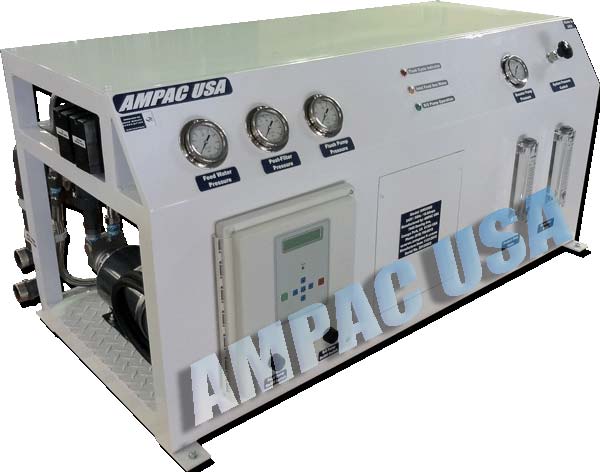
AMPAC Water Systems manufactures seawater desalination watermakers in a wide range of configurations:
- Portable emergency units (100-600 GPD) — For disaster relief, military field operations, and remote expeditions
- Marine watermakers (500-5,000 GPD) — For yachts, commercial vessels, and offshore platforms
- Land-based systems (1,500-100,000 GPD) — For coastal communities, resorts, and industrial facilities
- Mobile/containerized units — Trailer-mounted or container-housed for rapid deployment
Applications for Desalination Technology
Seawater desalination serves critical needs across diverse sectors:
- Island communities — Providing the only source of fresh water for remote populations
- Military operations — ROWPU (Reverse Osmosis Water Purification Unit) systems for forward operating bases
- Offshore oil and gas — Freshwater production on drilling platforms and FPSOs
- Coastal resorts — Independent water supply for luxury hotels in water-scarce regions
- Disaster relief — Rapid-deployment units for emergency freshwater production after natural disasters
Need a seawater desalination solution? AMPAC engineers custom systems for any capacity and deployment scenario. Get a free consultation.
Frequently Asked Questions
What are the latest advances in water treatment technology?
Modern water treatment combines advanced membrane filtration (RO, NF, UF), electrochemical processes, AI-driven monitoring, and IoT-enabled remote control. Smart systems from AMPAC Water Systems use real-time sensors to auto-adjust dosing, pressure, and flow, reducing chemical use by up to 30% and energy consumption by up to 25% compared to legacy systems.
How does smart monitoring improve water treatment operations?
IoT-enabled water treatment systems stream operational data (flow rate, TDS, pressure, pH, ORP) to cloud dashboards, enabling predictive maintenance, automatic alarm response, and remote troubleshooting. AMPAC Water Systems integrates SCADA-compatible control panels with remote access on all commercial and industrial installations.
What is the difference between NF and RO membranes?
Nanofiltration (NF) membranes operate at lower pressure (70-150 PSI) and remove multivalent ions, hardness, and color while passing monovalent salts. Reverse osmosis (RO) removes virtually all dissolved solids (95-99%). AMPAC Water Systems engineers specify NF or RO based on your source water quality and product water requirements.
Can water treatment systems integrate with renewable energy?
Yes. Solar-powered and wind-assisted water treatment is increasingly viable, particularly for off-grid and remote applications. AMPAC Water Systems designs energy-efficient systems with variable frequency drives (VFDs) and energy recovery devices that pair well with intermittent renewable power sources.
What certifications should water treatment equipment have?
Key certifications include NSF/ANSI 58 (RO systems), NSF/ANSI 61 (potable water contact), and WQA Gold Seal. Commercial and industrial systems should also meet ASME pressure vessel codes and UL electrical standards. All AMPAC Water Systems installations are engineered to applicable NSF, ASME, and local regulatory standards.
Conclusion
This post explored emerging and proven water treatment technologies reshaping how businesses and municipalities manage water quality. For organizations looking to deploy advanced water treatment solutions, AMPAC Water Systems engineers custom systems using the latest membrane, sensor, and automation technologies. Contact our team at info@ampacwatersystems.com or visit ampacwatersystems.com to discuss your project.
AMPAC Water Systems designs and manufactures advanced water treatment solutions for commercial, industrial, and municipal applications. From RO systems and PFAS removal to zero liquid discharge and smart water technology — engineered for your needs.