

Quick Answer
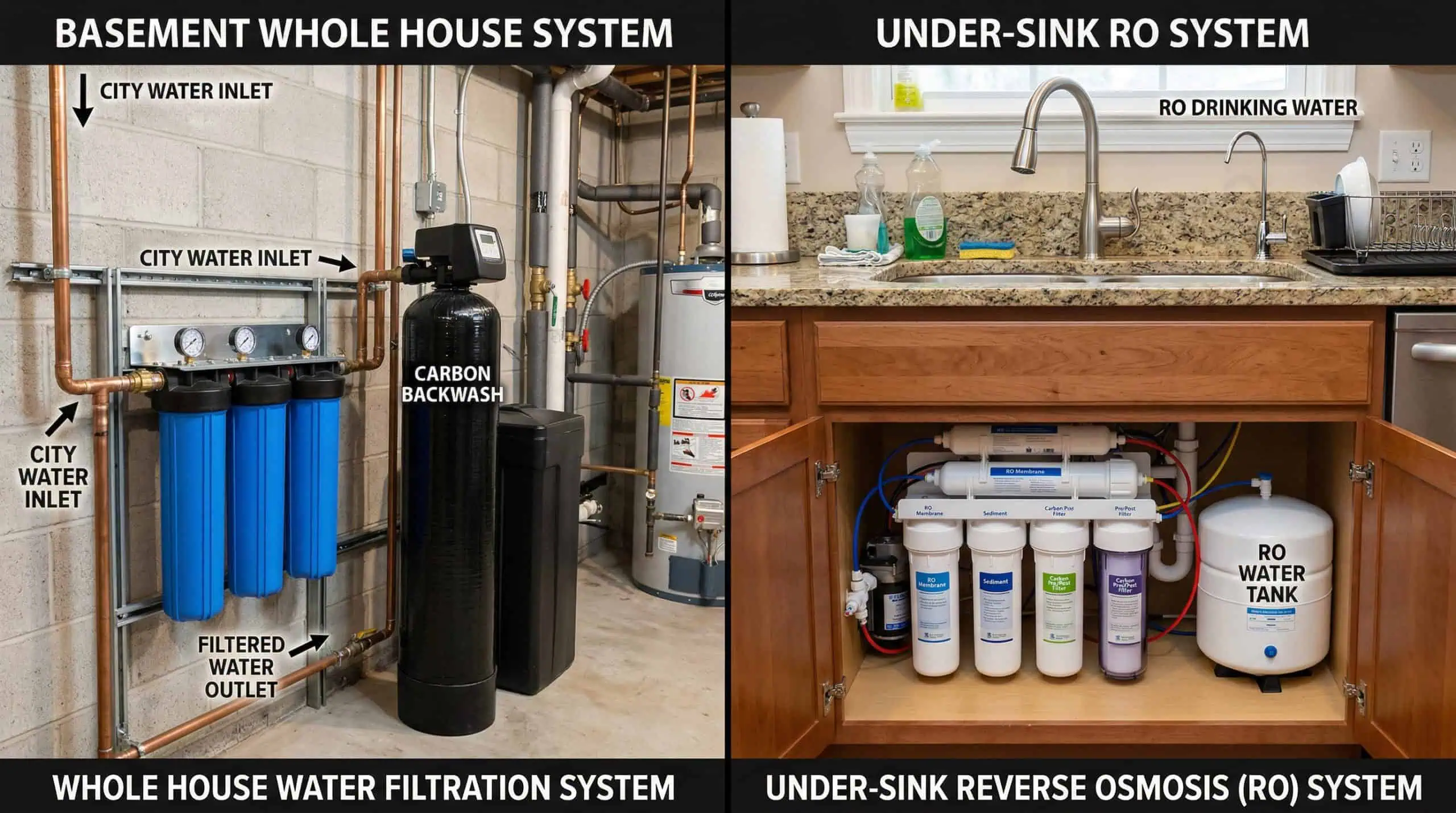
All right, let’s cut to the chase. A whole house water filter — the name says it all: it tackles every drop coming into your home. We’re talking filtered water at every faucet, every shower, even your washing machine. An under-sink unit, however, is strictly for a single tap, usually your kitchen sink. So, if you want total home protection, especially for chlorine in your showers and keeping those expensive appliances running longer, go whole house. But if your main goal is just pristine drinking and cooking water, and your wallet’s a bit lighter, an under-sink system is perfect.
Understanding Point-of-Entry vs Point-of-Use Filtration
Here’s the real breakdown: it’s all about where the filter intercepts your water. A whole house filter, what we call a Point-of-Entry (POE) system, gets plumbed right into your main water line. It’s usually near the meter or where the well line comes in – before any other treatment. It treats everything. An under-sink filter, or Point-of-Use (POU), is a different beast. It sits right under your kitchen sink, typically, with its own dedicated faucet. Simple, right? Both have their place. Honestly, what we’ve found is that the smartest homeowners often opt for both. It’s the ultimate one-two punch for truly clean water.
Whole House Water Filter: Complete Home Protection
How Whole House Filters Work
So, how does it actually work? We install a whole house filter on your main water line, often right after the meter — or for well water systems, just past your pressure tank. Water hits this system first. It then flows through several filtration stages before it even thinks about reaching your shower or washing machine. Typically, a robust sediment pre-filter (e.g., 5 to 20 microns) catches larger particles. Then, a hefty activated carbon stage kicks in, scrubbing out chlorine and other chemicals. Beyond that, depending on your water report, we might add specialty media for issues like excessive iron, manganese, or that tell-tale rotten egg smell from hydrogen sulfide.
Advantages of Whole House Filtration
- Clean Water Everywhere: Every single faucet, every shower, your laundry room, even outdoor spigots — it’s all filtered.
- Appliance and Plumbing Longevity: We’ve seen firsthand how sediment clogs and corrodes expensive water heaters, dishwashers, and washing machines. A whole house system stops that cold, saving you repair bills.
- Say Goodbye to Shower Chlorine: That harsh chemical smell? Gone. Chlorine exposure, both through your skin and by breathing it in during a hot shower, is a real concern for many.
- Less Scale Buildup: While not a softener, a good whole house system, especially when paired with a water softener, significantly extends the life of your appliances by reducing scale.
- Simple Upkeep: You’ve got one system to manage, not a dozen little filters all over the house. Easy.
Limitations of Whole House Systems
- Higher Initial Investment: Let’s be frank, these systems aren’t cheap upfront. You’re looking at anywhere from $500 to $3,000 or more for the unit itself, plus another $300 to $1,000 for professional installation. (It’s a significant project.)
- Broad-Stroke Filtration: Whole house filters are great for general issues like sediment and chlorine. But they aren’t designed to target specific dissolved contaminants with the same precision as an RO system.
- Limited Removal of Specific Contaminants: Most whole house units don’t include reverse osmosis (RO). That means total dissolved solids (TDS), lead, PFAS “forever chemicals,” and fluoride will usually pass right through. This is a critical distinction.
- Impact on Water Pressure: Adding multiple filter stages always causes some pressure drop. If your home already struggles with low incoming water pressure—say, under 40 PSI—you might need to factor in a booster pump.
Under-Sink Water Filter: Targeted Drinking Water Purification
How Under-Sink Filters Work
These systems are neat and tidy. We mount them discreetly inside the cabinet right beneath your kitchen sink. They tap directly into your cold water supply line. Most come with a sleek, dedicated faucet that we’ll install on your countertop or sink deck — that’s where your purified water comes out. You’ll find everything from basic single-cartridge carbon filters, effective for taste and odor removal, all the way up to sophisticated multi-stage reverse osmosis (RO) units, which often boast 4 to 7 distinct filtration stages. We’ve seen some of these units process water down to nearly zero TDS.
Advantages of Under-Sink Filtration
- Unmatched Contaminant Removal: This is where RO systems shine. They’re designed to strip out 95-99% of total dissolved solids (TDS), plus serious concerns like lead, PFAS, arsenic, and fluoride. What we’ve found is that for truly pure drinking water, nothing beats RO.
- Budget-Friendly: A quality under-sink RO system can start as low as $200 and go up to $500. That’s a much easier entry point than a whole house system.
- DIY Friendly: Many homeowners can handle the installation themselves in just an hour or two with basic tools. No need to call a plumber for this one, usually.
- Zero Impact on Main Pressure: These systems only affect the flow to their dedicated faucet. Your shower pressure won’t budge.
- Taste the Difference: Seriously, RO water often tastes crisp, clean, and incredibly refreshing. It’s a game-changer for coffee, tea, and cooking.
Limitations of Under-Sink Systems
- One Tap Only: This is the big one. An under-sink system only filters water at that one specific faucet. Your bathroom, laundry, and shower water remain untreated.
- No Appliance Protection: Your expensive water heater, dishwasher, and washing machine are still getting hit with whatever’s in your unfiltered tap water. Over time, that can lead to costly repairs.
- RO and Wastewater: Here’s the thing: traditional RO systems do produce wastewater. Historically, it was 3-4 gallons wasted for every gallon produced. Good news: modern, high-efficiency systems have brought that ratio down significantly, often to 1:1 or even better. (It’s a trade-off for purity.)
- Cabinet Real Estate: RO systems, especially those with a storage tank, do take up a fair bit of space under your sink. Make sure you measure!
Side-by-Side Comparison
To make your decision a little clearer, here’s a side-by-side look at the key differences we often discuss with our clients:
| Feature | Whole House Filter | Under-Sink Filter |
|---|---|---|
| Coverage | Every water outlet in home | Single faucet (kitchen) |
| Typical Cost | $500-$3,000+ installed | $150-$800 (DIY install) |
| TDS/Lead/PFAS Removal | No (carbon-based systems) | Yes (RO systems) |
| Chlorine Removal | Yes | Yes |
| Sediment Removal | Yes | Yes |
| Appliance Protection | Yes | No |
| Flow Rate | 10-25 GPM | 0.5-2 GPM (RO: 50-100 GPD) |
| Installation | Professional recommended | DIY friendly |
| Annual Maintenance Cost | $100-$400 | $50-$200 |
When to Choose a Whole House Water Filter
So, when should you really go for a whole house system? It’s simple: if your water quality problems are impacting your entire home, a POE system is your best bet. Think about it: are you seeing visible sediment coming out of all your faucets? Does your shower smell like a swimming pool? Do you have hard water — we’re talking stubborn scale on fixtures and appliances? Or maybe rust stains on your laundry, sinks, and toilets? For our clients with well water, we often recommend it to tackle iron, manganese, or that unmistakable hydrogen sulfide odor. We’ve worked on projects where well water had 5+ ppm iron, which a robust whole house system completely solved. We’ve got AMPAC whole house filtration options that we specifically size to match your home’s flow requirements, ensuring consistent performance.
When to Choose an Under-Sink Filter
Now, an under-sink system really shines when your main focus is on the quality of your drinking and cooking water. Go for POU filtration if you’re specifically worried about dissolved contaminants like lead, PFAS, arsenic, or fluoride. Perhaps your city water is generally fine, but you just want the absolute cleanest, best-tasting drinking water possible. It’s also a smart move if your budget is tighter, or if you’re renting and can’t cut into the main water line — a common scenario we encounter. Plus, as we mentioned, it’s often a straightforward DIY install. We carry a full line of residential RO systems designed to fit snugly under most standard kitchen sinks.
The Best Approach: Combining Both Systems
Honestly, for truly comprehensive water treatment, combining both systems is often the gold standard. It’s what we, as water treatment professionals, frequently suggest. Think of it: a whole house system handles the heavy lifting — pulling out sediment and chlorine from all your water. Then, a dedicated under-sink RO system steps in to deliver that ultra-pure drinking water. This layered strategy isn’t overkill; it’s smart. It safeguards your entire plumbing infrastructure and expensive appliances, while ensuring every drop you drink and cook with is as clean as science allows.
Here’s the takeaway: Whole house and under-sink filters aren’t interchangeable. Not by a long shot. They each have a specific job. Whole house systems are your frontline defense, protecting your entire plumbing infrastructure and ensuring comfortable showers. Under-sink RO systems? They’re for that ultimate, purest drinking water.
Frequently Asked Questions
What’s the difference between a whole house and under-sink filter?
A whole house filter (Point-of-Entry) treats every faucet in the home, plumbed into the main water line. An under-sink filter (Point-of-Use) treats a single tap, usually the kitchen sink.
Does a whole house filter remove lead or PFAS?
Typically no. Most whole house systems are carbon-based and don’t remove dissolved solids like lead, PFAS, or fluoride – that requires reverse osmosis.
How much water does an RO system waste?
Historically 3-4 gallons wasted per gallon produced. Modern high-efficiency systems bring that ratio down to around 1:1 or better.
Can I install an under-sink RO system myself?
Many homeowners install it in an hour or two with basic tools. Whole house systems, by contrast, typically need professional installation.
Should I get both a whole house and an under-sink system?
Combining both is the most complete approach – whole house filtration protects plumbing and appliances across the home, while under-sink RO delivers the highest-purity drinking and cooking water.
Related Products & Resources
- Under-Sink RO Systems — highest contaminant removal for drinking and cooking water at point of use
- Whole House Water Treatment Systems — protect all fixtures and appliances from sediment, chlorine, and hard water
- Annual Filter Replacement Kits — bundled kits for residential RO systems — one order covers the full year
- Get a System Recommendation — not sure which type fits your home? we help you choose based on your water and budget